The Research Institute for Sustainability (RIFS) Fellow Programme 2027 is an international fellowship opportunity for researchers, professionals, artists, policymakers, and changemakers working on sustainability issues. Hosted in Potsdam, the programme supports innovative and interdisciplinary projects that contribute to sustainability transformation. Fellows work closely with RIFS research groups and global experts while receiving financial and institutional support for a period of 6–12 months.
The fellowship spans sustainability transformations at the Research Institute for Sustainability (RIFS). Each year, approximately 20 fellows from diverse countries and professional backgrounds are selected to take part in this prestigious program.
Basic Information about the Fellowship
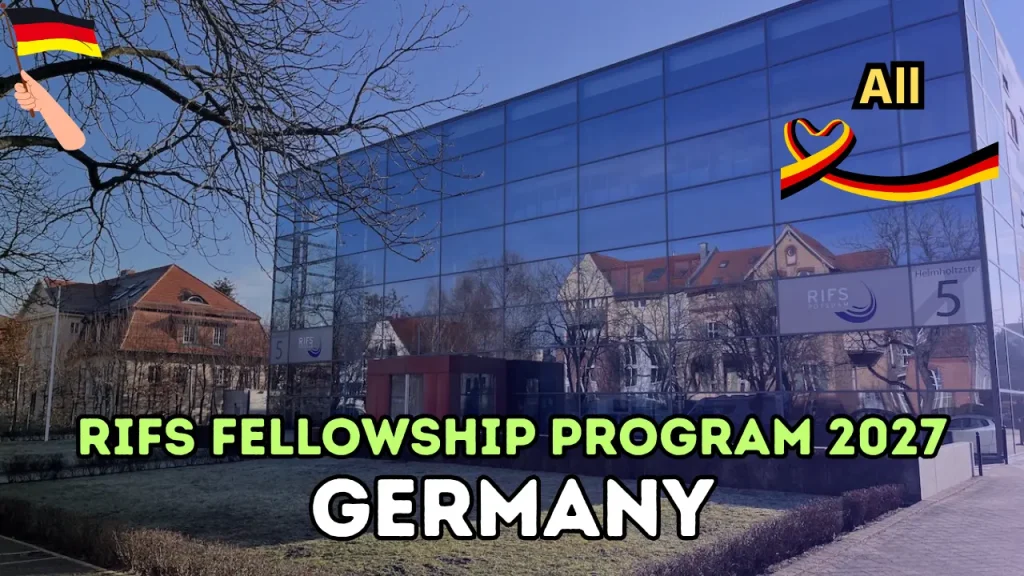
- Organized by the Research Institute for Sustainability (RIFS) at the GFZ Helmholtz Centre for Geosciences
- Focuses on research and practical solutions for sustainability transformation
- Fellows work with researchers, policymakers, businesses, civil society, media, and artists
- Around 10 fellows selected each year from around the world
- Fellowship name: RIFS Fellowship Program 2027 in Germany.
- Host country: Germany.
- Location: Potsdam Near Berlin
- Host institution: RIFS, Germany.
- Level: Fellowship for researchers and professionals, not a standard degree scholarship.
- Main focus: Interdisciplinary research, sustainability, transformation, and policy-relevant work.
- Fellowship Duration
- Usually 6–12 months
- Possible extension up to 24 months
- Application deadline: 21 June 2026 (23:59 CET)
- Application fee: Typically not highlighted as a separate fellowship fee, but applicants should verify any cycle-specific requirements.
Main Theme for 2027
“Sustainability in Tough Times – How to Move Forwards in Times of Backlash?”
Possible topics include:
- Resistance or backlash against sustainability policies
- Climate justice and inequality
- Polarization, emotions, and public narratives
- New alliances for sustainability
- Role of transdisciplinary research
- Trust in experts and political power
University/Institution Details
RIFS is known for working at the intersection of research, society, and transformation. It is a fitting host for fellows who want to produce ideas that are not only academically sound but also relevant to policy, institutions, and public debate.
Germany is one of the strongest destinations for research-oriented fellowships because of its robust academic ecosystem, relatively lower study and research costs compared with many other countries, and strong international reputation. For applicants who care about quality of life, access to European networks, and serious intellectual work, Germany is a strong base
Study Areas (available program names)
This fellowship is generally not structured around formal degree programs, so the better way to present the “study areas” section is as thematic research fields.
- Sustainability
- Climate policy
- Environmental governance
- Energy transition
- Social transformation
- Science and society
- Innovation policy
- Public policy
- Urban futures
- Interdisciplinary research
- Technology and society
- Global development
- Democracy and governance
The important point is that applicants should align their proposed work with the fellowship’s thematic priorities. A strong match matters more than a broad academic label.
RIFS Fellowship Program Benefits
- Monthly stipend (amount depends on experience and family situation)
- Possible additional benefits
- Housing support in Potsdam
- Help with:
- Visa/residence permit
- Health insurance
- School placement
- Relocation support
- Opportunity to work on interdisciplinary and policy-relevant themes.
- Networking with other fellows, researchers, and professionals.
- Academic visibility through presentations, seminars, and collaborative work.
- Strong international exposure in Europe.
- Better career positioning for future research, policy, or leadership roles.
The real value is not just funding. It is the platform. A strong fellowship can shape your next 3 to 5 years of work if you use it well.
Benefits Not Included
- Family support is usually not automatically included.
- Personal entertainment and private spending are not covered.
- Travel outside fellowship-related activities may not be included.
- Visa and relocation costs may not be fully covered unless stated.
- Not all accommodation or housing costs are guaranteed.
- The fellowship is not a degree scholarship, so it does not lead to a standard academic credential by itself.
This is where applicants often misread fellowships. A fellowship is a research opportunity with support, not a full personal finance package.
Eligibility Criteria for the RIFS Fellowship Program
- Who Can Apply?
- Researchers and academics
- Government/public administration professionals
- NGO and civil society workers
- Private sector professionals
- Journalists/media professionals
- Artists and creatives
- Applicants from any country
- Applicants should demonstrate relevance to the fellowship themes
- Important Requirement
- Your project must connect with:
- RIFS overall research goals
- At least two RIFS research groups
- Your project must connect with:
- Applicants are strongly encouraged to contact RIFS researchers before applying
- A clear project idea or research focus is usually essential.
- Strong English proficiency is commonly expected.
- International applicants may be eligible, depending on the call.
- Applicants should show the ability to contribute meaningfully to interdisciplinary work.
Diversity & Equality
RIFS encourages applications from:
- Women
- International applicants
- People from diverse backgrounds
- Persons with disabilities
Equal opportunity policies are strongly supported.
Required Documents for the Application
Submit all documents in English PDF format:
- Project Proposal
- Most important document
- Must use official template
- CV (max 3 pages)
- Education
- Career highlights
- Achievements
- Optional Annex
- Publications
- Portfolio
- Extra supporting materials
The most important file is usually the proposal. If the proposal is vague, the rest of the application rarely compensates for it.
RIFS Fellowship Program Application Process
- Step 1: Read the official 2027 fellowship announcement carefully.
- Step 2: Confirm that your background fits the fellowship themes.
- Step 3: Develop a focused proposal or project idea.
- Step 4: Prepare your CV, motivation letter, and supporting documents.
- Step 5: Submit the application before the deadline.
- Step 6: Wait for review, shortlist, or interview stages.
- Step 7: If selected, complete onboarding and planning for Germany.
- Step 8: Begin the fellowship and participate actively in the institution’s research culture.
The sharper approach is to treat this like a selection for intellectual fit, not just paperwork submission.
Tips for a Successful Application
- Pick one clear theme and do not spread your proposal too wide.
- Show why your work matters now, not just in theory.
- Make your proposal specific, realistic, and policy-relevant.
- Connect your experience to the fellowship’s mission.
- Use plain language and avoid overcomplicated academic jargon.
- Demonstrate evidence of impact, not only interest.
- If possible, show prior work that proves you can execute.
- Make the application look like a contribution, not a request.
A stronger application usually answers one question well: why you, why this topic, and why this fellowship now?
Monthly Living Expenses for International Students (USD)
Because this is a fellowship in Germany rather than a standard student scholarship, living costs depend heavily on city and housing.
- Accommodation: USD 500 to USD 1,200 per month.
- Food and groceries: USD 250 to USD 450 per month.
- Local transportation: USD 60 to USD 120 per month.
- Utilities and internet: USD 100 to USD 180 per month.
- Books and study materials: USD 30 to USD 80 per month.
- Personal expenses: USD 150 to USD 300 per month.
- Estimated total monthly cost: around USD 1,090 to USD 2,330.
This is why fellowship funding matters. Germany is excellent value for research, but location and housing can still be expensive, especially in major cities.
Why Choose This Fellowship?
- It supports serious interdisciplinary research in a respected German setting.
- It is well suited for applicants who want policy and practice impact.
- It can strengthen your academic and professional network in Europe.
- It offers a strong platform for future publications, collaborations, and career growth.
- It is ideal for people working on sustainability and transformation, two high-demand global themes.
- It gives international visibility to your work.
- It can help you shift from being a specialist to being a recognized contributor in your field.
Frequently Asked Questions about the fellowship
Is the RIFS Fellowship Program 2027 fully funded?
It is usually a funded fellowship, but the exact package depends on the official 2027 call.
Who can apply?
Researchers, professionals, and advanced practitioners with strong thematic fit are the best candidates.
Is this a degree scholarship?
No. It is a fellowship, not a standard university degree scholarship.
What fields are supported?
Themes usually include sustainability, transformation, climate, governance, and related interdisciplinary areas.
Do I need a PhD to apply?
Not always, but a strong research or professional profile is usually important.
What is the deadline?
It depends on the official 2027 call, so applicants should check the live announcement.
Is English required?
Most likely yes, because fellowship work and communication are usually in English.
Can international applicants apply?
In many such fellowships, yes, but eligibility always depends on the official call.
Important Dates
- Application Deadline: 21 June 2026 (23:59 CET)
- Possible interviews: November 2026
- Final decision: November or early December 2026
- Earliest fellowship start date: 1 April 2027