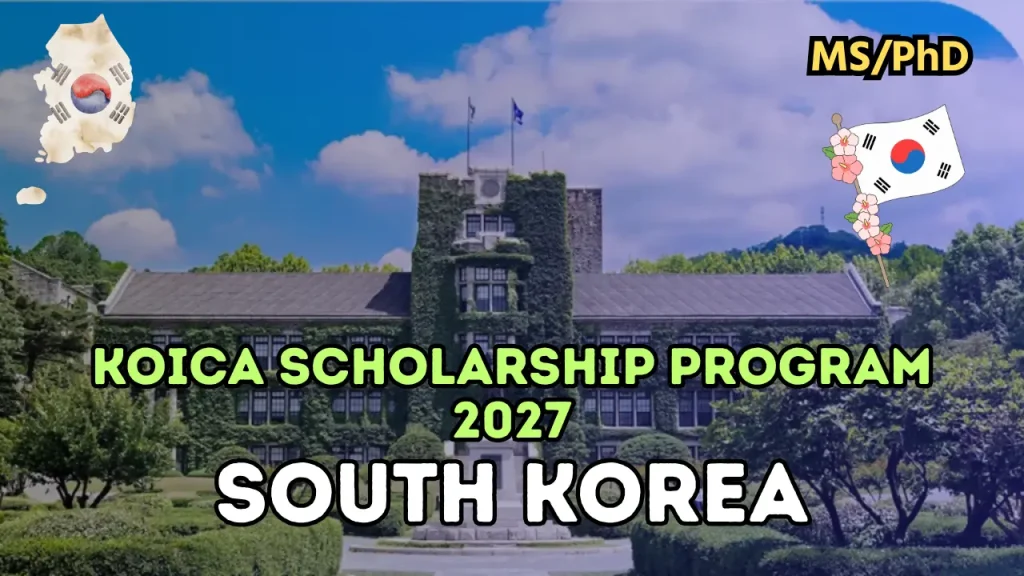
Are you a public sector professional or government official seeking a fully funded opportunity to earn a postgraduate degree abroad? The KOICA Scholarship Program 2027 in South Korea is one of the most elite and practical training fellowships in the world. The Korea International Cooperation Agency (KOICA) Scholarship Program aims to develop future leaders from partner countries who can contribute to the socio-economic development of their home nations. In this recruitment cycle, KOICA is offering 11 Master’s degree programs and 4 Doctoral degree programs at leading universities in South Korea. The program provides fully funded opportunities for qualified candidates to enhance their knowledge, leadership skills, and professional expertise.
Administered by the Korea International Cooperation Agency (KOICA) under the CIAT (Capacity Improvement and Advancement for Tomorrow) initiative, this flagship program is explicitly designed to train future leaders from partner developing nations. By combining cutting-edge academic theory with South Korea’s legendary socioeconomic development model, this scholarship equips you to drive meaningful policy changes back home.
Basic Information & Key Deadlines
The KOICA Scholarship targets high-potential civil servants and public sector workers. Unlike general academic scholarships, the application cycle runs a full year ahead of the actual university start date.
- Sponsoring Agency: Korea International Cooperation Agency (KOICA), Government of the Republic of Korea
- Degree Levels Offered: Full-Time Master’s Degrees (typically 17 months) and Doctoral/PhD Degrees (typically 36 months)
- Language of Instruction: 100% English
- Target Group: Government employees from approximately 97 designated OECD-DAC partner countries across Asia, Africa, Latin America, and the Middle East.
- Estimated Departure for South Korea: August 2027
2027 Intake Application Deadlines
There is no single global deadline for the KOICA scholarship. Each regional KOICA overseas office or local Korean Embassy sets an independent timeline tailored to their country’s government endorsement channels.
- General Submission Window: June – July 2026
- Specific Deadline Framework: Most local deadlines for the 2027 academic intake fall between late June 2026 and July 31, 2026.
- Action Plan: You must check directly with your national nominating ministry (e.g., the Economic Affairs Division in Pakistan or the Economic Relations Division in Bangladesh) or your regional KOICA country office. Late files are systematically rejected.
University/Institution Details: Elite Korean Academe
About KOICA
- Established in 1991 as South Korea’s government agency for grant aid.
- Supports socioeconomic development in partner countries.
- Activities include:
- Fellowship programs
- Volunteer programs
- Humanitarian assistance and disaster relief
- Public-private partnerships
- Bilateral and multilateral projects
About CIAT (Capacity Improvement and Advancement for Tomorrow)
- Provides training and knowledge-sharing opportunities in Korea.
- Invites:
- Policymakers
- Government officials
- Experts from partner countries.
- Offers graduate degree scholarships in Korean universities.
- Aims to develop participants’ capacities and strengthen cooperation between Korea and partner countries.
Study Areas & Available Programs
The available fields of study are strictly aligned with United Nations Sustainable Development Goals (SDGs) and South Korea’s core foreign aid priorities.
Key Master’s and PhD Program Streams Include:
- Governance & Public Sector: Public Policy, Public Administration, Digital Innovation in Artificial Intelligence, e-Government.
- Economic Development: Finance and Economic Policy, Trade and Industrial Policy, Regional Development.
- Agriculture & Environment: High-Value-Added Agriculture, Forest Resources, Climate Change Response, Water Resources Management.
- Health & Medicine: Global Health Policy, Healthcare Management, Infectious Disease Control.
- Education & Technology: ICT Tech Policy, Vocational Education and Training Development.
KOICA Scholarship Programs and Universities (Simplified)
- Master’s Degree Duration: 17 months
- Doctoral Degree Duration: 36 months
- Applicants can apply to only one program.
- Program quotas may change depending on KOICA and partner country circumstances.
Available Programs
- Handong Global University – Master’s in e-Government and Public Management (15 seats)
- Incheon National University – Master’s in Capacity Building for Climate Change and Environment Management (15 seats)
- KDI School of Public Policy and Management – Master’s in Economic Development Policy for Sustainable and Inclusive Growth (15 seats)
- Sungkyunkwan University – Master’s in e-Government and Public Management (15 seats)
- Yonsei University – Master’s in Health Policy and Financing Capacity Building (15 seats)
- Kyungpook National University – Master’s in High Value-added Agriculture (20 seats)
- Kyungpook National University – Doctoral in High Value-added Agriculture (3 seats)
- Pukyong National University – Master’s in Global Fisheries Development (20 seats)
- Pukyong National University – Doctoral in Global Fisheries Development (3 seats)
- University of Seoul – Master’s in AI Digital Innovation (20 seats)
- University of Seoul – Doctoral in AI Digital Innovation (3 seats)
- Yonsei University – Master’s in Control of Infectious Disease (20 seats)
- Yonsei University – Doctoral in Control of Infectious Disease (3 seats)
- Yonsei University (MIRAE Campus) – Master’s in Digital Health (20 seats)
- Yonsei University (MIRAE Campus) – Master’s in Social Economy (20 seats)
KOICA Scholarship Program Benefits: What is Fully Funded?
The KOICA CIAT framework is remarkably generous, offering a seamless financial package so that mid-career officials can focus entirely on development research.
- Airfare
- Round-trip economy class ticket.
- Settlement Allowance
- Master’s: KRW 600,000
- Doctoral: KRW 1,200,000
- Monthly Stipend
- KRW 1,200,000 per month
- Tuition Fee
- Full tuition covered.
- Accommodation
- University dormitory.
- Health Insurance
- National Health Insurance covered (approximately KRW 81,000/month).
- Additional private medical insurance provided.
- Completion Grant
- Master’s: KRW 300,000
- Doctoral: KRW 600,000
- Additional Support
- Korean language classes
- Workshops
- Study visits and extracurricular activities.
Benefits Not Included
Applicants must prepare small, independent out-of-pocket cash allocations for items that fall outside the agency’s primary financial mandate:
- Visa fees
- Document authentication
- Medical check-ups
- Courier services
- University application fees
- Local transportation and miscellaneous expenses.
Eligibility Criteria for KOICA Scholarship Program
Nationality
- Must be a citizen of one of the designated partner countries.
- Bangladesh is eligible.
Employment Status
- Must be a government official.
- Must receive an official government nomination.
Age
- Preferably under 40 years old.
Health
- Must be physically and mentally fit.
- Applicants with disabilities can apply if healthy enough to study.
- Applicants with severe illnesses are not eligible.
Education & Experience
Master’s Program
- Bachelor’s degree completed by 31 July 2026.
- Preferably at least 2 years of work experience.
Doctoral Program
- Master’s degree completed by 31 July 2026.
- Preferably at least 3 years of experience after the Master’s degree.
English Proficiency
- Good speaking and writing skills in English are required.
- Official English test scores are generally not required at the KOICA stage but may be required by some universities.
Restrictions
Cannot apply if:
- Previously received a Korean government scholarship for a degree program.
- Previously completed a KOICA-funded Master’s degree.
- Previously cancelled or withdrew from a KOICA scholarship.
Required Documents Checklist
Your physical application folder must be perfectly organized before submission to your government focal point:
- KOICA Application Forms (Parts 1–4): Including personal profiles, standard statements of understanding, and a basic medical self-assessment checklist.
- Official Government Nomination Letter: Signed and stamped by the authorized head of your country’s training ministry.
- Degree Certificates & Transcripts: Fully notarized or apostilled copies of your post-secondary milestones.
- Valid Passport Copy: Must show clear biographical details and remain valid for at least 6 months past your scheduled return date.
- Personal Essay & Detailed Study Plan: Explicitly mapping out your intended development thesis.
- Two Letters of Recommendation: Preferably from senior ranking government directors or supervisors who can attest to your operational capability.
KOICA Scholarship Program Step-by-Step Application Process
Landing a KOICA fellowship involves passing through two independent filtering rounds: the KOICA Round and the University Round.
1.Secure Central Government Nomination:June – July 2026.
Download the KOICA form packet. Submit your research plan directly to your country’s internal scholarship ministry to obtain an official nomination letter.
2.Submit Folder to Local KOICA Office:July 2026.
File your complete physical and digital document folders directly with the regional KOICA country office or local Korean Embassy before the localized deadline.
3.Pass the Initial KOICA Interview:July – August 2026.
Undergo a screening interview conducted by local KOICA directors and diplomats. If your file passes, KOICA headquarters will forward your dossier to South Korea.
4.Survive the University Academic Round:September – October 2026.
The designated Korean university reviews your transcripts. You will undergo a separate academic interview (and potentially a written essay exam) conducted via Zoom or phone by Korean professors.
5.Medical Clearance & Visa Processing:November 2026 – February 2027.
Complete a comprehensive physical medical review. Once final admission is confirmed, apply independently for your D-2 student visa at the Korean Embassy for an August 2027 departure.
Tips for a Highly Competitive Application
- Align with Your Country’s Macro Strategy: Don’t write a generic study plan. Review your nation’s current 5-year development plan or national vision statement. Explicitly explain how your chosen Korean program solves an active development bottleneck in your home ministry.
- Highlight the “Korean Miracle” Connection: Show that you understand South Korea’s history. Explain why learning from Korea’s transition from a war-torn aid recipient to an economic powerhouse is uniquely useful for your department.
- Prep for the Technical Interview: Korean professors respect data. During your university interview, be ready to defend your thesis proposal, detail your quantitative research skills, and outline the exact methodology you plan to deploy.
- Secure Senior Institutional Backing: A reference letter from a high-ranking director or secretary carrying real institutional weight shows the committee that your government is genuinely committed to promoting you upon your return.
Estimated Monthly Living Expenses in South Korea
Your KOICA stipend easily accommodates a very comfortable student lifestyle since your housing and tuition are completely handled. Here is a realistic breakdown of typical student monthly costs in South Korea, displayed in USD ($) for easy tracking:
| Budget Category | Estimated Cost (USD) | Local Living Dynamics |
| Dormitory Utilities & Fees | $30 – $60 | Base room rent is free; minor charges apply for laundry and high-speed Wi-Fi |
| Food & Campus Dining | $250 – $350 | Utilizing cheap, nutritious on-campus cafeteria meal tickets |
| Public Transportation | $50 – $80 | Subway and bus tracking via a rechargeable local T-Money card |
| Books & Academic Research | $40 – $70 | Laboratory prints, reference books, and thesis binding steps |
| Mobile Data & Connectivity | $35 – $55 | Local Korean high-speed SIM cards and data plans |
| Leisure & Cultural Discovery | $150 – $250 | Visiting historic palaces, local markets, and domestic travel |
| Total Estimated Expenses | $555 – $865 / month | Perfectly covered by your KRW 1,200,000 allowance! |
Why Choose the KOICA Scholarship? (5 Core Reasons)
- Tailored for Public Policy Leaders: Rather than drowning in abstract academic theory, you focus entirely on practical policy case studies that apply directly to real-world government work.
- Unrivaled Professional Networking: You study alongside senior civil servants from nearly 100 developing nations, building an elite international network of future ministers and directors.
- Comprehensive Economic Security: With accommodation, healthcare, flights, and a robust living stipend systematically paid for, you can focus on your research without financial stress.
- Immersive Site Visits: KOICA takes students out of the classroom on fully funded field trips to major Korean industrial hubs, smart-city control centers, and government ministries.
- Accelerated Executive Advancement: Earning a specialized degree from a world-class Korean institution significantly boosts your promotion metrics and credibility within your home country’s civil service framework.
Frequently Asked Questions (FAQs)
Can employees of private corporations or non-profits apply?
No. The KOICA Scholarship is strictly reserved for government officials, public servants, or employees working within state-affiliated public institutions.
Is an official English score sheet (like IELTS) mandatory?
It is not mandatory during the initial KOICA screening round. However, during the second round, specific partner universities may require you to provide a minimum IELTS or TOEFL score to clear their academic boards.
Am I allowed to stay and work in South Korea after graduation?
No. The core mission of the fellowship is national capacity building. All KOICA scholars are legally obligated to return to their home countries immediately after graduation to resume their government duties.
Can I apply for both a Master’s and a PhD at the same time?
No. Duplicate submissions across multiple programs or alternative universities will result in immediate disqualification from the entire KOICA selection pool.
Tentative Timeline
By July 2026
- Last date:
31 July 2026 - Submit application.
- Attend KOICA/Korean Embassy interview.
October 2026
- University document screening.
- Medical check-up.
- University interview.
By November 2026
- Submit original documents.
- Receive final admission notification.
- Prepare visa and vaccinations.
February 2027
- Arrive in Korea.
- Complete medical examination.
- Begin the degree program.
I want to apply for Koica Scholarship to improve my educational level.