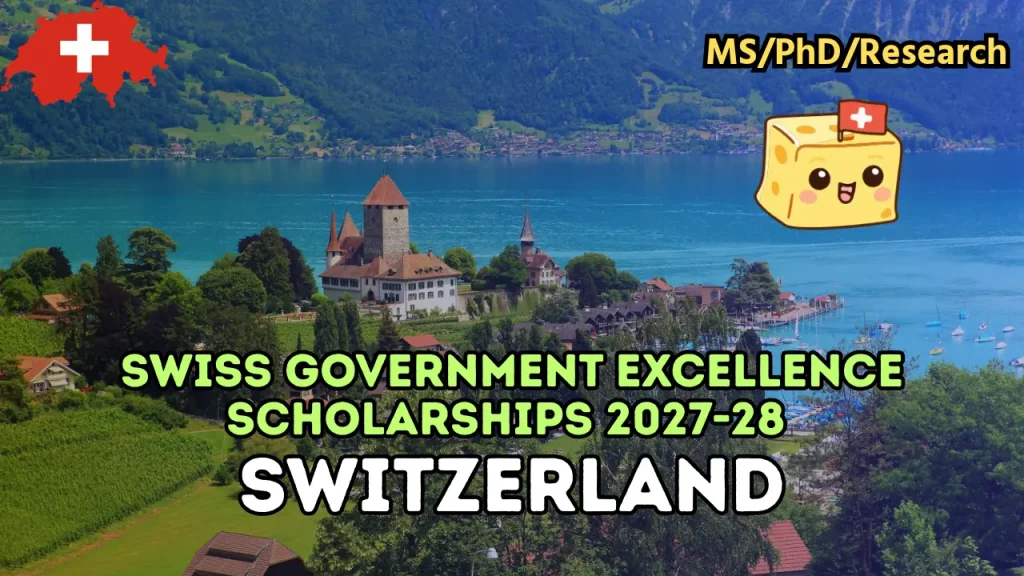
Are you an ambitious researcher, PhD candidate, or artist aiming to conduct world-class studies in Europe? The Swiss Government Excellence Scholarships 2027–2028 represent one of the most prestigious, fully funded fellowship opportunities globally. Each year the Swiss Confederation awards Government Excellence Scholarships to encourage international exchange and research cooperation between Switzerland and over 180 other countries. Recipients are selected by the awarding body, the Federal Commission for Scholarships for Foreign Students (FCS aka ESKAS).
Switzerland consistently ranks at the top of global innovation and research indices. Winning a Swiss Government Excellence Scholarship opens doors to top-tier laboratories, renowned academic mentors, and a lifelong network of global scholars. This guide breaks down everything you need to know about the 2027–2028 academic intake—from eligibility criteria and required documents to application processes, real monthly expenses in Switzerland, and insider tips to secure your spot.
Basic Information & Key Application Deadlines
The Swiss Government Excellence Scholarship is designed to foster international scientific exchange and academic collaboration. The program targets post-graduate researchers who hold at least a Master’s degree (or a Bachelor’s degree for specific art programs).
- Host Country: Switzerland
- Funding Body: Federal Commission for Scholarships for Foreign Students (FCS / ESKAS)
- Study Levels: Research Fellowships, PhD Scholarships, Postdoctoral Fellowships, and Arts Master’s Degrees
- Target Audience: Applicants from over 180 eligible countries
- Application Portal Opens: August 20, 2026
- Application Deadline: Country-specific deadlines vary between September and December 2026. Check the State Secretariat for Education, Research and Innovation (SERI / SBFI) portal or your local Swiss embassy for your nation’s exact cutoff.
University and Institution Details: The Swiss Academic Landscape
Recipients of the Swiss Government Excellence Scholarship can carry out their projects at premier Swiss public institutions, world-renowned technology institutes, and recognized research centers.
Swiss higher education institutions
For the Swiss Government Excellence Scholarships:
- University of Basel
- University of Bern
- University of Fribourg
- University of Geneva
- University of Lausanne
- University of Lucerne
- University of Neuchâtel
- University of St. Gallen
- University of Zurich
- Università della Svizzera italiana
- Swiss Federal Institute of Technology Lausanne (EPFL)
- Swiss Federal Institute of Technology Zurich (ETHZ)
- Research Institutes of the ETH Domain (PSI; WSL; EMPA; EAWAG)
- Graduate Institute of International and Development Studies (IHEID)
- University of Applied Sciences and Arts Western Switzerland (HES-SO)
- Bern University of Applied Sciences (BFH)
- University of Applied Sciences Northwestern Switzerland (FHNW)
- Eastern Switzerland University of Applied Sciences (OST)
- University of Applied Sciences of the Grisons (FHGR)
- Lucerne University of Applied Sciences and Arts (HSLU)
- University of Applied Sciences and Arts of Southern Switzerland (SUPSI)
- Zurich University of Applied Sciences (ZHAW)
- Universities of teacher education
- UniDistance Suisse (presence in Switzerland mandatory)
- Swiss Federal University for Vocational Education and Training (SFUVET)
- Swiss Federal Institute of Sport Magglingen (SFISM)
- University of Applied Sciences and Arts Western Switzerland (HES-SO)
- Bern University of the Arts (HKB-BFH)
- University of Applied Sciences and Arts Northwestern Switzerland (FHNW)
- University of Applied Sciences Eastern Switzerland (OST)
- Lucerne University of Applied Sciences and Arts (HSLU)
- University of Applied Sciences and Arts of Southern Switzerland (SUPSI)
- Conservatorio della Svizzera italiana
- Zurich University of the Arts (ZHDK)
Study Areas & Offered Program Tracks
Unlike scholarships restricted to narrow academic sectors, the Swiss Government Excellence Scholarship is open to all academic fields for research, doctoral, and postdoctoral tracks.
The 4 Main Scholarship Tracks:
- Research Fellowships (12 Months): For Master’s degree holders looking to conduct 1 year of post-graduate research without pursuing a full PhD.
- PhD Scholarships (12 to 36 Months): For Master’s degree holders undertaking a full-time doctoral degree at a Swiss university.
- Postdoctoral Fellowships (12 Months): For early-career researchers who hold a PhD and wish to execute advanced postdoctoral research at a Swiss institution.
- Arts Master’s Scholarships (12 to 21 Months): Restricted to students from select countries pursuing an initial Master’s degree at a Swiss conservatory or university of the arts.
Objectives
1. Master’s / Art Scholarship
- To support talented students in pursuing their first Master’s degree in Switzerland.
- To provide opportunities for full-time study at Swiss art schools or conservatories.
- To help talented young artists develop their academic and artistic skills.
- To promote international exchange in the arts and music.
2. PhD Scholarship — Objective
- To support highly qualified students in pursuing a PhD in Switzerland.
- To enable scholars to conduct full-time doctoral research at a Swiss university or recognised research institute.
- To develop advanced research skills and academic expertise.
- To promote research cooperation and future collaboration between Switzerland and other countries.
3. Research Fellowship — Objective
- To support PhD students who are already pursuing a doctoral degree in their home country.
- To allow them to conduct a 6–12 month research project in Switzerland.
- To provide access to Swiss universities, researchers, and research facilities.
- To strengthen international research cooperation and academic collaboration.
- To contribute to the applicant’s doctoral research and future academic career.
Swiss Government Excellence Scholarships Benefits: What is Funded?
1. Master’s / Art Scholarship Benefits
- CHF 2,450 per month for basic living expenses.
- Health insurance coverage for applicants from non-EU/EFTA countries.
- CHF 600 one-time rental deposit grant.
- Half-Fare Travelcard for public transportation.
- Excursions and activities organised for scholarship holders.
- Return flight allowance for non-EU/EFTA scholarship holders.
- Scholarship duration: up to 21 months.
- Opportunity to complete a first Master’s degree in Switzerland.
- Study at Swiss art schools, conservatories, or universities of the arts.
Note: Tuition/semester fees are generally not covered and must be paid by the student.
2. PhD Scholarship Benefits
- CHF 2,450 per month for basic living expenses.
- Scholarship duration: up to 36 months.
- Initially awarded for 12 months, with possible renewal twice.
- Health insurance coverage for non-EU/EFTA scholarship holders.
- CHF 600 one-time rental deposit grant.
- Half-Fare Travelcard for public transport.
- Excursions and activities organised by the scholarship programme.
- Return flight allowance for non-EU/EFTA students.
- Opportunity to pursue a PhD in Switzerland.
- Opportunity to work with a Swiss academic supervisor and develop international research collaboration.
- PhD students may conduct field research for up to 6 months.
Note: Tuition/semester fees, conference costs, and field research expenses are generally not covered.
3. Research Fellowship Benefits
- CHF 2,450 per month for basic living expenses.
- Duration of 6–12 months.
- Opportunity to conduct full-time research in Switzerland.
- Useful for researchers who are already pursuing a PhD in their home country.
- Opportunity to work with a Swiss academic supervisor.
- Opportunity to develop international research collaboration.
- Health insurance coverage for non-EU/EFTA scholarship holders.
- CHF 600 one-time rental deposit grant.
- Half-Fare Travelcard for public transport.
- Excursions and activities organised for scholarship holders.
- Return flight allowance for non-EU/EFTA scholarship holders.
- Can strengthen your academic profile, research experience, and future career prospects.
Note: The Research Fellowship is not a salary and does not provide additional funding for fieldwork or conferences.
Benefits Not Included (Self-Funded Elements)
While the stipend and health insurance packages are robust, applicants should account for a few personal responsibilities:
- Semester/Tuition Fees: The FCS scholarship itself does not automatically cover university tuition or semester fees. While many Swiss universities waive tuition fees for FCS holders, some institutions still charge reduced administrative/semester fees (approx. CHF 300 to CHF 800 per semester).
- Family & Dependent Allowances: The scholarship package is calibrated strictly for an individual scholar. No supplemental living stipends, family visas, or travel costs are provided for spouses or children.
- Pre-Arrival Expenses: Local passport processing, initial translation of academic transcripts, or personal electronic devices.
Eligibility Criteria for Swiss Government Excellence Scholarships
To be competitive for the 2027–2028 academic year, applicants must meet strict baseline metrics enforced by the Federal Commission for Scholarships:
1. Master’s / Art Scholarship
- Target: Students who want to pursue their first Master’s degree in Art/Music in Switzerland.
- Highly talented young artists.
- Applicants who do not already have a Master’s degree.
- Applicants from the eligible countries.
- Preference is given to those who have not previously studied or conducted research in Switzerland.
- Academic requirement: Bachelor’s degree or equivalent completed by 31 July 2027.
- Age: Born after 31 December 1991.
- Must not already have a Master’s degree when the scholarship starts.
- Must have an admission letter or proof of application to a Swiss university of arts or music.
- Must submit a strong artistic portfolio.
- Available only to applicants from selected countries.
Note: This is not a general Master’s scholarship. It is specifically for Art/Music Master’s programmes.
Selection Criteria
- Artistic profile and qualifications
- Motivation for studying in Switzerland
- Quality and potential of the art portfolio
- Artistic maturity
- Availability of enrolment at the chosen Swiss university
2. PhD Scholarship
- Target: Students who want to pursue a PhD in Switzerland.
- Highly qualified researchers who have completed a Master’s degree.
- Applicants from all academic fields.
- Applicants who want to pursue a PhD in Switzerland.
- Preference is given to applicants who have not previously studied or conducted research in Switzerland.
- Academic requirement: Master’s degree or equivalent completed by 31 July 2027.
- For ETH Zurich: by 30 June 2027.
- Age: Born after 31 December 1991.
- Must have a detailed PhD research proposal with a timeline.
- Must find a Swiss academic supervisor.
- Must receive a support letter from the Swiss supervisor.
- Supervisor must be authorised to supervise doctoral research.
- For graduate-school PhD programmes, official admission confirmation is required.
- Priority is given to applicants who have not previously studied or conducted research in Switzerland.
- Duration: 12 months, renewable up to 36 months.
Selection Criteria
- Academic profile
- Research competence
- Motivation
- Originality of the research project
- Methodological quality of the research proposal
- Quality of the Swiss academic supervision
- Potential for future research collaboration
3. Research Fellowship
- Target: Researchers who are already pursuing a PhD in their home country.
- Highly qualified early-career researchers.
- Researchers from all academic fields.
- Applicants who are currently pursuing a PhD in their home country.
- Young medical doctors can also apply.
- Preference is given to applicants who have not previously studied or conducted research in Switzerland.
- Academic requirement: Master’s degree or equivalent completed by 31 July 2027.
- For ETH Zurich: by 30 June 2027.
- Age: Born after 31 December 1991.
- Must be enrolled in a PhD in the home country.
- Must have a detailed research proposal and timeline.
- Must find a Swiss academic supervisor.
- Must receive a support letter from the Swiss supervisor.
- Priority is given to applicants who have not previously studied/researched in Switzerland.
- Research must be full-time in Switzerland.
- Duration: 6–12 months, with no extension.
- Start date: 1 September 2027.
Selection Criteria
- Academic profile
- Research competence
- Motivation
- Originality of the research project
- Methodological quality of the research proposal
- Quality of the Swiss academic supervision
- Potential for future research collaboration
Required Documents for the Application
All application materials must be submitted in English, French, German, or Italian. If your original transcripts are in another language, official certified translations are mandatory.
1. Documents Required for Master’s / Art Scholarship
- Complete CV
- Education
- Degrees
- Awards
- Exhibitions/concerts
- Teaching and practical experience
- Motivation letter — maximum 2 pages
- Bachelor’s degree certificate
- Academic transcripts
- Admission letter or proof of application to a Swiss University of the Arts/Music
- Art portfolio
- Music: recordings/YouTube link or QR code
- Visual arts: artwork + sketches
- Dance/acting/writing: performance or work samples
- Two recommendation letters
- Contact details of two professors must be provided
- Passport copy
- Swiss residence permit/registration confirmation, if already living in Switzerland
- Certified translations of documents if they are not in English, French, German, or Italian
2. Documents Required for PhD Scholarship
- Complete CV
- Education
- Degrees
- Awards
- Publications
- Research/work experience
- Teaching experience
- Master’s degree certificate
- Master’s academic transcripts
- Motivation letter — maximum 2 pages
- Research proposal — maximum 5 pages
- Research topic
- Objectives
- Methodology
- Timeline
- Key milestones
- Summary for non-specialists
- Letter of support from a Swiss academic supervisor
- Short CV of the Swiss supervisor — maximum 2 pages
- Two recommendation letters
- Contact details of two professors must be provided
- Admission confirmation from a graduate school, if applying to a graduate-school PhD
- Passport copy
- Swiss residence permit/registration confirmation, if applicable
- Certificates and transcripts with certified translations, if not in English/French/German/Italian
Important
- You must find a Swiss academic supervisor before applying.
- For an individual doctorate, admission confirmation is generally not required at the application stage.
- For a graduate-school PhD, official admission confirmation is required.
3. Documents Required for Research Fellowship
- Complete CV
- Education
- Degrees
- Awards
- Publications
- Research/work experience
- Teaching experience
- Master’s degree certificate
- Master’s academic transcripts
- Motivation letter — maximum 2 pages
- Research proposal — maximum 5 pages
- Research topic
- Objectives
- Methodology
- Timeline
- Key milestones
- Non-specialist summary
- Letter of support from a Swiss academic supervisor
- Short CV of the Swiss supervisor — maximum 2 pages
- Short CV of your home-university academic supervisor
- Two recommendation letters
- Contact details of two professors must be provided
- Passport copy
- Swiss residence permit/registration confirmation, if applicable
- Certificates and transcripts with certified translations, if not in English/French/German/Italian
Swiss Government Excellence Scholarships Step-by-Step Application Process
Securing a Swiss Government Excellence Scholarship requires methodical planning starting months before the deadline. Follow this sequence:
1.Contact Potential Swiss Academic Supervisors:January – July.
Identify professors conducting research in your field across Swiss universities. Send a professional email containing your CV, a brief research draft, and a clear request for supervision.
2.Secure the Mandatory Endorsement Letter:July – August.
Obtain a signed letter of support from your prospective Swiss professor confirming their willingness to host and supervise your research.
3.Access the Application Portal:August 20.
Access the ESKAS/SERI online portal or contact the Swiss Embassy in your home country to download official application guidelines and forms.
4.Draft Your Detailed Research Proposal:August – September.
Fine-tune your 5-page research proposal in direct consultation with your Swiss host professor to ensure alignment with local research infrastructure.
5.Submit Your Complete Application Package:September – December.
Upload all required digital documents to the online portal or submit physical application sets to your local Swiss Embassy, depending on your nationality’s specific submission rules.
6.Evaluation & Official Results:January – May 2027.
Applications undergo a dual review by national committees and the Federal Commission in Bern. Selection outcomes are announced via email by May 2027.
Expert Tips for a Winning Application
- Start Outreach Early: The biggest hurdle applicants face is finding a Swiss professor willing to host them. Avoid cold, generic mass emails. Tailor every outreach message specifically to the professor’s published papers.
- Demonstrate Bilateral Impact: The FCS selection committee prioritizes research that creates long-term scientific collaboration between Switzerland and your home country. Clearly state how your project builds academic bridges.
- Refine Your Research Proposal: Ensure your 5-page proposal has clear hypotheses, sound methodology, an explicit timeline, and achievable milestones.
- Coordinate with Your Supervisor: A strong letter of support from a respected Swiss professor who explicitly outlines why your project fits their laboratory dramatically increases your selection probability.
Estimated Monthly Living Expenses in Switzerland (USD)
Switzerland is renowned for its high quality of life, accompanied by higher living costs. The CHF 2,450 to CHF 3,500 monthly stipend provided by the Swiss Government easily covers standard student living costs.
Here is a realistic breakdown of typical monthly expenses for an international researcher in Swiss cities like Zurich, Geneva, or Bern, converted into USD ($):
| Expense Category | Monthly Cost (USD) | Notes & Context |
| Accommodation / Rent | $850 – $1,300 | Student housing (WOKO, Cité Universitaire) or shared flats (WG) |
| Food & Groceries | $380 – $550 | Cooking at home using stores like Aldi, Lidl, Migros, or Coop |
| Local Transportation | $50 – $90 | Optimized via your FCS-provided 50% Half-Fare travelcard |
| Course Materials & Books | $40 – $80 | Lab supplies, printing allocations, and academic journals |
| Mandatory Health Insurance | $0 (Covered) | Fully paid directly by the FCS Scholarship! |
| Leisure & Personal Expenses | $200 – $350 | Local dining, weekend hiking, and city cultural activities |
| Total Estimated Budget | $1,520 – $2,370 / month | Fully offset by your CHF 2,450+ stipend! |
Why Choose the Swiss Government Excellence Scholarship? (5 Core Reasons)
- World-Class Innovation Ecosystem: Switzerland consistently leads global rankings in patent outputs, research impact, and academic publishing.
- Access to Cutting-Edge Facilities: Work inside top labs at ETH Zurich, EPFL, CERN, or state-of-the-art university hospitals.
- Generous Financial Stability: The stipend provides complete financial freedom, allowing you to focus entirely on your doctoral or postdoctoral research without taking on part-time jobs.
- Central European Location: Situated in the heart of Europe, Switzerland provides unmatched travel connectivity and international networking opportunities across neighboring nations.
- Career Mobility & Alumni Prestige: FCS Scholars carry an internationally recognized stamp of excellence that opens doors in academia, international organizations (UN, WHO, WTO), and global R&D sectors.
Frequently Asked Questions (FAQs)
Can I apply for a standard Master’s degree using this scholarship?
Except for the specific Arts Track (which funds Master’s degrees in music, fine arts, and design for select countries), the Swiss Government Excellence Scholarship does not fund general Master’s degree programs. It is focused primarily on PhD, Postdoctoral, and Advanced Research Fellowships.
Is there an English language requirement?
Yes. You must demonstrate strong proficiency in the language of instruction required by your Swiss host program (typically English for STEM and research fields, or German/French/Italian depending on the canton and discipline).
What happens if I cannot find a Swiss supervisor before the deadline?
Securing a host professor’s written support letter is a mandatory prerequisite. Without this letter, your application is considered incomplete and will be automatically disqualified.
Can I apply if I am currently living in Switzerland?
You are eligible only if you arrived in Switzerland after August 1, 2026. If you have been living in Switzerland for longer than 1 year prior to the start of the scholarship, you are ineligible.
For Deadline:
Visit A-Z list of all countries and territories deadlines
Official Link
Scholarship applications only via this link (access available from 20 August 2026).
Notre Dame’s Kellogg Postdoctoral Fellowship 2027 in the USA