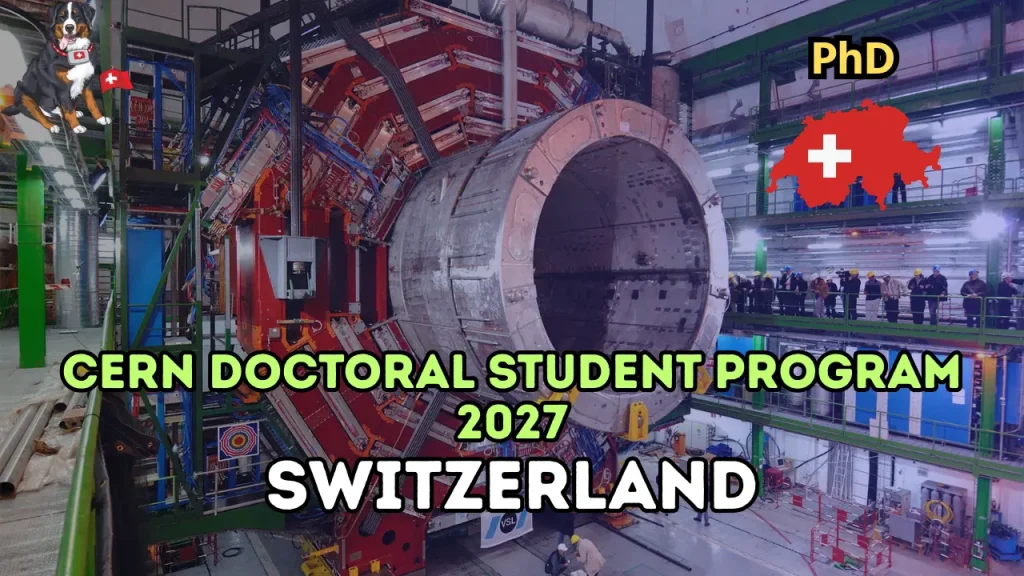
Are you a doctoral candidate looking to carry out your PhD research at the world’s most advanced particle physics laboratory? The CERN Doctoral Student Program 2027 in Geneva, Switzerland offers an exceptional fully funded opportunity for doctoral students to conduct cutting-edge research while working on their thesis at CERN, the European Organization for Nuclear Research in Geneva. Operating the Large Hadron Collider (LHC), CERN (the European Organization for Nuclear Research) provides a high-tech ecosystem for PhD students in applied physics, engineering, and computing.
At CERN, the European Organization for Nuclear Research, physicists and engineers are probing the fundamental structure of the universe. Using the world’s largest and most complex scientific instruments, they study the basic constituents of matter – fundamental particles that are made to collide together at close to the speed of light. The process gives physicists clues about how particles interact, and provides insights into the fundamental laws of nature. This prestigious program lasts up to 36 months (3 years) and is designed to foster advanced research in applied physics, engineering, and computing. With no application fee or IELTS requirement, it caters to students who have started or are about to start a doctoral program at their home universities.
Basic Information About the CERN Doctoral Student Program 2027
The CERN Doctoral Student Program is an association contract program allowing university-enrolled PhD candidates to complete their doctoral thesis research on-site at CERN.
- Host Organization: CERN (European Organization for Nuclear Research)
- Location: Geneva (Meyrin / Prévessin), Switzerland
- Programme: Doctoral Student Programme 2027
- Duration: 12–36 months, renewable up to 3 years
- Start date: Around 1 April 2027
- Working hours: 40 hours/week
- Work mode: Fully onsite
- Ideal Start Date: Around April 1, 2027 (TSC-2027-1 cycle)
- Application Deadlines: CERN runs two main selection committees per year for doctoral students.
- Cycle 1 (TSC-2027-1): Applications typically close on October 16, 2026 (23:59 Geneva Time).
- Cycle 2 (TSC-2027-2): Applications typically open in early 2027, with deadlines in March/April 2027.
Organization & Location Details: The CERN Experience
CERN is situated right on the border between Switzerland and France, near Geneva. It brings together over 12,000 visiting scientists and thousands of resident engineers, technical experts, and students from more than 110 nationalities.
As a doctoral candidate at CERN, you remain registered at your degree-granting home university, which ultimately awards your PhD degree. However, you gain direct access to CERN’s world-famous experimental facilities, high-performance supercomputing clusters, advanced particle accelerators, and specialized engineering laboratories.
Eligible Study Areas & Program Fields
While CERN is famous for particle physics, the Doctoral Student Program primarily targets technical, applied, and computational disciplines that keep the laboratory running.
Eligible Research Fields Include:
- Applied Physics: Accelerator physics, detector technology, cryogenics, magnet technology, optics, and radiation protection.
- Engineering: Electrical engineering, mechanical engineering, mechatronics, electronics, civil engineering, robotics, and material science.
- Computing & Data Science: High-performance computing (HPC), artificial intelligence/machine learning, cybersecurity, cloud architecture, and big data management.
- Mathematics & Applied Sciences: Numerical modeling, complex simulation, and statistical analysis.
Important Distinction: Pure theoretical particle physics is generally excluded from this specific student contract program, as those fields are typically supported by different academic fellowships or university-based grants.
What you will do
- Conduct your PhD research at CERN.
- Work together with CERN and your home university.
- Contribute to research projects in areas such as:
- Applied Physics
- Engineering
- Computer Science/Computing
- Related technical and applied science fields
- Work with international scientists, engineers, and researchers.
- Present and document your research findings.
CERN Doctoral Student Program Benefits
- CHF 3,907/month, tax-free
- 30 days paid leave per year
- 2 weeks annual CERN closure
- CERN health insurance
- Possible family allowance
- Possible travel expenses to Geneva
- International research experience at CERN
- Opportunity to work with world-class scientists and engineers
Benefits Not Included in the CERN Doctoral Student Program
- Tuition fees or any fees payable to the home university
- Living expenses or allowances during periods when the student is at their home university (outside the CERN contract time) are not provided
- Costs related to home university registration and academic supervision are the student’s responsibility
Eligibility Criteria for the CERN Doctoral Student Program 2026
You must:
- Be a citizen of a CERN Member State or Associate Member State.
- Be already enrolled in a PhD/doctoral programme when applying.
- Your PhD field must be related to physics, engineering, computing, or a related field.
- Your university must support your participation and agree that your CERN research will contribute to your PhD thesis.
- Have a good command of English or French.
- Be interested in practical research, teamwork, and innovation.
Important: Bangladesh is not listed among the CERN Member or Associate Member States, so Bangladeshi nationals are generally not eligible for this programme.
Required Documents for the Application
Applicants should prepare the following documents in English or French, all in PDF format:
- CV in English or French
- Relevant supporting documents
- Academic reference letter — optional
- Academic transcript — optional
- Motivation letter detailing the impact of this grant on your research, career, and academic community
- Statement of research interest relating to your PhD thesis and CERN’s projects
- Two letters of reference, at least one from your university professor or thesis supervisor
- A letter confirming the interest of a university team to co-supervise your thesis work
- Latest academic transcripts and diploma copies
- Proof of enrolment in a doctoral program
Step-by-Step CERN Doctoral Student Program Application Process
- Check eligibility – Confirm you meet all the criteria including nationality and PhD enrollment status.
- Gather documents – Prepare your CV, motivation letter, references, transcripts, and other documents in PDF format.
- Find relevant doctoral projects – Browse CERN’s doctoral student projects online to identify one matching your interests (optional but recommended).
- Apply online – Submit your application via CERN’s official job portal or dedicated scholarship platform (LinkedIn, Indeed, or CERN’s career website).
- Complete the form – Fill in personal information, academic background, upload required documents, and specify the project of interest.
- Submit reference letters – Submit references yourself or ask referees to upload directly via provided links.
- Confirm submission before deadline – Ensure all materials are submitted by November 16, 2025, 23:59 CET.
- Await selection results – Applications are reviewed by CERN experts, with some external panel involvement focusing on capacity building.
Tips for a Successful CERN Application
- Highlight Practical Technical Skills: CERN is a hands-on engineering and research ecosystem. Emphasize your coding abilities (C++, Python, Linux), laboratory expertise, or simulation tools in your CV.
- Tailor Your Motivation to CERN’s Projects: Demonstrate a clear understanding of CERN’s ongoing projects (e.g., High-Luminosity LHC, Future Circular Collider studies, or detector upgrades).
- Get a Strong Supervisor Recommendation: Ensure your referee speaks directly to your capacity for independent research, analytical thinking, and team-based collaboration.
- Keep Your Documents Clear: Clearly label all PDF files (e.g.,
CV_YourName.pdf,Transcripts_YourName.pdf) to make parsing seamless for the selection panel.
Estimated Monthly Expenses for International Students in Geneva
Geneva is known as one of the most expensive cities in the world. However, your CHF 3,907 monthly allowance provides a comfortable living standard. Here is a breakdown of average monthly costs in USD ($):
| Expense Category | Estimated Monthly Cost (USD) | Local Context & Tips |
| Housing & Utilities | $1,100 – $1,600 | Studio apartments or shared housing in Geneva / neighboring French border towns (e.g., St. Genis, Ferney-Voltaire) |
| Food & Groceries | $450 – $650 | Grocery shopping across the border in France can significantly reduce costs |
| Public Transport | $80 – $120 | Geneva UNIRESO transport pass covers buses, trams, and local trains |
| Health Insurance Contribution | $150 – $220 | Deducted automatically for CERN’s CHIS scheme coverage |
| Leisure & Personal Expenses | $300 – $500 | Dining out, sports clubs, and weekend travel in Switzerland |
| Total Estimated Budget | $2,080 – $3,090 / month | Fully covered by your CERN Stipend (~$4,400 USD)! |
Why Choose the CERN Doctoral Student Program? (5 Core Reasons)
- Access to Unrivaled Scientific Infrastructure: Work directly with state-of-the-art particle accelerators, detectors, and supercomputers found nowhere else on Earth.
- Fully Funded Peace of Mind: A tax-exempt monthly stipend of CHF 3,907 allows you to focus 100% on your research without taking on academic debt.
- Global Networking: Collaborating daily with thousands of international scientists builds a powerful professional network for your future career in academia or industry.
- Strong Career Trajectory: CERN alumni are highly sought after by top technology companies, research institutions, financial firms, and aerospace agencies worldwide.
- Flexible Border Living: Experience a unique lifestyle living on the Swiss-French border, combining Swiss quality of life with French culture and scenic Alpine access.
Frequently Asked Questions (FAQs)
Can I apply if my university is not located in a CERN Member State?
To apply through the standard Doctoral Student Program, you generally must hold the nationality of a CERN Member or Associate Member State. If you are from a non-member state, explore alternative mechanisms like Marie Skłodowska-Curie Actions (MSCA) or specialized non-member agreements.
Do I need to speak fluent French to work at CERN?
No. English is widely used as the primary working language in technical and scientific departments. However, basic knowledge of French is helpful for daily life around Geneva and neighboring France.
Does CERN award my PhD degree?
No. CERN is a research organization, not a degree-granting university. Your PhD degree will be awarded by your home university where you are officially enrolled.
Can I live in France while working at CERN in Geneva?
Yes! Many CERN students and staff choose to live across the border in neighboring French towns (such as Ferney-Voltaire, Saint-Genis-Pouilly, or Thoiry), where housing costs are often lower, while commuting daily to CERN’s Geneva campus.
Application deadline
16 October 2026, 23:59 Geneva time
Official Link:
The CERN Doctoral Student Program 2027 represents a golden opportunity to combine world-renowned scientific research with full financial support in one of Europe’s most prestigious laboratories. With its wide-ranging benefits and cutting-edge facilities, it is an ideal path for doctoral candidates looking to elevate their research career on a global stage.
KAIST University Scholarship 2027 in South Korea
University of Vienna Andreas Tietze Memorial Fellowship 2027 in Austria