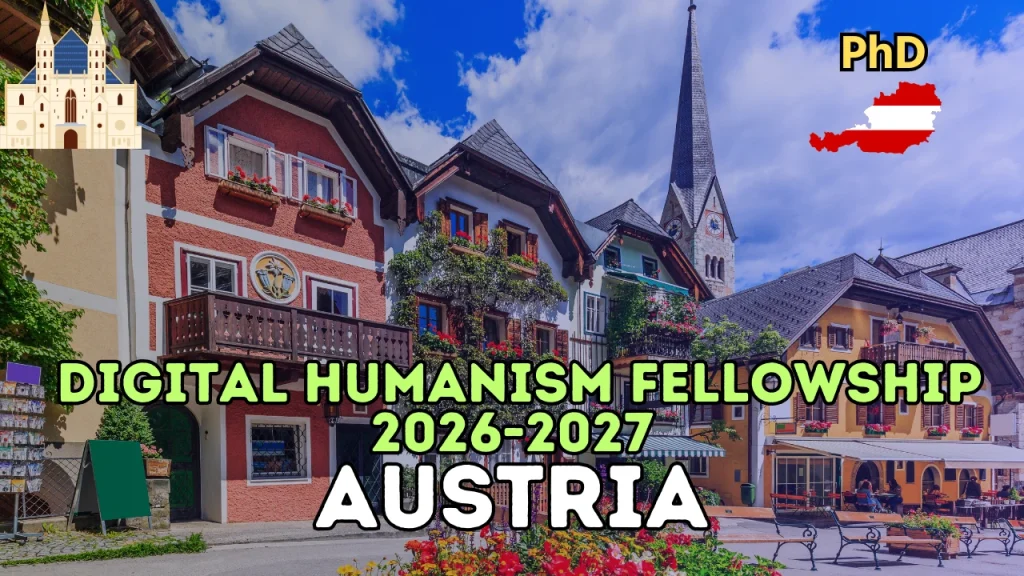
The Digital Humanism Fellowship 2026–2027 in Austria is a fully funded, short-term research fellowship at the Institute for Human Sciences (IWM) in Vienna. Designed for doctoral and postdoctoral researchers working on the societal impacts of digitalization and technology. It offers a competitive monthly stipend, research facilities, and a vibrant intellectual community. And making it an excellent opportunity for scholars in the humanities, social sciences, and related fields.
Basic information about the fellowship
The Digital Humanism Fellowship is hosted by the Institute for Human Sciences (IWM) in Vienna, Austria, within its broader Digital Humanism Program. The program focuses on understanding and shaping the complex relationship between digital technologies and human values, democracy, and social structures.
- Host institution: Institute for Human Sciences (IWM), Vienna, Austria.
- Partner institution: TU Wien Informatics, which collaborates with IWM to support Digital Humanism research and joint activities.
- Fellowship duration: Typically 3 consecutive months, usually from September to December 2026 for the 2026–2027 cohort.
- Fellowship type: Visiting fellowship for junior (doctoral) and postdoctoral researchers.
- Focus: Research on how digitalization affects society, economy, politics, and human values.
- NOT the same as Digital Humanities (not for projects using tech to study humanities).
- Open to all academic disciplines.
Application deadline: The main call for the 2026–2027 Digital Humanism Fellowship closes around 21 September 2025. (check the official IWM call page for the exact date before applying).
University / institution details
The fellowship is based at the Institute for Human Sciences (IWM), an independent institute for advanced study that hosts international scholars and offers a strong interdisciplinary research environment. IWM brings together researchers from philosophy, political science, sociology, history, and related disciplines to address major social and political challenges.
IWM’s Digital Humanism Program collaborates with TU Wien Informatic. Including its Center for Artificial Intelligence and Machine Learning (CAIML), to integrate humanities perspectives with cutting-edge technological research. Being in Vienna, fellows benefit from one of Europe’s most livable cities with rich cultural life, excellent public transport, and strong academic networks.
Study areas / research fields
The Digital Humanism Fellowship is not a taught degree program but a research fellowship. So there are no “courses” or “majors.” Instead, fellows propose their own independent research projects that must align with the themes of digitalization and its impact on society, politics, and human life.
Typical focus areas include:
- Digital democracy, disinformation, and platform governance.
- AI ethics, algorithmic accountability, and human rights in the digital age.
- Digital labor, platform economies, and changes in work and welfare.
- Datafication, surveillance, privacy, and security.
- Digital education, culture, and the transformation of public spheres.
Projects are usually rooted in humanities or social sciences but can involve interdisciplinary work with computer science or AI.
Digital Humanism Fellowship benefits
Fellows receive a monthly stipend that is intended to cover living costs in Vienna as well as travel and insurance expenses.
- Monthly stipend:
- EUR 3,300 (postdocs with PhD defended before deadline)
- EUR 2,750 (current PhD students)
- Stipend covers all living and research expenses.
- Fellows receive office space, internet, research facilities, and join IWM activities.
- Research environment: Fellows receive office space, internet access, in-house research infrastructure, and administrative support at IWM.
- Academic community: participation in seminars, workshops, lectures, and networking activities with IWM and TU Wien researchers.
- In-house lunch and some institutional services are typically provided free of charge during the stay.
These benefits make the Digital Humanism Fellowship effectively fully funded for the 3‑month research period in Vienna.
Benefits not included
Even though the fellowship is described as fully funded, there are some important items that are typically not separately covered:
- Additional housing allowance beyond the monthly stipend; accommodation must be arranged and paid from the stipend.
- Family or dependent support is not usually included
- Visa fees and some administrative costs may need to be covered from the stipend
- Personal travel during the fellowship, extra health services, and leisure activities are the fellow’s responsibility.
Eligibility criteria for Digital Humanism Fellowship
The Digital Humanism Fellowship targets emerging and established researchers whose work connects technology and society. Typical eligibility criteria include:
- Must be:
- Enrolled in a doctoral program, OR
- Have a PhD awarded after 20 Jan 2022.
- Only one application per academic year.
- Past IWM fellows must wait 2 academic years before reapplying.
- Discipline: Primarily humanities and social sciences), but applicants from other fields working on relevant topics are welcome.
- Research relevance: Proposed project must clearly relate to digitalization, digital society, or digital humanism themes such as democracy, labor, human rights, or AI.
- Language: Strong command of English is required because all application documents and most academic activities at IWM are in English.
- Nationality: Open to international applicants from all countries.
Some calls may specify that scholars at early or mid-career stages are prioritized, so applicants should read the latest call carefully.
Required documents
Applicants must submit a complete application package through the IWM online system. Typical required documents include:
- Motivation letter (why IWM + goals).
- Project description (max 550 characters).
- Full proposal (max 7,500 characters) covering:
- Objectives
- Current research state
- Methods
- Work plan
- CV + publication list.
- Two recommendation letters (submitted directly by referees).
- All documents in one PDF.
All documents must be in English and uploaded as a single PDF file according to IWM’s technical instructions.
Digital Humanism Fellowship Application process (step-by-step)
Use this practical, SEO-friendly step-by-step guide to apply for the Digital Humanism Fellowship 2026–2027 in Austria:
- Check eligibility and research fit
- Develop your research idea
- Prepare your project proposal
- Write a strong motivation letter
- Update your CV and publication list
- Secure academic referees
- Combine documents into one PDF
- Submit online before the deadline
- Wait for the selection decision
- Applications are reviewed by an expert jury, and selected fellows are normally notified a few months later
Tips for success (bullet points)
- Choose a focused research question. That can show meaningful progress in 3 months instead of an overly broad topic.
- Demonstrate clear alignment with “digital humanism” by connecting your project to democracy, ethics, human rights, or societal impacts of digital technology.
- Show why Vienna and IWM are essential for your project (archives, experts, networks, events) rather than generic benefits of a fellowship.
- Highlight existing publications or strong research output to prove that you can deliver concrete results from the fellowship.
- Ask referees early and provide them with your proposal and CV so they can write detailed, personalized letters.
- Respect word/character limits and technical instructions. Incomplete or non‑compliant applications are often disqualified.
- Proofread your documents multiple times to avoid language errors and ensure clarity, coherence, and strong academic style.
Monthly living expenses in Vienna (USD)
The stipend provided by the fellowship is designed to cover typical living expenses in Vienna, but planning your budget is crucial. Approximate monthly costs for a single international researcher:
- Rent (shared flat or student residence): 700–900 USD per month.
- Food and groceries: 350–450 USD per month.
- Public transport pass: 60–70 USD per month.
- Health insurance: 70–120 USD per month (may vary by provider and coverage).
- Miscellaneous (phone, clothing, leisure, local travel): 200–300 USD per month.
Overall, a typical monthly budget ranges between roughly 1,400 and 1,800 USD. Which fits within the fellowship stipend (about 2,900–3,500 USD equivalent, depending on EUR–USD rates) and leaves some margin for savings or research-related costs.
Why choose this fellowship? (at least 5 reasons)
- Fully funded, competitive stipend
- Unique focus on digital humanism
- Prestigious host institution and network
- Short yet intensive research stay
- Career-enhancing international experience
- No tuition or application fee
- Strategic location in Europe
Frequently asked questions (FAQ)
1. How long does the fellowship last?
The standard fellowship period is three consecutive months. Most often scheduled between September and December 2026 for the 2026–2027 cycle.
2. Do I need to speak German?
Knowledge of German is helpful for daily life, but not required for the fellowship, as academic activities and all application documents are in English.
3. Can scholars from any country apply?
Yes. The program is open to international applicants from all regions of the world as long as they meet academic and thematic requirements.
4. Do I have to be a computer scientist to be eligible?
No. Most fellows are from humanities and social sciences. But they must work on topics connected to digitalization, digital society, or technology and ethics.
5. Can I bring my family with me?
Family members may accompany you at your own expense. But the stipend is calculated for one person, and there is no separate family allowance.
6. When will I know if I am selected?
Selection decisions are made by an expert jury, and successful applicants are typically informed a few months after the deadline
7. Is there an age limit?
The official calls generally focus on academic status (doctoral vs. postdoctoral) rather than age. So applicants at various stages may apply if they meet research and degree requirements.
8. Can I apply with a co-authored project?
The fellowship is normally awarded to individuals. But your project can be part of a larger collaborative research agenda as long as your specific contribution is clearly defined.
Deadline
- 20 January 2026, 23:59 CET
- Results announced by 30 April 2026.