
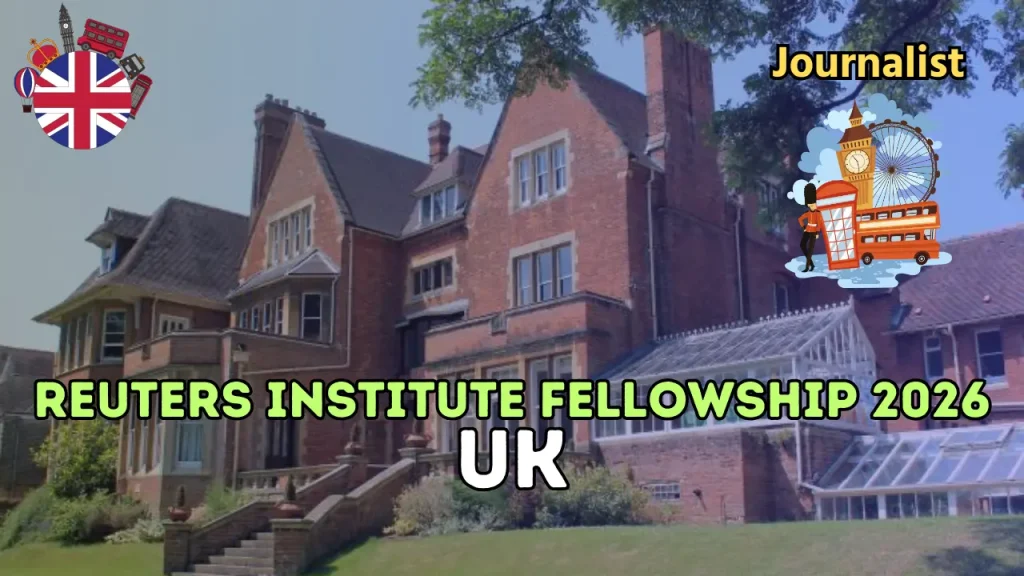
The Reuters Institute Fellowship 2026 in the UK (officially the Journalist Fellowship Programme at the Reuters Institute for the Study of Journalism, University of Oxford) is one of the world’s leading opportunities for practising, mid‑career journalists to step away from daily deadlines and explore journalism in depth at Oxford. Applications are open for the 2026–27 academic year, and you’ll need a strong proposal, work samples, and references to compete successfully.
Basic information (including application deadline)
The Reuters Institute Journalist Fellowship Programme is designed for practising, mid-career journalists to take time out from their day jobs to reflect, research, and develop ideas about journalism in a rigorous academic setting. The institute states that the majority of Journalist Fellows are fully funded and receive a stipend to cover living and travel costs.
- Host institution: Reuters Institute for the Study of Journalism (RISJ), University of Oxford, UK.
- Location: Oxford, United Kingdom.
- Fellowship type: Journalism fellowship for practising, mid-career journalists.
- Funding: Majority fully funded + stipend to support living and travel (varies by funding route).
- Academic year: Fellowships for the 2026–27 academic year are open.
- Duration & Start Dates
- Duration: 3 or 6 months
- Start options:
- October 2026
- January 2027
- April 2027
- Must stay in Oxford during term time
- Start options:
About the Fellowship
- One of the world’s leading fellowships for mid-career journalists
- Designed to give journalists time away from daily work to explore journalism in depth
- Based at the Reuters Institute, University of Oxford
- Fellows return to journalism after completing the programme
University/institution details
The fellowship is hosted by the Reuters Institute for the Study of Journalism, a research centre within the University of Oxford, focused on understanding the future of journalism and its impact on society. Fellows join Oxford’s intellectual environment while pursuing an individual research project that relates to journalism, media, and change in the industry.
A major reason this fellowship ranks highly in “best journalism fellowships” lists is its combination of academic time, professional networking, and a structured research output. This makes it ideal for journalists who want deeper expertise in areas like media transformation, audience trust, platform governance, newsroom innovation, AI in journalism, and business sustainability.
What You Will Do
- Work on a practical project relevant to your career, newsroom, or the media industry
- Attend weekly seminars with leading journalists, editors, academics, and industry experts
- Participate in networking events, discussions, and conferences
- Learn about misinformation, trust, press freedom, sustainability, audience engagement
- Join and help organize public symposiums at the end of each term
Study areas (available program names)
This is a fellowship programme, not a degree, so “study areas” are best described as research themes and project topics you can propose. The application process requires a research project statement of up to 1,000 words, which means your topic is central to selection.
Popular high-performing (searchable) journalism research areas to propose include:
- Newsroom innovation and digital transformation
- Media trust, misinformation, and fact-checking ecosystems
- AI in journalism and automation ethics
- Audience strategy, subscriptions, and business models
- Press freedom, safety, and legal threats
- Platform governance and the role of social networks in news distribution
When writing your blog, describe these as “project categories” and encourage applicants to propose a topic that matches their professional experience and newsroom reality—because the programme explicitly asks for your values, local media trends, and what you will contribute.
Reuters Institute Fellowship benefits
The Reuters Institute explains that the majority of Journalist Fellows are fully funded and also receive a stipend to cover living and travel costs. This combination is powerful because it allows journalists to focus on research and development rather than short-term income pressure.
- Most fellowships are fully funded
- Coverage includes:
- Tuition fees
- £2,000 monthly stipend
- Accommodation and living costs
- Travel to/from the UK
- Visa costs
- Time and space to explore journalism in depth at Oxford as part of a structured fellowship community.
Benefits not included
Even when a fellowship is “fully funded,” some costs can still arise depending on your situation (family commitments, extra travel, housing choices, insurance, etc.). In addition, the programme requires fellows to provide work samples and references, and applications are not considered without work samples—so “not included” also means “not waived”: incomplete applications won’t be reviewed.
Common expenses or gaps to plan for:
- Personal expenses beyond what your stipend comfortably covers (especially in Oxford).
- Family/dependents’ living costs (if you choose to travel with family).
- Extra travel before/after the fellowship period (not part of the fellowship schedule).
- Costs for gathering documents and translations (for work samples not in English, translations are required).
Eligibility criteria for the Reuters Institute Fellowship
Practical eligibility indicators (based on official requirements):
- Minimum 5 years of journalism experience (or equivalent)
- Open to:
- Staff journalists
- Freelancers
- Not eligible:
- Public relations, public affairs, or corporate communications professionals
- Open to applicants from all regions worldwide
- Must plan to return to journalism after the fellowship
- Fellows cannot work professionally during the fellowship
- Visas and English language requirements
English Language Requirement
- English proficiency required (no test during application)
- Accepted tests include:
- IELTS Academic: Overall 7.5 (min 7.0 each)
- TOEFL iBT: 110
- Cambridge C1 / C2
- Pearson PTE Academic
- Other recognised qualifications (GCSE, IB, O-Level, etc.)
- Some online/UKVI/general versions are not accepted
Required documents for the application
This fellowship is document-heavy in a good way: the Reuters Institute wants to understand your journalistic values, your media environment, and your proposed research. Use a checklist in your blog—readers love scannable lists and it increases time-on-page (good for SEO).
According to the Reuters Institute “Application Materials” page, you will need:
- Full curriculum vitae (CV).
- Personal statement (max 500 words total) covering:
- Your journalistic values.
- Major trends in the media landscape where you work.
- What would you contribute to the fellowship?
- Research project statement (up to 1,000 words).
- Employer reference supporting your application and granting leave of absence (or professional reference if freelance).
- Second professional reference (e.g., former employer).
- Work sample(s) with specific requirements:
- Print: three articles/reports (more than three not reviewed) + English translation if not in English.
- Broadcast: video link (max 10 minutes) + written description + English summary/transcription if not in English.
- English language evidence (if English is not your first language; certificate not more than 2 years old).
Reuters Institute Fellowship application process (step-by-step guide)
The Reuters Institute application is easier when you treat it like a mini project: research topic → storytelling → evidence (work samples) → professional validation (references). The institute is explicit that applications will not be considered without the required work samples.
Step-by-step:
- Pick a research topic that matters
- Identify a journalism problem you know deeply (from your beat/newsroom/market) and turn it into a research question.
- Draft the 1,000-word project proposal
- Keep it clear: problem, why it matters, what you’ll examine, and what outcomes you’ll produce.
- Write your 500-word personal statement
- Cover your values, the trends in your media environment, and what you will contribute to the fellowship cohort.
- Prepare strong work samples
- Follow the format rules (three print pieces or up to 10 minutes broadcast link) and provide English translation/summary if needed.
- Secure references early
- Get your employer leave-of-absence reference (or freelance professional reference) and a second professional reference.
- Submit your application through the official portal
- Upload documents in required formats, check every file opens correctly, and ensure the application is complete.
Tips for a successful application
Winning applicants usually look like “journalists who can think like researchers”—curious, structured, and serious about impact. The institute’s document requirements hint at exactly what reviewers want: clear values, deep knowledge of your media ecosystem, strong published work, and a research plan that fits the fellowship timeframe.
Practical tips:
- Make your research proposal specific, not a broad “state of journalism” overview; aim for one sharp question.
- Use your work samples strategically: pick pieces that show originality, depth, and public value (not only breaking news).
- In your personal statement, show what you will add to the cohort (regional insights, investigative methods, newsroom leadership, innovation experience).
- If you are freelance, choose referees who can verify your work quality and reliability at a professional level.
- If you need English proof, plan early so your certificate meets the “not more than two years old” requirement.
Monthly living expenses in Oxford (USD)
Oxford is a high-cost UK city, so budget planning matters even with funding. A cost benchmark estimates the average monthly cost of living for a single person in Oxford at about $2,924 including rent or $1,223 excluding rent.
Practical monthly budget ranges (USD) for fellows:
- If housing is covered or you share accommodation: $1,200–$2,000/month (food, local transport, personal expenses, plus partial housing).
- If you rent privately alone: $2,800–$4,500/month is a safer range depending on rent and lifestyle.
Why choose the Reuters Institute Fellowship? (5+ reasons)
Strong reasons to apply:
- Only ~30 fellows are selected worldwide each year
- Fellows come from different countries and media backgrounds
- Access to world-class Oxford libraries and research centres
- Part of a global media research institute
- Just 1 hour from London, close to BBC, The Guardian, Financial Times, etc.
Frequently asked questions (FAQ)
1) What is the Reuters Institute Fellowship 2026?
It is the Reuters Institute Journalist Fellowship Programme at the University of Oxford for practising, mid‑career journalists to explore journalism in depth, usually with full funding and stipend support for many fellows.
2) Is the Reuters Institute fellowship fully funded?
The Reuters Institute says the majority of Journalist Fellows are fully funded and they also receive a stipend to cover living and travel costs.
3) What documents are required?
You need a CV, a 500-word personal statement, a 1,000-word research project statement, two professional references (including employer leave reference or freelance equivalent), work samples, and English language evidence if applicable.
4) How many work samples should print journalists submit?
Print journalists must submit three articles or reports (more than three will not be reviewed), and non-English work must include English translation.
5) What are the work sample rules for broadcast journalists?
Broadcast journalists must submit a link (Vimeo/YouTube) with a maximum length of 10 minutes, plus a written description, and an English summary or transcription if the work is not in English.
6) Is English proficiency required?
If English is not your first language, you must supply evidence of English ability (original certificate not older than two years).
7) What does it cost to live in Oxford (USD)?
A benchmark estimates average monthly living costs for a single person in Oxford around $2,924 including rent (or $1,223 excluding rent).\
Application Details
- Applications open: Now
- Deadline: Friday, 13 February 2026 (23:59 UK time)
- Fellowship periods:
- Oct 2026
- Jan 2027
- Apr 2027