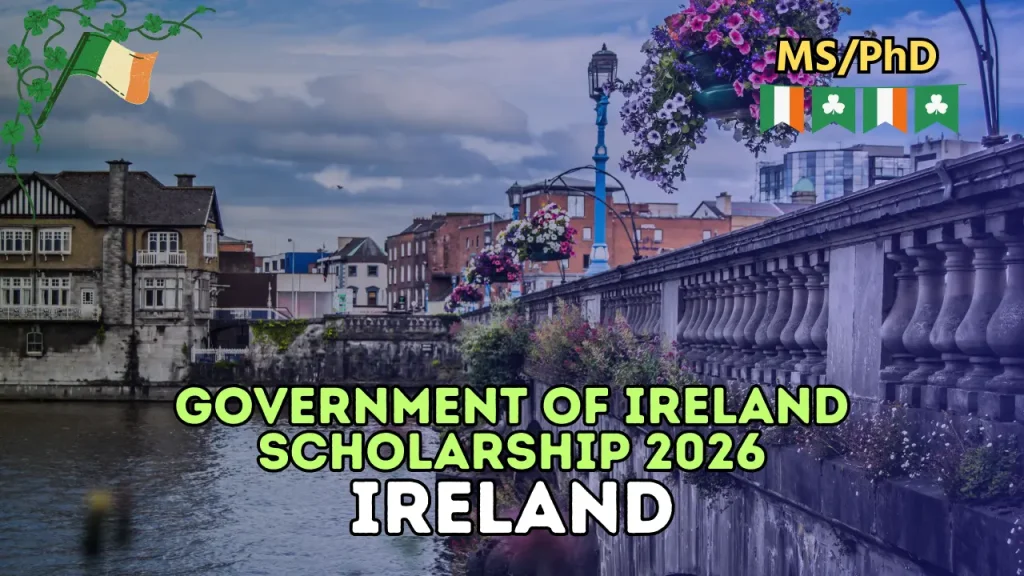
The Government of Ireland International Education Scholarship 2026 (GOI-IES) is a prestigious, highly competitive award that funds one year of full-time master’s, postgraduate diploma, or PhD study at leading Irish universities for outstanding non‑EU/EEA students. It combines a generous financial package with global recognition, making it one of the most attractive fully funded scholarships in Europe for postgraduate studies in 2026.
Basic information about the Government of Ireland Scholarship 2026
The Government of Ireland International Education Scholarship (GOI‑IES) 2026 targets high‑calibre international students who wish to pursue full‑time study at NFQ Level 9 or 10 (master’s, postgraduate diploma, or PhD) in Ireland. The programme is funded by the Government of Ireland in partnership with Irish higher education institutions (HEIs) and administered by the Higher Education Authority (HEA).
Key points:
- Scholarship type: Government of Ireland International Education Scholarship (GOI‑IES) 2026.
- Level: Postgraduate (taught or research)
- Supports high-calibre international students
- For full-time study in Ireland at:
- NFQ Level 9 (Master’s / Postgraduate Diploma)
- NFQ Level 10 (PhD)
- Funded by the Government of Ireland
- Managed by the Higher Education Authority (HEA)
- 60 scholarships awarded each year
- Duration: 1 academic year
- Duration: One academic year of full‑time, in‑person study.
- Eligible applicants: Students domiciled outside the EU/EEA, Switzerland, and the United Kingdom.
Application timeline (2026 call)
- Call opens: 29 January 2026.
- Application deadline: 5:00 pm (Irish time), 12 March 2026.
Eligible Study Levels
- Taught Master’s degree (minimum 1 year)
- Postgraduate Diploma (NFQ Level 9, minimum 1 year)
- Research Master’s or PhD (minimum 1 year)
- All disciplines are eligible (subject to availability)
University and institution details
The GOI‑IES scholarship can be used at a wide range of eligible Irish higher education institutions across the country. These include major universities and institutes of technology that are recognized under the National Framework of Qualifications (NFQ).
Examples of participating institutions include:
- Trinity College Dublin (TCD).
- University College Dublin (UCD).
- University College Cork (UCC).
- Dublin City University (DCU).
- South East Technological University (SETU).
- Other eligible universities, technological universities and colleges listed in Appendix 1 of the official 2026 GOI‑IES call document.
Applicants must first apply for and secure a conditional or final offer from one of these eligible HEIs before submitting the GOI‑IES scholarship application. Each university has its own course‑specific entry requirements and application process, so you should carefully review your chosen institution’s international admissions page before applying.
Study areas and available programs
The Government of Ireland International Education Scholarship 2026 covers all disciplines, as long as the programme is at NFQ Level 9 or 10 in an eligible HEI and there is an available place. This means you can apply for a wide range of master’s, postgraduate diploma, or PhD programmes.
Typical study areas include:
- Engineering and Technology (e.g., MSc in Data Science, MSc in Mechanical Engineering, MSc in Cybersecurity).
- Business and Management (e.g., MSc in Finance, MSc in Marketing, excluding some MBA courses at certain institutions).
- Computer Science and IT (e.g., MSc in Computer Science, Artificial Intelligence, Software Engineering).
- Natural and Applied Sciences (e.g., MSc in Biotechnology, Environmental Science, Physics, Chemistry).
- Health and Life Sciences (e.g., Public Health, Nursing, Biomedical Sciences, Pharmaceutical Sciences).
- Social Sciences and Humanities (e.g., International Relations, Economics, Sociology, Law, Education).
- Creative Arts, Design, and Media (e.g., Digital Media, Film Studies, Design Innovation).
Each institution publishes a list of eligible programmes and may highlight specific priority fields aligned with its strategic objectives. Always verify that your chosen course:
- Is full‑time and on‑campus.
- Starts in the 2026/27 academic year.
- Is at NFQ Level 9 or 10.
Government of Ireland Scholarship benefits
The Government of Ireland International Education Scholarship offers a strong funding package combined with academic prestige.
Core financial benefits:
- €10,000 stipend for living and study expenses (one year)
- Full tuition fee waiver by the host Irish higher education institution
- Covers tuition and registration fees
- Scholarship cannot be extended, but fee waivers may be extended by some HEIs for longer courses
Additional non‑financial benefits:
- Recognition as a Government of Ireland International Education Scholar, which strongly enhances your academic and professional profile.
- Access to high‑quality research environments and modern campus facilities at leading Irish universities.
- Opportunity to build an international professional network in Europe’s dynamic and innovation‑driven economy.
Because the funding is concentrated in one intensive year, many students combine the GOI‑IES year with additional personal or external funding if their degree extends beyond one year.
Benefits not included
While the Government of Ireland International Education Scholarship is very generous, it does not cover everything. Understanding this helps you plan realistic finances.
Benefits typically not included:
- Travel costs to and from Ireland (airfare/visa travel).
- Health insurance, unless covered through separate university arrangements; students are usually expected to purchase private health insurance.
- Accommodation guarantee: The scholarship does not guarantee on‑campus housing, though universities may assist with guidance.
- Living costs beyond the €10,000 stipend; if your annual expenses are higher, you need additional funds.
- Costs for dependents or family members, which must be self‑funded.
The scholarship only covers one academic year, even if your master’s or PhD program is longer, so you must secure funding for any remaining years.
Eligibility criteria for the Government of Ireland Scholarship 2026
To qualify for the GOI‑IES 2026, you must meet all of the core requirements.
Main eligibility conditions:
- Be from a country outside the EU/EEA, Switzerland, and the UK
- Hold an offer (conditional or final) from an eligible Irish HEI
- Apply for a full-time, in-person programme
- Not have previously received a GOI-IES scholarship
- Not be a Russian or Belarusian citizen
- Scholars must live in Ireland during their studies
- An official award ceremony will be held in Spring 2027
- Candidate profile
- Applicants are expected to demonstrate:
- a record of outstanding academic achievement;
- excellent communication skills;
- participation in extracurricular activities, for example, humanitarian work, politics,
arts or sport; - a strong rationale for pursuing their study in Ireland that indicates how a GOI-IES
would align with their longer-term goals.
Assessment Criteria
Applicants are evaluated on:
- Strong academic record
- Excellent communication skills
- Involvement in extracurricular activities (e.g., volunteering, arts, sports, leadership)
- Clear motivation for studying in Ireland
- Alignment with long-term academic and career goals
Evaluation Breakdown (100 Marks)
- Academic qualifications & experience: 40 marks
- Personal statement: 45 marks
- Personal and professional benefits
- Contribution to Ireland and home country
- Engagement with Irish society
- Long-term links with Ireland
- Two references: 15 marks
Required documents for the application
Exact document requirements are outlined in the 2026 GOI‑IES call and online application portal, but most applicants need to prepare the following.
Common required documents:
- Valid passport or national ID (for identity and nationality verification).
- Academic transcripts and degree certificates for all completed degrees (bachelor’s and, if applicable, master’s).
- A conditional or final offer letter from an eligible Irish higher education institution.
- Curriculum Vitae (CV) highlighting academic achievements, research experience, work experience, and extracurricular activities.
- Motivation/Personal statement explaining:
- Why you choose Ireland and your programme?
- How the scholarship fits your academic and career goals.
- How you will contribute to Irish higher education and your home country afterward.
- Two academic or professional reference letters, depending on the HEA’s instructions.
- Proof of English language proficiency (IELTS/TOEFL or equivalent) if required by your host university.
You should read the official 2026 call document carefully and follow any specific formatting, word limits, and templates mentioned there.
Government of Ireland Scholarship application process (step‑by‑step guide)
Below is a simplified, SEO‑friendly step‑by‑step guide on how to apply for the Government of Ireland International Education Scholarship 2026.
- Apply through the 2026 GOI-IES online application portal
- Only one application per candidate
- Upload:
- Proof of admission offer
- Two references via the portal
- No changes allowed after submission
- Late applications are not accepted
- General queries: [email protected]
Tips for a successful Government of Ireland Scholarship application
Strong applications stand out with clear motivation, excellent academics, and a strong fit with Ireland’s higher education system.
Actionable tips:
- Highlight academic excellence: Emphasize your grades, awards, publications, and any research or project work relevant to your field.
- Show leadership and community impact: Include volunteer work, campus activities, start‑up initiatives, or social impact projects to prove your broader contribution.
- Write a focused personal statement: Clearly explain why Ireland, why this university, why this program, and how the scholarship will help you contribute globally and at home.
- Align with institutional strengths: Research your chosen university’s research areas and show how your interests match their priorities.
- Avoid generic applications: Customize your answers rather than using the same text for multiple scholarships.
- Respect word limits and instructions: Following formatting, length limits, and document naming rules shows professionalism and attention to detail.
- Apply early: Do not wait for the deadline; early preparation reduces stress and avoids technical submission issues.
Monthly living expenses in Ireland (USD)
The €10,000 stipend is intended to support living costs for one academic year, but actual expenses vary by city and lifestyle. Below are approximate monthly costs for an international student in Ireland, using typical estimates and converting from euros to US dollars (rounded).
Estimated monthly expenses in Ireland (USD):
- Accommodation (shared apartment or student residence): 800–1,200 USD.
- Food and groceries: 250–400 USD.
- Public transport: 80–150 USD (student discounts available in major cities).
- Utilities and internet: 80–130 USD.
- Health insurance (averaged monthly): 50–80 USD.
- Miscellaneous / personal expenses: 150–250 USD.
Total average monthly living cost: approximately 1,400–2,100 USD, depending on the city (Dublin being more expensive than smaller towns). These figures show that while the GOI‑IES stipend provides solid support, you may need some additional savings or part‑time work (subject to visa rules) to live comfortably.
Why choose the Government of Ireland Scholarship 2026?
There are many reasons why the Government of Ireland International Education Scholarship 2026 is a top choice for international students who want to study in Europe.
At least five strong reasons:
- Generous financial support
- The combination of a €10,000 living stipend and a full tuition fee waiver significantly reduces your financial burden for one academic year.
- Study at world‑class universities
- You gain access to leading Irish universities and institutes that are well‑ranked internationally and known for high‑quality research and teaching.
- Prestigious and competitive scholarship
- Only around 60 scholarships are awarded worldwide each year, so being selected marks you as a high‑achieving, globally competitive scholar.
- Gateway to Europe’s innovation ecosystem
- Ireland hosts many global tech, finance, and pharmaceutical companies, offering opportunities for internships, networking, and future career growth.
- Diverse fields and flexible pathways
- The scholarship is open to all disciplines at NFQ Level 9 or 10, allowing you to pursue a wide range of programs from engineering to humanities or business.
- Strong internationalization strategy
- Ireland actively welcomes international students and promotes multicultural campuses, which can make adaptation and networking easier.
Frequently asked questions (FAQ)
1. Is the Government of Ireland Scholarship 2026 fully funded?
For one academic year, the GOI‑IES scholarship is effectively fully funded, as it includes a €10,000 stipend plus a full tuition fee waiver from the host institution. However, you still need to cover travel, insurance, and any living costs beyond the stipend.
2. Can undergraduate students apply?
No. The Government of Ireland International Education Scholarship 2026 is only for postgraduate students at NFQ Level 9 (master’s, postgraduate diploma) or Level 10 (PhD).
3. Do I need an offer letter before applying?
Yes. You must have a conditional or final offer of admission from an eligible Irish higher education institution at the time of submitting your scholarship application.
4. Can I apply if I am from the EU or UK?
No. The scholarship is specifically for students whose domiciliary of origin is outside the EU/EEA, Switzerland, and the United Kingdom.
5. How many times can I apply?
You may submit only one application in the 2026 GOI‑IES cycle, and previous GOI‑IES scholars are not eligible to apply again.
6. Is IELTS or TOEFL mandatory?
You must meet the English language requirements of your chosen Irish university, which often means submitting IELTS, TOEFL, or an equivalent test unless exempt under their policy. These results are normally required for both university and scholarship consideration.
7. When will I know the result of my application?
Decisions for the 2026 Government of Ireland International Education Scholarship are expected in early June 2026. Successful candidates receive formal confirmation and further steps from the HEA and their host institutions.
Key Dates
- Application deadline: 12 March 2026 (5:00 pm Irish time)
- Results announced: Early June 2026
- Study start: September or October 2026
Official Link:
By understanding the benefits, requirements, and application process of the Government of Ireland International Education Scholarship 2026, you can craft a strong, competitive application and take a major step toward studying in Ireland on a prestigious, fully funded award.