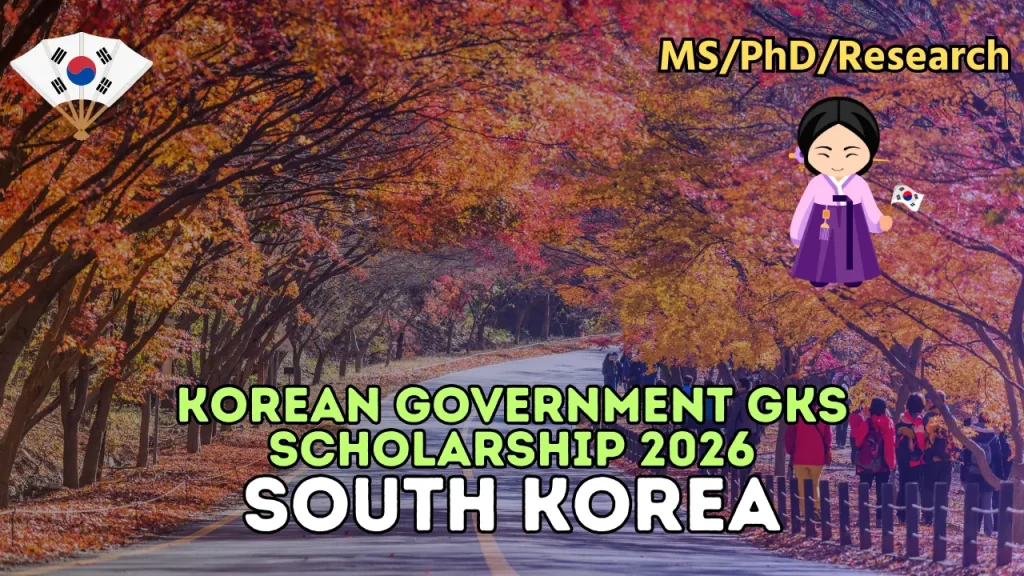
The Korean Government GKS Graduate Scholarship 2026 (Global Korea Scholarship – GKS-G) is a fully funded opportunity for international students to study a master’s or PhD degree in South Korea at top Korean universities in 2026. This is a government-invited scholarship degree program aimed at fostering global talent and establishing international networks by inviting outstanding students from around the world.
Basic information about the GKS Graduate Scholarship 2026
The Global Korea Scholarship (GKS) for Graduate Degrees is administered by NIIED (National Institute for International Education) under the Korean Ministry of Education and supports outstanding international students to pursue master’s, doctoral and research programs in Korea. For the 2026 intake, the Korean government plans to invite around 2,000 international students for graduate studies under this fully funded scholarship program.
- A Korean government-funded scholarship
- Invites outstanding international students to study in South Korea
- Aims to develop global talent and strengthen international networks
- There are two main application tracks:
- Embassy Track – You apply through the Korean embassy in your home country, pass national selection, and then your application is forwarded to Korean universities and NIIED.
- University Track – You apply directly to one of the designated GKS universities in Korea, and the university recommends shortlisted candidates to NIIED.
- Available Programs
- Degree Programs
- Korea–Japan Programs
- Exchange Student Programs
- Program Objectives
- Attract talented students worldwide
- Support undergraduate and graduate degree studies
- Promote global academic and cultural cooperation
Degree Levels & Duration
- Associate Degree: 2–3 years
- Bachelor’s Degree: 4–6 years
- Master’s Degree: 2 years
- Doctoral Degree: 3 years
- Includes mandatory Korean language training (except some programs)
University and institution details
The GKS Graduate Scholarship covers a wide network of Korean universities approved by NIIED, including national, public, and private institutions. You can only apply to universities and departments listed in the official GKS “University Information” file for the corresponding year.
Type A Universities (35 institutions)
- Ajou University
- Chung-Ang University
- Dankook University
- DGIST
- Dongguk University
- Duksung Women’s University
- Ewha Womans University
- GIST
- Hankuk University of Foreign Studies
- Hanyang University (ERICA & Seoul)
- Hongik University
- Incheon National University
- Inha University
- KAIST
- KDI School of Public Policy and Management
- Konkuk University
- Kookmin University
- Korea University
- Kyung Hee University
- NCC-GCSP
- POSTECH
- Sejong University
- Seokyeong University
- Seoul National University
- SeoulTech
- Sogang University
- Sookmyung Women’s University
- Soongsil University
- Sungkyunkwan University
- Sungshin Women’s University
- The Academy of Korean Studies
- UNIST
- University of Seoul
- Yonsei University
Type B Universities (41 institutions)
- Baeseok University
- Busan University of Foreign Studies
- Changwon National University
- Cheongju University
- Chonnam National University
- Chosun University
- Chungbuk National University
- Chungnam National University
- Daegu University
- Daejeon University
- Dong-A University
- Dongseo University
- Gyeongkuk National University
- Gyeongsang National University
- Hannam University
- Hoseo University
- Inje University
- Jeju National University
- Jeonbuk National University
- Kangwon National University
- Keimyung University
- Kongju National University
- Konyang University
- KOREATECH
- Kunsan National University
- Kyungpook National University
- Kyungsung University
- Kyungwoon University
- Mokwon University
- Pai Chai University
- Pukyong National University
- Pusan National University
- Semyung University
- Silla University
- Soonchunhyang University
- Sun Moon University
- Sunchon National University
- Tongmyong University
- University of Ulsan
- Wonkwang University
- Yeungnam University
Specialization Programs
R&D Program (25 institutions)
- Ajou University
- Cheongju University
- Chonnam National University
- Dong-A University
- Ewha Womans University
- Gyeongsang National University
- Hannam University
- Incheon National University
- Inje University
- Jeju National University
- KAIST
- Keimyung University
- Konkuk University
- Kookmin University
- KOREATECH
- Kunsan National University
- Kyungpook National University
- Pukyong National University
- Pusan National University
- Seoul Theological University
- SeoulTech
- Sogang University
- Sunchon National University
- Yeungnam University
- Yonsei University
Global Network Program (6 institutions)
- Ajou University
- Gyeongkuk National University
- Hongik University
- KDI School of Public Policy and Management
- Pusan National University
- Seoul National University
Study areas and available programs
The GKS Graduate Scholarship is open to almost all academic fields and disciplines offered by participating universities. In general, available study areas include:
- General Programs
- Humanities
- Social Sciences
- Natural Sciences
- Arts
- Specialized Programs (Master’s & Doctoral only)
- R&D Programs: Science & Engineering fields
- Global Network Programs:
- Humanities & Social Sciences
- Courses mainly taught in English
- No Korean language training
Korean Government GKS Graduate Scholarship benefits
The GKS Graduate Scholarship 2026 is a fully funded scholarship that covers nearly all essential study and living costs in Korea.
Key benefits typically include:
- Round‑trip airfare: Economy‑class flight tickets for arrival in and departure from Korea at the beginning and end of the scholarship period.
- Tuition fees: NIIED covers tuition up to 5 million KRW per semester, and any excess above that is usually covered by the host university, making tuition effectively free for scholars.
- Korean language training: One year of intensive Korean language course (for most scholars) at a designated language institute, fully funded by NIIED.
- Monthly allowance: Graduate degree students receive a monthly living stipend (recent guidelines around 900,000 KRW per month), and research scholars may receive slightly higher amounts.
- Settlement allowance: One‑time settlement grant upon arrival in Korea.
- Medical insurance: Monthly health insurance support and additional coverage under Korean national health insurance after enrollment.
- Research and printing support: Additional funds for research, thesis printing, and academic activities (varies by program and level).
- Korean language proficiency grants: Extra monthly stipend for scholars who achieve TOPIK level 3–6, with higher support for level 5–6.
Benefits not included
Although GKS is fully funded, some expenses are not fully covered and must be paid by the student:
- Visa fees and some document legalization or apostille costs in your home country.
- Personal expenses beyond the monthly allowance, such as leisure travel, expensive gadgets, and premium housing upgrades.
- Some university-specific fees (student union, certain lab or studio deposits) if not exempted by the institution.
- Costs related to additional language courses or test fees (TOPIK, IELTS, TOEFL) if you take them independently.
Planning a small personal budget for emergencies and extras is important even with a fully funded scholarship.
Eligibility criteria for the Korean Government GKS Graduate Scholarship
The core eligibility criteria for GKS Graduate 2026 are defined by NIIED and are similar every year, with minor adjustments.
Main requirements include:
- Nationality:
- Applicant must be a citizen of a country designated by NIIED for GKS.
- Neither the applicant nor their parents can hold Korean citizenship (dual citizens, including those with Korean nationality, are not eligible).
- Age limit: Under 40 years
- GPA: Minimum 80% average in the most recent degree
- Education: Bachelor’s or Master’s degree completed
- Academic qualifications:
- Master’s applicants must hold (or expect to hold) a bachelor’s degree before the specified deadline.
- PhD applicants must hold (or expect to hold) a master’s degree before the deadline.
- A minimum CGPA of 80% or being in the top 20% of your class is typically required.
- Health requirements:
- Applicants must be in good physical and mental health to study in Korea for the full scholarship period, and must pass a medical exam after selection.
Selection Process
- Announcement: February (NIIED)
- Application Submission: February–March (Embassy or University)
- Review: April–June (Embassy / University / NIIED)
- Final Results: June (NIIED)
Selection Quota
- Undergraduate students: ~500
- Graduate students: ~1,900
- Total: ~2,000 students
Available Universities by Application Track
🇰🇷 Embassy Track
- Programs:
- General
- Overseas Korean & Adoptee
- Eligible Universities: Type A or Type B
- Can choose up to 3 universities
- Must select at least 1 Type B university
- Overseas Koreans = ethnic Koreans without Korean citizenship
University Track
General Program
- Eligible Universities: Type A or Type B
R-GKS Program
- Eligible Universities: Type B only
Research Program
- Eligible Universities: Type A or Type B
Required documents for the application
Documents are critical for the GKS evaluation process and must be correctly prepared, often notarized or apostilled.
Typical required documents include:
- GKS application form and personal statement (motivation letter).
- Study plan or research proposal for your intended major.
- Two or more letters of recommendation (sealed and signed).
- Official academic transcripts and graduation certificates (bachelor’s and/or master’s), plus a certificate of expected graduation if you have not yet graduated.
- Proof of nationality for the applicant and parents (passports, birth certificates, or national IDs, depending on guidelines).
- Curriculum Vitae (CV) or resume (sometimes optional but highly recommended).
- Proof of language proficiency, such as TOPIK or English tests (IELTS, TOEFL, TOEIC), if available. These are not always mandatory but provide extra points.
- Additional certificates, awards, publications, or work experience documents related to your field of study.
- Signed agreement for scholarship regulations and medical assessment forms.
All documents must generally be submitted in Korean or English, or accompanied by certified translations.
Scholarship application process (step‑by‑step)
The GKS Graduate application process includes multiple evaluation stages.
Step 1: Choose a track and universities
- Decide whether you will apply via Embassy Track or University Track.
- Check the official GKS 2026 guidelines and the University Information file to select eligible universities and departments.
Application Method
- Degree Programs
- Apply through:
- Embassy Track: Online via Study in Korea website
- University Track: Apply directly to a GKS-designated university
- Apply through:
- Research Programs
- Apply directly to a GKS-designated university
Step 2: Prepare your documents
- Download the current year’s application forms from Study in Korea or your embassy/university website.
- Collect, translate, notarize, or apostille academic transcripts, degrees, and identity documents.
- Write a strong personal statement and detailed study plan or research proposal.
3rd Step: Submit application
- Embassy Track: Submit your complete application package to the Korean embassy in your country before their specified deadline (often February–March for graduate GKS).
- University Track: Submit your documents directly to the international admissions office of your chosen university within their announced application period.
Step 4: First‑round selection
- Embassy Track: The embassy conducts document screening and interviews and selects candidates to recommend to NIIED.
- University Track: The university evaluates your academic profile, research fit, and interviews (if any) and recommends shortlisted candidates to NIIED.
5th Step : Second‑round selection (NIIED)
Tips for a successful GKS application
To strengthen your GKS Graduate Scholarship 2026 application, focus on both academic competitiveness and personal storytelling.
Practical tips:
- Highlight academic excellence: Maintain a strong CGPA and clearly mention your rank or percentile if it is in the top 20%.
- Build a focused study plan: Connect your past studies, current research interests, and future career goals to Korea and your chosen program.
- Show language readiness: Even if TOPIK or IELTS is not mandatory, having scores gives extra points and demonstrates you can handle courses in Korean/English.
- Emphasize leadership and community impact: Use your personal statement to show how you contribute to your community and how you will become a bridge between Korea and your home country.
- Choose strategic universities: Consider a mix of top and regional universities (Type B), where competition might be slightly lower but benefits are the same.
- Follow formatting strictly: Use the official forms, respect page limits, signatures, and seal requirements; incomplete or incorrectly formatted documents are a common reason for rejection.
Monthly living expenses for international students in Korea (in USD)
While GKS provides a monthly stipend, it is useful to understand typical living costs in Korean cities.
Approximate monthly expenses (assuming 1 USD ≈ 1,300 KRW, rounded):
- Housing (goshiwon, one‑room, or dormitory): 300–500 USD depending on city and room type.
- Food: 250–350 USD if you combine cafeteria meals, convenience store food, and occasional restaurant visits.
- Transportation (subway, bus): 40–70 USD, depending on commute distance and frequency.
- Mobile phone and internet: 30–50 USD.
- Utilities and miscellaneous (laundry, supplies, small trips): 80–150 USD.
Total estimated monthly cost of living for a GKS graduate student is roughly 700–1,100 USD, and the GKS stipend is designed to cover the majority of these basic expenses, especially if you live in a university dorm or a modest one‑room.
Why choose the Korean Government GKS Graduate Scholarship? (at least 5 reasons)
There are many strong reasons to aim for the Korean Government GKS Graduate Scholarship 2026:
- Fully funded with comprehensive benefits: Airfare, tuition, language training, monthly allowance, and insurance are covered, making it one of the most generous scholarships in Asia.
- World‑class education and research: You gain access to leading Korean universities and cutting‑edge labs in fields like engineering, ICT, biotech, and social sciences.
- One‑year Korean language training: GKS includes intensive Korean language education, which boosts your academic performance, employability, and everyday life in Korea.
- Strong career and networking opportunities: Studying in Korea connects you to global companies, startups, and an active alumni network, which can be valuable for future jobs in Korea or internationally.
- Preference and support for diverse backgrounds: GKS gives evaluation preference to applicants from low‑income or underprivileged backgrounds, regional universities, and certain developing countries, increasing inclusion.
- Cultural immersion and soft‑power experience: Living in Korea allows you to experience K‑culture, K‑pop, Korean food, and unique festivals while building cross‑cultural skills.
- Clear structure and long‑term support: The scholarship period (3–4 years) is long enough to complete a full degree plus language training, with consistent financial and academic support throughout.
Frequently asked questions (FAQs)
1. Is the GKS Graduate Scholarship 2026 fully funded?
Yes, GKS Graduate 2026 is a fully funded scholarship that covers airfare, tuition, language training, monthly living allowance, medical insurance, and some research and settlement grants.
2. How many seats are available for GKS Graduate 2026?
For 2026, the Korean government plans to offer about 2,000 seats for international graduate students (Master’s, PhD, and research).
3. Do I need TOPIK or IELTS/TOEFL to apply?
Language certificates are not always mandatory for initial application, but having TOPIK or English proficiency scores gives additional points and may be required by certain universities or departments.
4. Can I apply to more than one university?
Under Embassy Track, you can usually list multiple preferred universities (according to that year’s guidelines), while under University Track, you apply directly to one institution in most cases.
5. What is the age limit for GKS graduate applicants?
Graduate applicants must generally be under 40 years of age by a specified cut‑off (e.g., September 1 of the scholarship year), with some exceptions for academic professors from ODA countries.
6. Can current final‑year students apply?
Yes, final‑year bachelor’s or master’s students can apply with a certificate of expected graduation and current transcripts, but they must submit final graduation documents by the deadline fixed by NIIED.
7. Are dependents (spouse/children) covered by the scholarship?
GKS benefits are designed for the student only; family members are not generally funded, and bringing dependents may require separate financial planning and visas.
8. How competitive is the GKS Graduate Scholarship?
Competition is high, especially for popular majors and top Seoul universities, but strong academics, a clear study plan, language skills, and a well‑organized application significantly improve your chances.
Application Deadline: different for every country
Official Link:
By understanding the GKS Graduate Scholarship 2026 requirements, benefits, and process in detail, you can optimize your application and increase your chances of winning this prestigious fully funded opportunity in Korea.