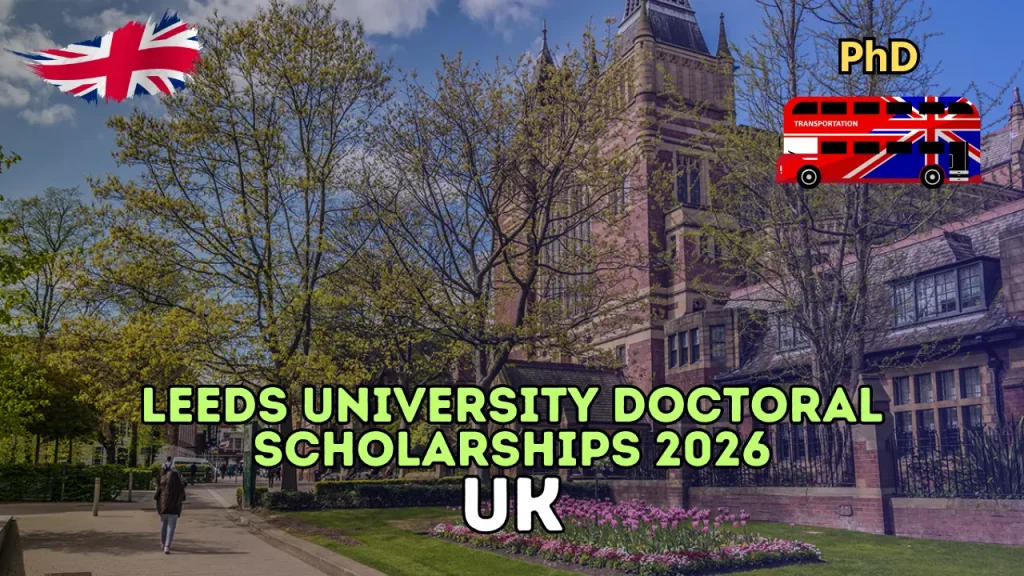
Leeds University Doctoral Scholarships 2026 are fully funded PhD awards that cover full tuition fees and provide a generous tax‑free stipend for up to 3.5 years of research at the University of Leeds. These prestigious doctoral scholarships are highly competitive and aimed at outstanding researchers who want to study at one of the UK’s leading research‑intensive universities.
Basic information about Leeds Doctoral Scholarships 2026
Leeds Doctoral Scholarships 2026 support PhD research starting on 1 October 2026. Applications usually open many months in advance to give candidates time to prepare a strong research proposal and complete the admission process.
Key points:
- Scholarship name: Leeds Doctoral Scholarships 2026
- Reference: PGR-F-209
- University: University of Leeds
- Number of awards: Up to 5
- Eligible country: UK (Home fee-rated students only)
- Level: PhD / Postgraduate Research
- Study mode: Full‑time or part‑time (funding pro rata for part‑time).
- Funding duration: Up to 3.5 years of support.
- Duration
- Full-time: 3.5 years
- Part-time: Pro-rata
- Initially awarded for 1 year, renewable for up to 2.5 additional years (subject to academic progress)
- Duration
- Start date of award: 1 October 2026.
- Application deadline: 1 April 2026 (typically 17:00 UK time).
- Country/fee eligibility: Primarily Home (UK fee status) students for the main Leeds Doctoral Scholarships.
There are other PhD funding schemes at Leeds (such as Leeds Opportunity Research Scholarships and Business School Excellence Scholarships), but here we focus on the core Leeds Doctoral Scholarships 2026.
University and scholarship overview
The University of Leeds is a major Russell Group research university located in Leeds, West Yorkshire, UK, with strong global rankings and a large international student community. The institution invests over £14 million annually in scholarships and funding for international and home students, reflecting a strong commitment to research and postgraduate education.
Leeds Doctoral Scholarships are funded directly by the University of Leeds and are designed to:
- Attract high‑calibre doctoral researchers across all major faculties.
- Provide stable, multi‑year funding aligned with UKRI stipend rates.
- Offer access to world‑class research facilities, academic mentoring, and a supportive doctoral training environment.
Successful applicants join a vibrant research community with opportunities for training, conferences, teaching experience, and interdisciplinary collaboration.
Study areas and eligible PhD programs
Leeds Doctoral Scholarships 2026 are available for PhD research in almost any discipline at the University of Leeds. The award is normally open to all faculties, including (examples):
- Arts, Humanities and Cultures (e.g. History, English, Linguistics, Philosophy).
- Social Sciences (e.g. Sociology, Politics, International Relations, Education, Psychology).
- Business and Economics (via Business School and related faculties).
- Engineering and Physical Sciences (e.g. Mechanical Engineering, Computing, Physics, Chemistry).
- Biological and Biomedical Sciences (e.g. Molecular Biology, Medicine‑related research).
- Environment, Earth and sustainability‑related fields.
In practice, you apply for a specific PhD research project or propose your own topic within a school or faculty that participates in the Leeds Doctoral Scholarships scheme.
Leeds University Doctoral Scholarships benefits
This is a fully funded PhD scholarship, which makes it particularly attractive for ambitious researchers.
Main benefits:
- Full tuition fees (3 years for full-time)
- Maintenance stipend: £20,780 per year (2025/26 rate)
- Stipend increases annually in line with UKRI rates
- Maintenance funding covers 3.5 years (pro-rata for part-time)
- Academic support: Supervision from experienced researchers and integration into research groups.
- Research environment: Access to laboratories, libraries, training workshops, and research events at a leading UK university.
The scholarship is typically renewed each year subject to satisfactory academic progress, meaning you must meet milestones set by your school or supervisory team.
Benefits not included
Although generous, the Leeds Doctoral Scholarships 2026 do not cover every possible cost.
Usually not included:
- Visa application fees and immigration health surcharge for international applicants.
- Relocation costs or flights to the UK.
- Financial support for dependants (spouse/children) beyond your stipend.
- Extra research expenses not covered by your school (for example, some conferences or fieldwork may require separate funding).
- Accommodation is not provided directly, although your stipend is intended to help with rent and living costs.
Always check the specific scholarship page and your offer letter to confirm exactly what is covered.
Eligibility criteria for Leeds University Doctoral Scholarships
Eligibility criteria for Leeds Doctoral Scholarships 2026 are strict because the awards are highly competitive.
Typical requirements include:
- Nationality and fee status: Applicants must usually be classed as Home (UK fee‑rated) under UK regulations for the main scholarship scheme.
- UK First Class Honours degree (or equivalent), or
- Lower undergraduate results accepted if:
- You have (or expect) a Distinction at Master’s level, or
- You can show relevant professional/industry experience
- Must be a new PhD applicant (full-time or part-time)
- Must not already hold a PhD or be currently registered for one
- Applicants who started but did not complete a PhD may be considered
- Must live within reasonable distance of the University of Leeds during the award
- Research match: Your proposed project must fit within the expertise and strategic priorities of the host school or faculty.
English Language Requirements
- IELTS 6.0 overall, with minimum 5.5 in each component, or equivalent
- Higher requirements may apply depending on the School
- Test must be within 2 years of course start date
Selection Process
- Each School shortlists candidates
- Final selection by University Scholarship Selection Panel
- Merit-based selection only (financial need not considered)
- Results published within 10 weeks of closing date
Required documents for the application
To submit a strong Leeds University Doctoral Scholarship 2026 application, you will need a complete set of documents.
Commonly required documents:
- Completed PhD application form to the University of Leeds (online) and 9‑digit student application ID.
- Separate Leeds Doctoral Scholarship application form (online).
- Academic transcripts and degree certificates for all higher education studies.
- Curriculum Vitae (CV) highlighting academic achievements, research experience, publications, and relevant skills.
- Research proposal (often 1,000–2,000+ words) outlining aims, questions, methodology, and significance of your project.
- Two academic reference letters, usually from lecturers or supervisors who know your work.
- Proof of English language proficiency if required (IELTS, TOEFL, etc.).
Missing or incomplete documents can significantly weaken your chances, so plan ahead to gather everything before the deadline.
Leeds University Doctoral Scholarships Application process: step‑by‑step
The application process has two main stages: admission to a PhD program and the scholarship application.
Follow these steps:
- Identify your research area and supervisor
- Explore PhD projects or propose your own topic within a relevant school at the University of Leeds.
- Contact potential supervisors with a brief research idea and CV if advised by the school.
- Apply for PhD admission
- Stage 1:
- Apply for a PhD research programme
- Submit all required supporting documents by the scholarship deadline
- Stage 2:
- After receiving your 9-digit Student Application ID, complete the online scholarship application
- Incomplete applications will not be considered
- Stage 1:
- Complete the Leeds Doctoral Scholarship application form
- Access the dedicated online scholarship application form and log in using your details.
- Provide your Student Application ID, personal information, and project details.
- Answer any motivation or suitability questions (e.g. why you are an excellent candidate).
- Submit before the deadline
- Ensure both your PhD admission application and scholarship form are submitted by 1 April 2026.
- Confirm that referees have supplied references if required separately.
- Selection and outcome
Tips for a successful scholarship application
Strong competition means you must present a well‑prepared and persuasive application.
Helpful tips:
- Develop a clear, original research proposal: Show why your project matters, how it fits existing literature, and what methods you will use.
- Align with faculty expertise: Demonstrate that your chosen school and supervisor have the right research environment and facilities for your topic.
- Highlight academic excellence: Emphasise high grades, awards, publications, conference presentations, and any research assistant experience.
- Show long‑term potential: Explain how the PhD and the Leeds Doctoral Scholarship will support your career goals in academia, industry, or policy.
- Proofread everything: Ensure your application is clear, free from errors, and consistent across forms, documents, and references.
- Apply early: Submitting well before the deadline allows time to fix problems, chase references, and respond to any requests from the school.
Monthly living expenses in Leeds (USD)
Understanding the cost of living is crucial for planning your PhD in the UK. Leeds is more affordable than cities like London, but students should still budget carefully.
Recent estimates for students in Leeds suggest:
- Typical monthly budgets: about £660–£1,120 per month, with an average around £805–£1,280 depending on accommodation and lifestyle.
Using a recent approximate exchange rate where £1 ≈ 1.25 USD (rate varies), this gives a rough monthly range of:
- Around 830–1,600 USD per month for a typical student budget.
- An example mid‑range budget of about 1,100–1,450 USD per month.
Breakdown in GBP before conversion:
- Accommodation: approximately £351–£826 per month depending on housing type.
- Food and groceries: around £100–£150 per month.
- Transport: roughly £50–£112 per month depending on travel patterns.
- Utilities and internet (if not included in rent): about £45–£75 per month combined.
- Personal expenses and leisure: often £80–£175 per month.
Your Leeds Doctoral Scholarship stipend (around £20,780 per year) is designed to help cover these typical living costs over 12 months.
Why choose the Leeds University Doctoral Scholarships 2026?
There are several strong reasons to choose this PhD funding opportunity if you are eligible.
Key advantages:
- Fully funded PhD with generous stipend
- The scholarship covers full UK tuition fees and offers a tax‑free maintenance grant around £20,780 per year for up to 3.5 years.
- World‑class research environment
- You will conduct your doctoral research at a leading UK research‑intensive institution with extensive facilities, libraries, and laboratories.
- Wide range of disciplines
- Scholarships are available across most faculties, allowing you to pursue projects in arts, social sciences, business, engineering, sciences, and more.
- Long‑term academic and career development
- Leeds provides training in research skills, teaching, communication, and professional development, helping you build a competitive CV.
- Stable, multi‑year funding
- Funding is awarded initially for one year and renewed annually subject to progress, giving you financial security to focus on your research.
- Attractive, student‑friendly city
- Leeds offers relatively affordable living costs and a vibrant student culture compared to other major UK cities.
For eligible candidates, these factors make the Leeds Doctoral Scholarships 2026 one of the most appealing fully funded PhD options in the UK.
Frequently asked questions (FAQ)
1. How long does the funding last?
The scholarship typically funds a PhD for up to 3.5 years for full‑time study, with part‑time awards on a pro‑rata basis.
2. Can international students apply?
Some sources describe Leeds doctoral funding as fully funded for international students in certain schemes, but the specific Leeds Doctoral Scholarships 2026 advertised by the University primarily target Home fee students; international applicants should explore other Leeds international scholarships and funding options.
3. Do I need to apply for admission before the scholarship?
Yes. You must first apply for a PhD research degree at the University of Leeds and obtain your 9‑digit Student Application ID before submitting the separate Leeds Doctoral Scholarship application form.
4. Are visa, flights, and dependants’ costs covered?
No. The scholarship does not cover visa fees, relocation costs, or dependent support; your stipend is meant to help with your own living expenses in Leeds.
5. Can I work while holding the scholarship?
Leeds generally permits limited part‑time work, such as teaching or demonstrating, provided it does not interfere with your research commitments; detailed conditions are usually set out in your offer and university regulations.
6. What if I am already enrolled on a PhD?
Applicants who already hold or are currently registered on a PhD are normally ineligible for the Leeds Doctoral Scholarships 2026.
Important Dates
- Application deadline: Wednesday, 1 April 2026 (5:00 PM UK time)
- Funding start date: Thursday, 1 October 2026
- Award must be taken up by: 1 October 2026