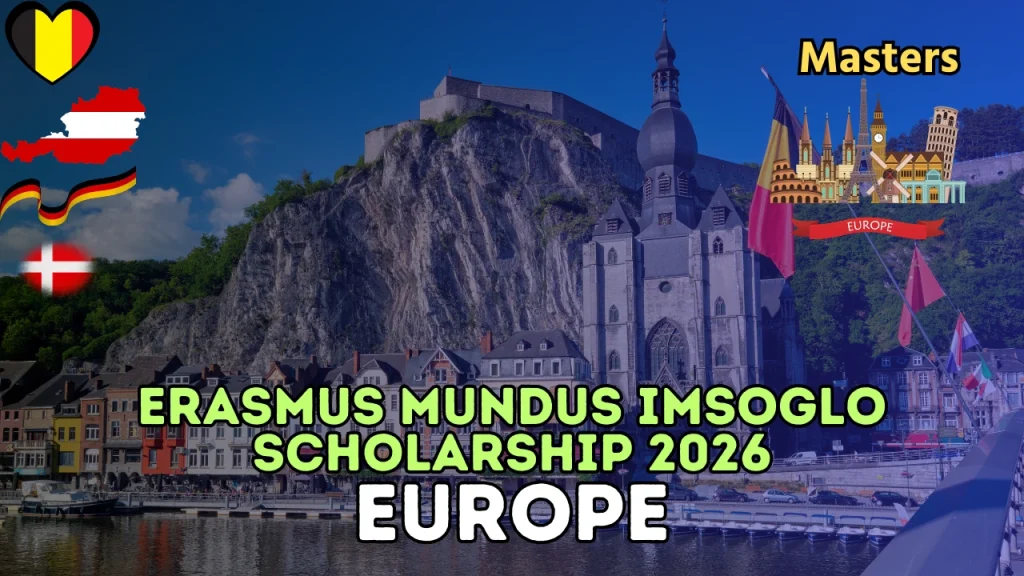
The Erasmus Mundus IMSOGLO Scholarship 2026 is a fully funded opportunity to study a prestigious joint master’s in Soils and Global Change at top universities in Belgium, Denmark, Germany, and Austria, with a strong focus on climate change, soil sustainability, and global environmental challenges. This guide covers all key details you need for a successful application for the 2026 intake.
Basic information about the Erasmus Mundus IMSOGLO Scholarship 2026
The Erasmus Mundus International Master in Soils and Global Change (IMSOGLO) is a two‑year (120 ECTS) Erasmus Mundus Joint Master Programme funded by the European Union, designed to train future experts in soil science, climate change, and sustainable land management. The program combines advanced scientific training with international mobility, allowing students to study in at least two different European countries and receive a joint master’s degree from leading universities.
- Program name: International Master of Science in Soils and Global Change (IMSOGLO).
- Degree type: Erasmus Mundus Joint Master (two‑year, 120 ECTS).
- Language of instruction: English.
- Duration: 2 academic years (4 semesters).
- Study locations: Ghent (Belgium), Aarhus (Denmark), Göttingen (Germany), Vienna (Austria).
- Intake start: August/September 2026.
- Target applicants: Talented students from all nationalities with a strong background in natural or environmental sciences.
Application timeline for scholarships:
- Applications for the IMSOGLO student intake September 2026 open in October 2025.
- The commonly advertised deadline for Erasmus Mundus IMSOGLO scholarships for the 2026 intake is 28 February 2026 (23:59 CET).
Institution details
About IMSOGLO (International Master in Soils and Global Change)
- Soil is essential for:
- Biomass production
- Carbon sequestration
- Water purification
- Ecosystem health and human wellbeing
- Climate change, industrialization, and population growth are damaging soil functions.
- IMSOGLO trains the next generation of soil scientists to:
- Understand soil chemistry, physics, and biology
- Study soil-plant interactions
- Measure, monitor, and model soil processes
- Develop climate-smart soil management policies
- Graduates can:
- Work in multidisciplinary environments
- Contribute to policy-relevant research
- Support UN SDGs and EU Green Deal goals
- Promote sustainable soil use and soil health
Partner Universities (4 European Universities)
- Ghent University (Belgium)
- BOKU University (Austria)
- University of Göttingen (Germany)
- Aarhus University (Denmark)
Study areas and available programme tracks
- Pure Sciences:
- Chemistry
- Biology
- Physics
- Mathematics
- Geology
- Astronomy
- Applied Sciences:
- Civil Engineering
- Agricultural Engineering
- Environmental Science
- Agricultural Science
- Chemical Engineering
- Biomedical Engineering
- Computer Science (often considered both pure and applied)
- Physical Geography
- Geo-ecology
- Relevant Background:
- Physics,
- Chemistry,
- Mathematics,
- Ecology,
- Biology,
- Geology,
- Physical Geography,
- Environmental Sciences, and
- Agricultural Sciences.
Programme Structure
- Duration: 2 years
- Credits: 120 ECTS
- Degree: Joint MSc in Soils and Global Change
- Language: English
- Includes mobility between partner universities
Study Plan:
- 1st Semester (Belgium – Ghent University)
- Fundamental soil science courses
- 1-week Primer Event
- Specializations (2nd & 3rd Semester):
- Soil Ecosystem Services and Global Change
- Ghent University (Belgium)
- Aarhus University (Denmark)
- Soil-Plant System Processes and Global Change
- BOKU University (Austria)
- University of Göttingen (Germany)
- Soil Ecosystem Services and Global Change
- Includes:
- Mandatory & elective courses
- Internship option
- Soft skills training
- Summer School
- 4th Semester:
- Master thesis
- Supervised by at least two partner universities
Erasmus Mundus IMSOGLO Scholarship benefits
The Erasmus Mundus IMSOGLO Scholarship 2026 is a highly competitive fully funded scholarship that significantly reduces the financial burden for international students. Typical benefits of the Erasmus Mundus IMSOGLO scholarship include:
- Monthly allowance: €1,400 (up to 24 months)
- Covers:
- Living expenses
- Travel
- Accommodation
- Full tuition waiver
- Includes insurance coverage
- Joint degree from top European universities in soil and global change sciences.
- Intensive international mobility with study in at least two European countries.
- Exposure to cutting‑edge research groups and a wide network of collaborating universities worldwide.
Exact amounts (monthly allowance, travel contributions) are defined by Erasmus+ EMJM guidelines and can evolve, so applicants should consult the IMSOGLO scholarship information page before submitting their application.
Benefits not included
Even with a fully funded Erasmus Mundus IMSOGLO scholarship, there are some costs and items that you may need to cover yourself:
- Visa and residence permit fees, which vary by country and nationality and may not be fully reimbursed.
- Certain administrative costs at local level (e.g., city registration, student union fees) that are usually modest but not always covered.
- Extra travel for personal trips or holiday travel beyond the official mobility paths funded by the scholarship.
- Higher‑than‑average accommodation or lifestyle expenses in expensive cities if your spending exceeds the standard monthly allowance.
- Costs for personal laptops, specific field gear, or optional excursions that are not part of the standard curriculum.
Planning an accurate personal budget and keeping some savings or backup funding is important, especially at the beginning of your stay in each new country.
Eligibility criteria for the Erasmus Mundus IMSOGLO Scholarship
The IMSOGLO Erasmus Mundus scholarship has both academic and language requirements, in addition to general Erasmus Mundus eligibility rules.
Academic background:
- Open to all nationalities
- Bachelor degree (minimum 180 ECTS) in:
- Chemistry, Biology, Geology
- Environmental/Agricultural Sciences
- Engineering or related sciences
- Must include at least 40 ECTS in natural sciences
- Must cover at least 4 of the following:
- Physics
- Chemistry
- Mathematics
- Ecology
- Biology
- Geology
- Environmental/Agricultural sciences
- Strong academic performance (top 30%)
Language requirements:
- Accepted tests:
- TOEFL iBT: Minimum 90
- IELTS Academic: Overall 6.5 (minimum 6 in each section)
- Cambridge C1 Advanced
- Not accepted:
- TOEIC
- TOEFL ITP
- Duolingo
- IELTS Online
- Exemption is possible only if:
- Previous degree completed in specific English-speaking countries
- Must provide official Language of Instruction certificate
- No other exemptions allowed.
Selection based on:
- Academic results
- CV
- Motivation letter
Results announced: By end of April 2026
List of Eligible Countries:
The English Language Test is not required of applicants from the following nations:
- Australia,
- Belize,
- Botswana,
- Cameroon,
- Canada,
- Gambia,
- Ghana,
- Guyana,
- Hong Kong,
- India,
- Ireland,
- Kenya,
- Liberia,
- Malawi,
- Malta,
- Namibia,
- New Zealand,
- Nigeria,
- Papua New Guinea,
- Philippines,
- Rwanda,
- Sierra Leone,
- Singapore,
- South Africa,
- Sudan,
- South Sudan,
- Tanzania,
- Uganda,
- United Kingdom,
- United States of America,
- Zambia or Zimbabwe.
Required documents for the application
To submit a complete and competitive Erasmus Mundus IMSOGLO Scholarship 2026 application, you will typically need the following documents, all uploaded via the online application system:
- Valid passport or national ID (for EU/EEA applicants).
- Bachelor’s degree certificate or official proof of graduation (or statement of expected graduation if you are in the final year, as allowed by the programme).
- Official academic transcripts listing courses and grades for your bachelor’s (and any relevant master’s) degree.
- Certified English translation of documents if originals are not in English.
- Proof of English language proficiency (IELTS, TOEFL, or equivalent) or English‑medium instruction certificate if eligible for exemption.
- Detailed CV or résumé (usually in Europass or similar format) highlighting academic background, research experience, internships, and relevant skills.
- Motivation letter / statement of purpose clearly explaining why you want to study soils and global change, your academic interests, and your career goals.
- Two or more letters of recommendation from academic staff or employers who can assess your academic performance and potential.
- Optional but beneficial: proof of research output, conference participation, relevant work experience, or extracurricular activities in environmental or agricultural fields.
Erasmus Mundus IMSOGLO Scholarship application process (step‑by‑step guide)
A clear, structured approach helps you submit a strong Erasmus Mundus IMSOGLO Scholarship application for 2026:
- Check eligibility and deadlines
- Review academic and language requirements, mobility rules, and scholarship eligibility on the official IMSOGLO website.
- Confirm that applications open in October 2025 and note the scholarship deadline of 28 February 2026 (or the exact date listed that cycle).
- Gather your academic documents
- Obtain official bachelor’s transcripts, degree certificates, and, if applicable, preliminary graduation statements.
- Arrange certified translations if your documents are not in English.
- Prepare your English test results
- Register for and complete an approved English test early so that official results are available before the scholarship deadline.
- If eligible, request an official English‑medium instruction certificate from your university instead.
- Complete the online application
- Access the online IMSOGLO application portal through the official website when it opens for the 2026 intake.
- Fill in personal data, academic history, programme track preferences (if required), and scholarship application sections carefully.
- Upload all required documents
- Upload PDFs of all required files (transcripts, degree, passport, test scores, CV, motivation letter, references, etc.) in the correct format and size.
- Double‑check that each document is clearly readable and correctly labelled.
- Submit before the scholarship deadline
- Submit the complete application well before 28 February 2026 to avoid last‑minute technical problems.
- After submission, monitor your email regularly for any further instructions or requests from the IMSOGLO admissions team.
Tips for a successful Erasmus Mundus IMSOGLO application
To maximize your chances of being selected for the Erasmus Mundus IMSOGLO Scholarship 2026, apply these practical tips:
- Align your profile with soil and climate topics
- Emphasize courses, projects, and internships related to soil science, climate change, agriculture, ecology, or environmental engineering in your CV and motivation letter.
- Show clear long‑term goals
- Explain how IMSOGLO will help you become a soil scientist, environmental consultant, climate policy expert, or researcher, and how you plan to contribute to sustainable land and climate solutions in your country or globally.
- Demonstrate academic excellence
- Highlight strong grades, awards, scholarships, or research experience in your field, as Erasmus Mundus scholarships prioritize very good to excellent academic records.
- Tailor your motivation letter
- Make your statement specific to IMSOGLO, mentioning its international mobility, multidisciplinary training, and unique expertise in soils and global change.
- Apply early and error‑free
- Avoid rushed submissions; early applications allow time to fix document issues or upload missing items.
- Choose recommenders strategically
- Ask referees who know your academic work well in relevant subjects and can convincingly support your suitability for a demanding international master’s.
Monthly living expenses for international students (USD)
Living costs for Erasmus Mundus IMSOGLO students vary between Belgium, Denmark, Germany, and Austria, but a realistic budget is essential. The Erasmus Mundus monthly allowance is designed to cover typical living expenses, although high‑cost cities may require careful budgeting.
Approximate monthly living expenses (converted to USD; amounts vary by lifestyle):
- Accommodation (shared room or student housing):
- Belgium/Germany/Austria: around 400–650 USD per month.
- Denmark: around 600–900 USD per month (often higher in big cities).
- Food and groceries:
- 250–400 USD per month, depending on how often you cook at home versus eating out.
- Local transport:
- 50–100 USD per month with student discounts and public transport passes.
- Health insurance and utilities:
- Some insurance is usually covered by the scholarship, but you may pay about 30–70 USD for additional coverage, phone, and internet.
- Study materials and personal expenses:
- 70–150 USD per month for books, printing, clothing, and leisure.
In total, a typical IMSOGLO student might spend roughly 800–1,400 USD per month depending on the city and lifestyle, which is broadly aligned with the subsistence level that Erasmus Mundus Joint Master scholarships aim to support. Careful budgeting and sharing accommodation can keep costs closer to the lower end of this range.
Why choose the Erasmus Mundus IMSOGLO Scholarship? (at least 5 reasons)
There are many compelling reasons to choose the Erasmus Mundus IMSOGLO Scholarship 2026 if you want a future‑proof career in environmental and climate‑related fields.
- 1. Unique specialization in soils and global change
IMSOGLO is one of the only master’s programmes in Europe that fully focuses on soils as part of ecosystems under global climate and land‑use change, giving you rare and highly relevant expertise. - 2. Joint degree from four leading universities
You earn a prestigious joint master’s degree from Ghent University, Aarhus University, the University of Göttingen, and BOKU Vienna, all of which are internationally recognized for environmental and agricultural sciences. - 3. Fully funded international study experience
The Erasmus Mundus scholarship covers tuition fees, offers a monthly allowance, and contributes to travel and installation, making high‑quality European education accessible regardless of your financial background. - 4. Strong international mobility and networking
You study in at least two European countries, build intercultural competence, and join a dense global network of researchers, universities, and alumni working on soil and climate issues. - 5. Multidisciplinary, research‑driven training
IMSOGLO integrates physics, chemistry, biology, hydrology, and environmental modelling, exposing you to cutting‑edge research and a mix of classroom, laboratory, and field‑based training. - 6. Excellent career prospects
Graduates are equipped for careers in environmental consultancy, international organisations, academia, government agencies, and NGOs focused on climate adaptation, land management, and sustainable agriculture. - 7. Structured quality assurance and support
The programme includes a dedicated quality assurance system, preparatory activities such as the “BePrepared” summer school, and joint summer activities that help you transition smoothly and build community.
Frequently asked questions (FAQ)
1. Can students from any country apply for IMSOGLO?
The IMSOGLO Erasmus Mundus scholarship is open to talented students from all nationalities who meet the academic and language requirements, with specific mobility rules for some nationalities (for example, Danish or Belgian students may have restrictions on scholarship eligibility for certain specialisations).
2. How long does the IMSOGLO programme last, and when does it start?
IMSOGLO is a two‑year full‑time master’s programme (120 ECTS) that usually starts in August/September with a first semester at Ghent University. Subsequent semesters take place at different partner universities depending on your chosen specialisation.
3. Do I need professional experience to apply?
Professional experience is not mandatory, but relevant internships, research assistantships, or work in environmental, agricultural, or climate‑related sectors can strengthen your application and demonstrate your commitment to soils and global change.
4. Can I apply if I have not graduated yet?
Final‑year students can usually apply if they expect to complete their bachelor’s degree before the programme starts and can provide official proof of enrolment and expected graduation, as specified in IMSOGLO’s admission guidelines. A final degree certificate will be required before enrolment is confirmed.
5. Can I apply as a self‑funded student if I am not selected for the scholarship?
Yes, IMSOGLO also accepts self‑funding students who meet the academic and language criteria but do not receive an Erasmus Mundus scholarship, paying participation costs as indicated on the programme fee page.
6. How competitive is the Erasmus Mundus IMSOGLO Scholarship?
Erasmus Mundus Joint Master scholarships are highly competitive worldwide, and IMSOGLO selects candidates based on academic excellence, motivation, and fit with the programme’s focus on soils and global change. Submitting a well‑prepared, complete application before the deadline greatly improves your chances.
Application Deadlines (Intake: September 2026)
- Erasmus Mundus Scholarship: 28 February 2026
- Self-funding (Non-EEA): 28 February 2026
- Self-funding (EEA nationals): 31 May 2026
Official Link:
University of Hong Kong HKU CDS Research Internship 2026 in Hong Kong