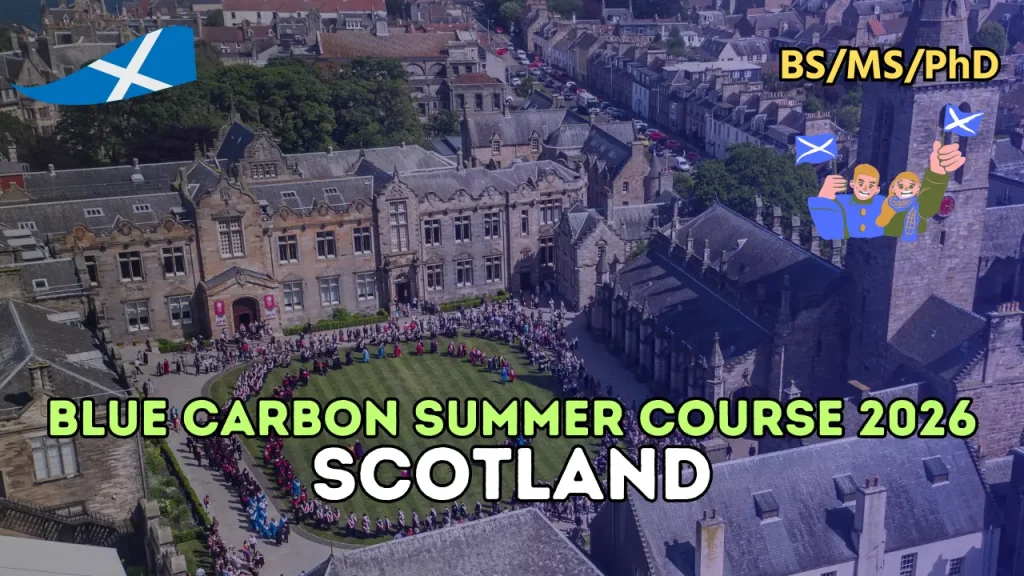
Blue Carbon Summer Course 2026 in Scotland is a fully funded, two‑week international summer programme on blue carbon science and climate policy hosted by the University of St Andrews, Scotland, UK. It offers up to six WWF Blue Carbon scholarships that cover course fees, accommodation, and international travel, making it one of the most attractive short-term climate and marine conservation opportunities in Europe for 2026.
Title Page Separator Site title
Basic information about the scholarship
The Blue Carbon Science & Policy Summer Course 2026 will take place at the University of St Andrews in Scotland, a world‑leading institution in marine science and climate research. The intensive course runs for two weeks in June 2026 (6–20 June 2026), combining lectures, fieldwork, laboratory sessions, and policy training focused on blue carbon ecosystems such as mangroves, seagrasses, and saltmarshes.
- Host Country: UK
- Location: St. Andrews, Scotland
- Duration: Two weeks
- Financial Benefits: Fully Funded
- Scholarship Deadline: 4th March 2026
Key dates include a general course application deadline of 31 March 2026 (23:59 UK time) and a separate WWF scholarship deadline of 4 March 2026 (23:59 UK time). The course sits within the University’s Blue Carbon Academy and is aligned with the UN Decade of Ocean Science for Sustainable Development, which strongly boosts its international relevance and visibility
University and course details
The programme is hosted by the University of St Andrews, one of the oldest and most prestigious universities in the UK, located in the coastal town of St Andrews in Scotland. The Blue Carbon Science & Policy Summer Course is delivered through the University’s summer study framework and Blue Carbon Academy, bringing together leading scientists and policy experts working on ocean and climate issues.
The course design blends morning lectures with afternoon practicals, including field excursions to Scottish coastal environments and laboratory analysis using modern techniques. Participants also gain access to university facilities such as the library, sports centre, and a structured cultural and social programme during their stay.
Study areas and programme content
The Blue Carbon Summer Course 2026 is focused on blue carbon science, climate change mitigation, and environmental policy. While it is a single summer programme rather than multiple degrees, it covers several specialised study areas that are highly relevant for students and professionals in environment‑related fields.
Main academic and practical themes include:
- Blue carbon theory and core concepts
- Coastal ecosystems (mangroves, seagrasses, saltmarshes) and carbon storage
- Sampling strategies and field methods for blue carbon research
- Sediment cores, stratigraphy, and coastal geomorphology
- Laboratory analysis and estimation of blue carbon stocks
- Climate change mitigation, nature‑based solutions, and marine conservation
- Policy frameworks, governance, and real‑world applications
Participants also earn academic credit: the two‑week course is worth 10 SCQF credits, typically equivalent to about 2.5 US credits or 5 ECTS, though students must confirm transfer with their home institution.
Blue Carbon Summer Course benefits
The Blue Carbon WWF Awards offer up to six fully funded places for the 2026 summer course
Main scholarship benefits include:
- Full coverage of the Blue Carbon Science & Policy Summer Course fee (worth about £3,050 in 2026)
- En‑suite accommodation in university-arranged shared apartments
- University-arranged return economy travel to St Andrews (international travel support)
- Daily meals during the programme (breakfast 7 days a week; lunch and dinner Monday–Friday)
- Access to cultural and social activities organised by the university
- Use of the University of St Andrews library, sports centre, and student services
These benefits make the programme effectively a fully funded climate summer school in the UK for selected scholarship awardees.
Benefits not included
- Personal expenses (local transport outside programme activities, personal travel, shopping, etc.)
- Visa fees and related immigration costs
- Passport costs or renewals
- Any additional insurance (health or travel) not arranged personally
- Transcript access fee or processing fees related to official academic documents
Applicants should budget separately for these out‑of‑pocket expenses to avoid financial stress during the programme.
Eligibility criteria for the Blue Carbon Summer Course
The Blue Carbon Summer Course 2026 is open to both undergraduate and postgraduate students as well as early‑career professionals with an interest in ocean science and climate policy.
- Being at least 18 years old by the time you arrive in St Andrews
- Having completed at least one year (two semesters) of full‑time university study
- A minimum GPA equivalent to 3.2 on a 4.0 US scale (or international equivalent)
- Demonstrated English language proficiency (for non‑native speakers) using an approved test or evidence accepted by the university
The fully funded WWF scholarships strongly encourage applications from the Global South and from candidates passionate about climate change, marine conservation, and blue carbon policy.
Required documents for the application
To apply for the Blue Carbon Science & Policy Summer Course and then the WWF Blue Carbon scholarship, you must prepare a complete set of application documents. Typical required documents are:
- Official academic transcript(s) from your current or most recent university
- Personal statement or motivation letter explaining your interest in blue carbon, climate change, and this specific programme
- Academic reference or letter of recommendation
- English language certificate (if applicable)
- Valid passport details (often needed later for travel arrangements if selected)
Having these documents ready before you start your online application helps you submit a strong and timely scholarship application.
Blue Carbon Summer Course application process (step‑by‑step)
Use the following step‑by‑step guide to apply for the Blue Carbon Summer Course 2026 and the fully funded WWF Blue Carbon scholarship:
- Check eligibility
- Confirm you meet the age, academic year, and GPA requirements.
- Review English language guidelines and whether you need a test result.
- Confirm credit transfer (if needed)
- Talk to your home university about recognising the 10 SCQF credits.
- Get any internal approvals you may require for credit transfer or study abroad.
- Prepare your documents
- Request official transcripts early from your university.
- Ask a professor or supervisor to provide an academic reference.
- Draft and refine your personal statement, focusing on blue carbon, climate action, and your future plans.
- Arrange your English language certificate if required.
- Submit the online course application
- Go to the University of St Andrews summer study / Blue Carbon course page and complete the online application form by 31 March 2026 (23:59 UK time).
- Upload all required documents as instructed.
- Apply for the WWF Blue Carbon scholarship
- After or alongside your course application, complete the dedicated WWF Blue Carbon scholarship form before 4 March 2026 (earlier deadline).
- Highlight your financial need, regional background (especially if from the Global South), and your commitment to blue carbon science and policy.
Tips for a successful application
To stand out in this competitive fully funded summer school in Scotland, keep these practical tips in mind:
- Emphasise climate impact: Clearly show how blue carbon science and policy fit into your academic background, research interests, or professional goals.
- Connect to the Global South: If you are from a developing country or coastal community, explain how this training will directly benefit your region and support climate resilience.
- Show academic strength: Highlight research projects, coursework, or field experiences related to marine science, ecology, climate change, or environmental policy.
- Write a focused personal statement: Be specific about why the University of St Andrews and this blue carbon course are the right fit for you and how you will use the skills after returning home.
- Apply early: Do not wait until the final day; early applications reduce the risk of technical issues and give you time to fix any missing documents.
- Choose strong referees: Ask referees who know your academic work and can comment on your potential to contribute to climate and ocean solutions.
Monthly living expenses for international students (in USD)
The course fee and scholarship cover most academic and on‑campus living costs during the two‑week programme, including accommodation and meals. However, international students should still estimate some basic monthly living expenses in Scotland for budgeting, even for a shorter stay.
Approximate monthly living costs in St Andrews (outside covered items) can include:
- Local transport and occasional trips: around 70–120 USD
- Personal expenses (phone, toiletries, clothes, etc.): around 100–200 USD
- Additional food or eating out beyond the provided meals: around 150–250 USD
- Leisure, sightseeing, and social activities: around 100–200 USD
For a two‑week stay, your personal budget requirement will usually be around half of a typical month, but planning for 200–400 USD in personal funds is a realistic and safer estimate.
Why choose this scholarship? (at least 5 reasons)
There are many reasons why the Blue Carbon Summer Course 2026 in Scotland stands out as a top fully funded climate scholarship opportunity:
- World‑class host institution
You will study at the University of St Andrews, a globally respected university with strong expertise in marine science, climate change, and coastal ecosystems. - Fully funded blue carbon scholarship
Up to six WWF Blue Carbon Awards cover course fees, accommodation, and international travel, significantly reducing financial barriers for talented students from all regions. - Unique focus on blue carbon and policy
The course combines scientific training with policy and governance, helping you understand how research translates into climate solutions and coastal management. - Hands‑on fieldwork and lab experience
You gain real field experience in Scottish coastal environments, collect samples, and learn analytical techniques for estimating blue carbon stocks, which is valuable for research and future careers. - International networking and career boost
Participants join a global community of students, researchers, and practitioners interested in ocean science and climate mitigation, opening future pathways in academia, NGOs, and international organisations. - Academic credit that travels
The 10 SCQF credits can often be transferred back to your home institution, allowing you to gain both experience and recognised academic credit in a short time.
Frequently asked questions (FAQ)
1. Is the Blue Carbon Summer Course 2026 fully funded?
The course itself charges a fee, but up to six WWF Blue Carbon scholarships are available that fully fund the fee, accommodation, and international travel, making it effectively fully funded for selected participants.
2. Where does the programme take place?
The Blue Carbon Science & Policy Summer Course is held at the University of St Andrews in St Andrews, Scotland, United Kingdom.
3. Do I need to pay an application fee?
Available descriptions of the summer programme and scholarship do not mention an application fee, and many similar University of St Andrews summer opportunities do not charge a fee; applicants should still verify on the official course page before submission.
4. Which documents are required for the application?
You will need official academic transcripts, a personal statement, at least one academic reference, and proof of English language proficiency if applicable.
5. Can professionals apply, or is it only for students?
The course is suitable for undergraduate and postgraduate students as well as early‑career professionals working in related fields such as marine science, climate policy, or environmental management.
6. Is on‑campus accommodation included?
For scholarship holders, en‑suite accommodation in shared apartments is included as part of the fully funded package. Paying participants may also access residential options through the standard course fee.10. How do I apply?
Application Deadline:
You must complete the online application form for the Blue Carbon Science & Policy Summer Course via the University of St Andrews website by 31 March 2026 and then submit a separate application for the WWF Blue Carbon scholarship by 4 March 2026, following the instructions given on official announcement pages.