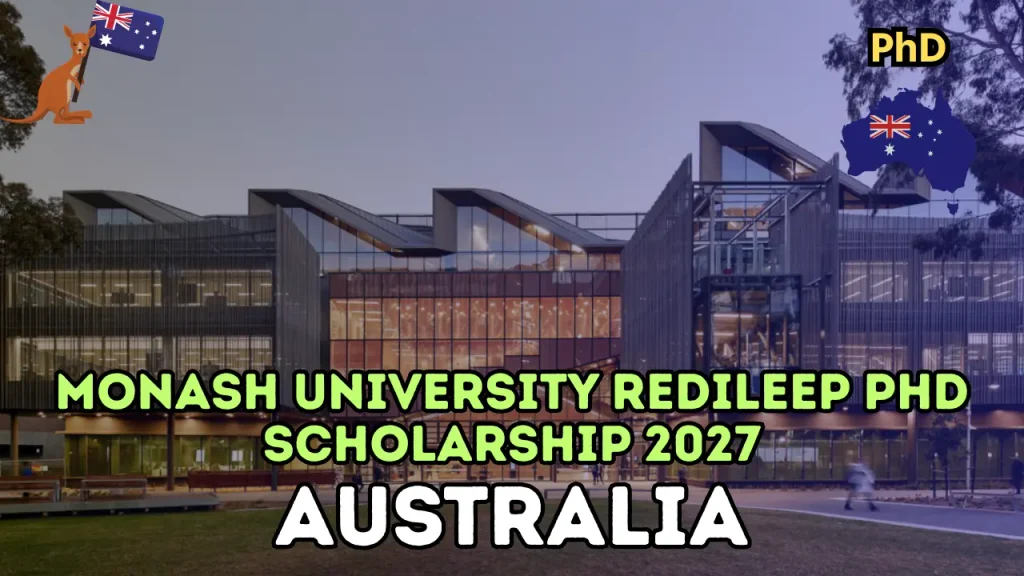
Are you looking to advance your academic career with a fully funded doctorate at one of Australia’s top-ranking research institutions? The Monash University ReDiLEEP PhD Scholarship 2027 offers a premier research opportunity in Melbourne, Australia, focused on critical environmental issues like climate change biology, ecological resilience, and marine science.
Part of the international ReDiLEEP Doctoral Network (Response Diversity in Life History and Ecological Evolutionary Processes), this doctoral position pairs international academic collaboration across Europe and Japan with cutting-edge experimental biology. This comprehensive guide covers everything you need to know: key deadlines, funding benefits, eligibility criteria, required documents, step-by-step application instructions, and realistic monthly living costs in Australia.
Basic Information & Key Deadlines
The ReDiLEEP PhD project operates through a two-stage process. Candidates apply first for project selection with the principal investigator; the chosen candidate is then nominated to compete for a full Monash University Graduate Research Scholarship.
- Position: Doctoral Candidate (PhD) — Physiological Basis and Consequences of Response Diversity
- Project: DC13, under the ReDiLEEP Marie Skłodowska-Curie Actions (MSCA) Doctoral Network
- Host University: Monash University, Australia
- School: School of Biological Sciences, Clayton, Victoria
- Supervisor: Dr Giulia Ghedini
- Duration: 36 months, full-time
- Expected start: April 2027
- Application deadline: 30 September 2026 for the first application step
(The heading says 30 October, but the detailed application instructions say 30 September. The detailed instructions should be verified with Monash.)
Institution Details: The Monash University Experience
Ranked consistently among the Top 50 Universities Worldwide (QS World University Rankings) and a member of Australia’s prestigious Group of Eight (Go8), Monash University is a global power in graduate research.
Located in Melbourne—frequently named one of the world’s most liveable cities for international students—Monash provides state-of-the-art laboratory facilities, high-performance computing clusters, and expansive marine research setups. The ReDiLEEP doctoral researcher will be based within the School of Biological Sciences, benefiting from a vibrant academic culture, dedicated career development workshops, and direct global networking through the ReDiLEEP network.
Study Areas & Specific Research Focus
- The project focuses on marine phytoplankton and how they respond to environmental changes.
- You will study response diversity, meaning differences in how different species respond to environmental changes.
- The goal is to understand how these differences help ecosystems:
- remain stable,
- recover after disturbances,
- survive global environmental change.
- The research will involve:
- Laboratory experiments
- Phytoplankton
- Physiological studies
- Eco-evolutionary experiments
- Data analysis
- Ecological modelling
Main responsibilities
- Read and understand scientific literature.
- Design and conduct laboratory experiments.
- Work with phytoplankton.
- Collect and analyse research data.
- Publish research papers.
- Work independently and with international researchers.
- Participate in ReDiLEEP training and activities.
- Take part in international secondments.
Monash University ReDiLEEP PhD Scholarship Benefits: What’s Covered?
Successful applicants selected for the project who secure a Monash Graduate Research Scholarship (such as the Monash Graduate Scholarship – MGS or Research Training Program – RTP) receive a comprehensive financial package:
- Gross salary: AUD $37,143 per year, tax-free if there is no other income.
- Scholarship typically covers:
- Tuition fees
- Living stipend
- Relocation allowance
- Duration: 3 years
- Research Infrastructure Support: Full access to laboratory equipment, experimental consumables, field site funding, and software tools.
- Conference & Travel Grants: Funding opportunities to present findings at international symposia and visit ReDiLEEP partner institutions in Europe and Asia.
International opportunities
You may spend up to 6 months at partner institutions:
- University of Namur, Belgium — community assembly, disturbance responses and species traits.
- Swansea University, UK — modelling physiological responses.
- University of Oldenburg, Germany — community ecology and experimental evolution.
You will also receive training in:
- R/Tidyverse
- Data management
- Machine learning and AI for ecology
- Data visualization
- Response diversity methods
- Evidence-based policymaking
- Science-policy communication
- Policy brief writing
Benefits Not Included
While the funding covers primary tuition and living expenses, candidates should budget for a few out-of-pocket costs:
- Overseas Student Health Cover (OSHC): Mandatory health insurance for international visa holders in Australia (unless covered by specific institutional top-up awards).
- Australian Student Visa Fees (Subclass 500): Processing fees charged directly by the Australian Department of Home Affairs.
- Initial Deposit & Temporary Housing: First month’s rental bond and initial temporary accommodation before securing permanent housing.
- Personal Laptop/Electronics: While lab desktop access is provided, personal laptops for off-campus work are generally self-funded.
Eligibility Criteria for Monash University ReDiLEEP PhD Scholarship
To be competitive for the ReDiLEEP PhD project and Monash doctoral funding, candidates must meet strict academic and technical criteria:
You should have:
- A Bachelor’s degree with First Class Honours or equivalent Master’s degree.
- Your degree should be in:
- Biology
- Ecology
- Marine Biology
- Environmental Sciences
- Or a closely related field.
- Strong English communication skills.
- Ability to work independently and in a team.
- Strong motivation for ecological research.
- Willingness to perform laboratory work.
- Experience with R or similar statistical software.
Publication requirement
- A peer-reviewed publication is not mandatory.
- However, having a publication—especially as first author—will significantly strengthen your application.
Selection criteria
Your application will be assessed based on:
- Academic qualifications
- Research potential
- Scientific excellence
- Motivation
- Fit with the DC13 project
- Potential contribution to the ReDiLEEP network
- English communication
- Research experience
Required Documents for the Application
Ensure all documents are clear, up to date, and formatted in English:
- Curriculum Vitae (CV): Detailed resume highlighting academic achievements, lab skills, statistical software proficiency, research projects, and publications/conference talks.
- Cover Letter: A 1–2 page document detailing your scientific motivation, research background, and specific interest in response diversity and marine phytoplankton ecology.
- Academic Transcripts & Certificates: Official records for all completed undergraduate and postgraduate studies (with official English translations if applicable).
- Research Statement/Proposal Summary: Brief outline detailing your technical competence in experimental biology and quantitative analysis.
- Proof of English Proficiency: Official score report (IELTS, TOEFL, or PTE).
- Academic References: Contact details for 2–3 academic referees who can attest to your research potential and technical capacity.
Monash University ReDiLEEP PhD Scholarship Step-by-Step Application Process
Follow this sequential pathway to successfully submit your expression of interest and scholarship application:
Step 1 — Contact the supervisor
Send one PDF file in English to Dr Giulia Ghedini containing:
- Cover letter — maximum 2 pages
- CV
- Degree certificates
- Academic transcripts
- Contact details of 2 referees
Step 2 — Monash application
- If Dr Ghedini supports your application, you can then apply for the Monash PhD scholarship through Monash University’s application system.
Important point about MSCA
- Although the project is part of the ReDiLEEP MSCA Doctoral Network, this position is not officially an MSCA doctoral candidate position because Monash University is outside the EU.
- However, you will still be integrated into the international network and receive opportunities for collaboration, training and secondments.
Insider Tips for a Winning Application
- Emphasize Quantitative & Analytical Abilities: Ecology is increasingly data-driven. Clearly showcase experience with statistical modeling, experimental design, and data processing in R or Python.
- Personalize Your Initial Contact: Avoid generic cold emails. Read recent publications from Dr. Ghedini’s lab and explain specifically why the concept of response diversity in phytoplankton communities aligns with your scientific goals.
- Highlight Lab & Experimental Skills: Detail hands-on experience in culturing marine organisms, measuring physiological parameters, or running eco-evolutionary experiments.
- Publishing Advantage: While a first-author paper is not strictly required, having published research or a strong Master’s thesis will significantly boost your ranking during the university-wide scholarship competition.
Estimated Monthly Living Expenses in Melbourne (USD)
Melbourne provides an exceptional quality of life for international researchers. Below is an estimated breakdown of average monthly living costs in Australia, converted into USD ($):
| Expense Category | Monthly Cost (USD) | Notes & Context |
| Rent & Accommodation | $750 – $1,150 | Shared housing or student apartments near Clayton/Notting Hill campuses |
| Groceries & Food | $250 – $400 | Cooking at home vs. campus dining options |
| Public Transport (Myki) | $70 – $110 | Subsidized tertiary/concession travel passes for public transport |
| Utilities & Internet | $80 – $140 | Electricity, gas, water, and high-speed home internet |
| Mobile Phone Plan | $20 – $40 | Prepaid/postpaid Australian SIM plans with generous data |
| Leisure & Socializing | $150 – $280 | Cafes, dining out, weekend trips, and cultural events |
| Total Estimated Expenses | $1,320 – $2,120 / month | Fully covered by the Monash PhD Stipend! |
Why Choose the Monash ReDiLEEP PhD Scholarship? (5 Core Reasons)
- High-Impact Environmental Research: Work on urgent scientific questions addressing how ocean ecosystems respond to global climate change and environmental stress.
- International Network Integration: Benefit from direct collaboration with international researchers, workshops, and scientific exchanges across Europe and Japan through the ReDiLEEP network.
- World-Class Facilities: Access advanced experimental biology units, controlled climate chambers, and high-throughput analytical tools at Monash University.
- Complete Financial Security: Tuition waivers and tax-free stipends ensure you can focus entirely on your doctoral research without financial strain.
- Post-PhD Career Opportunities: Australia offers favorable post-study work pathways for PhD graduates, opening doors to global academic, governmental, and industrial research careers.
Frequently Asked Questions (FAQs)
Is a peer-reviewed publication required to apply?
No, a published paper is not mandatory. However, demonstrated research capability—such as a high-scoring Master’s thesis, conference presentations, or relevant research assistant experience—is essential to remain competitive.
Can international candidates apply for this scholarship?
Yes! The Monash ReDiLEEP PhD project is open to both Australian domestic students and international candidates from any country.
What happens if I am selected for the project but miss the scholarship round?
Project selection and scholarship funding are managed in two steps. The supervisor team will work closely with the selected candidate to assemble a strong application package for the competitive Monash Graduate Research Scholarship round.
Is work experience required before applying?
Professional industry experience is not required, but hands-on laboratory, field, or quantitative research experience in biological/environmental science is critical.
Application deadline:
30 October, 2026 for the first application step