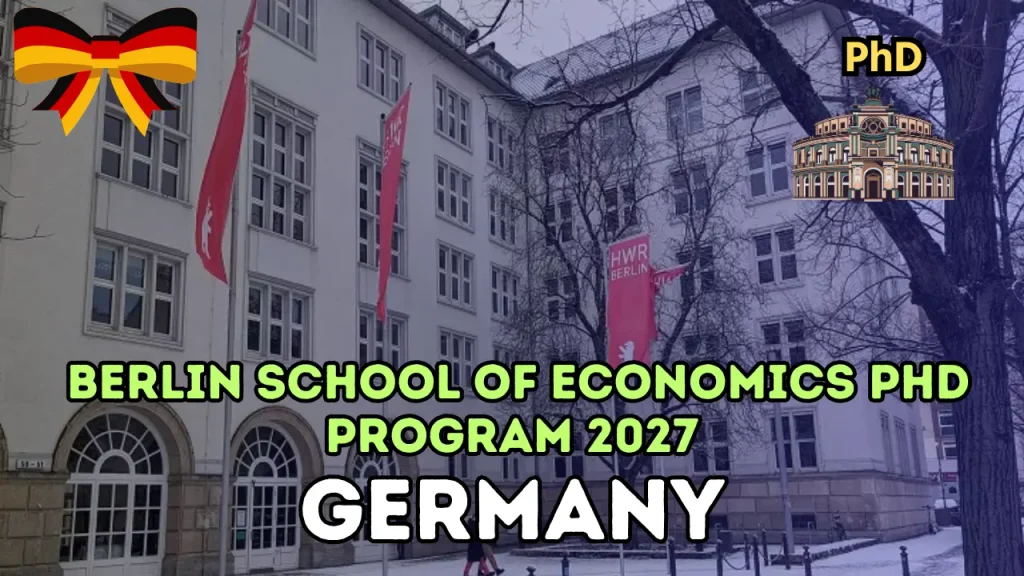
Are you looking to pursue an elite, fully funded doctoral degree in business, economics, finance, or management in Europe? The Berlin School of Economics (BSE) PhD Program 2027 stands out as one of Germany’s premier research initiatives. The Berlin School of Economics PhD Program provides outstanding doctoral students with a vibrant, intensively networked research community. The program develops the students’ talents in a unique combination of a high-level, academic research environment together with applied, policy-oriented research opportunities. Students receive state-of-the-art coursework training and can select from a wide array of specializations. For each specialization, a professional research environment is provided by the universities and economic research institutes participating in the Berlin School of Economics.
Bringing together nine world-renowned academic institutions, research centers, and universities across Berlin, the BSE offers an exceptional platform for early-career researchers. This guide provides details on eligibility, funding benefits, required application materials, living costs, and step-by-step application instructions.
Basic Information About the BSE Scholarships & Key Deadlines
The BSE doctoral program operates on an annual recruitment cycle, admitting top international talents for the academic intake starting in October 2027.
- Host Country: Germany
- Location: Berlin
- Degree Level: Doctor of Philosophy (PhD / Dr. rer. pol.)
- Funding Type: Fully Funded Doctoral Fellowships / Scholarships
- Tuition Fees: €0 / Free
- Target Audience: Open to all nationalities globally
- Application Deadline: January 15, 2027 (CET)
- Academic Reference Letter Deadline: January 19, 2027 (CET)
- Interview Window: March 3 – March 19, 2027
- Final Admission Decisions: Late March 2027
About the Program
- The Berlin School of Economics offers a structured PhD programme in Germany.
- It is a collaboration of nine major universities and research institutions in the Berlin-Brandenburg region.
- The programme provides advanced academic training and opportunities for applied, policy-oriented research.
- Students can choose from four PhD tracks:
- Economics
- Accounting
- Finance
- Management
- Students can select research topics and receive supervision from experienced academics.
- The PhD degree is awarded by one of the participating universities with doctoral degree-awarding authority.
University and Institution Details
The Berlin School of Economics (BSE) operates as a joint doctoral network. Instead of enrolling at an isolated faculty, BSE PhD students benefit from a joint academic environment provided by nine leading academic institutions:
Participating Institutions
The Berlin School of Economics is a collaboration of nine major institutions in the Berlin-Brandenburg region of Germany:
- European University Viadrina Frankfurt (Oder)
- Freie Universität Berlin
- Humboldt-Universität zu Berlin
- Technische Universität Berlin
- University of Potsdam
- ESMT Berlin
- Hertie School
- ROCKWOOL Foundation Berlin Institute for the Economy and the Future of Work (RFBerlin)
- WZB Berlin Social Science Center
This consortium allows doctoral candidates to access extensive library systems, high-performance computing centers, joint seminars, and faculty networks spanning macroeconomics, quantitative finance, and public policy.
Available Study Areas and Academic PhD Tracks
The BSE PhD program structure consists of two phases: a rigorous course-based qualification phase (typically Year 1) followed by a dedicated research phase. The program offers research tracks across four main areas:
The Berlin School of Economics PhD Program offers four different PhD tracks:
1. Core Courses
These are the main compulsory courses:
- Business Analytics and Data Science
- Econometric Methods
- Econometrics I
- Advanced Macroeconomics
- Advanced Microeconomic Theory
2. Elective Courses
Students can choose from different specialised subjects, including:
- Accounting and Financial Research
- Advanced Marketing Modelling
- Applied Econometrics using Stata
- Applied Macroeconomics
- Causal Machine Learning
- Competition Policy
- Crime, Labour and Inequality
- Economic History
- Empirical Labour Economics
- European Economic History
- Organisational Incentives
- Monetary Policy
- Preparatory Mathematics
- Finance Research
- Social Preferences
- Economics of Climate Change
- Labour Market Theory
- Advanced Information Economics
- Urban Economics
3. Seminars
These seminars help students develop research skills and learn about current economic research.
- Applied Labour Economics
- Applied Microeconomics
- Behavioural and Experimental Economics
- Behavioural Economics
- Economic History
- Macroeconomics
- Microeconomic Theory
- Econometrics
- Finance
- Environmental, Resource and Climate Economics
- Quantitative Spatial Economics
- Social Science Research
4. Short Courses
– RFBerlin Masterclass on Racial Inequality in the Labour Market.
The programme has two main phases and normally lasts around five years.
A. Qualification Phase (First 3 Semesters)
- Duration: Approximately 1.5 years.
- Students receive advanced training in:
- Economic theory
- Applied economics
- Business studies
- Econometrics
- Economic policy
- Students complete mandatory and elective courses.
- Students identify their research interests and develop a research proposal.
- They find their first supervisor by the end of the second semester.
- Students must complete at least 90 ECTS credits.
- Students receive a monthly stipend during this phase.
B. Dissertation Phase (Semesters 4–10)
- Duration: Approximately 3 years.
- Students conduct independent research and write their doctoral thesis.
- They find a second supervisor.
- They may participate in:
- Research conferences
- Summer schools
- Academic seminars
- Teaching activities
- Professional research projects
- Students are normally employed by their supervisor’s university department or a participating research institute.
- The programme ends with thesis submission and an oral defence.
Berlin School of Economics PhD Program Financial Benefits
Selected PhD candidates receive full financial support designed to cover living standards in Berlin:
- No tuition fees are charged.
- During the Qualification Phase, students receive:
- Monthly stipend of €1,650.
- Additional family allowance for eligible applicants with children.
- During the Dissertation Phase:
- Students are normally employed by participating universities or research institutions.
- Funding is generally provided through employment.
- Continued funding depends on meeting the programme’s academic performance requirements.
- Students also receive opportunities to work in professional research environments.
Additional fees
- Students must pay a semester contribution of approximately €300–€350 per semester to their degree-awarding university.
- This fee includes access to public transport in Berlin at no additional cost.
Benefits Not Included
While the BSE scholarship package is generous, applicants should budget for the following out-of-pocket expenses:
- Administrative Semester Fees: Partner universities charge a mandatory administrative semester fee of approximately €300 – €350 per semester.
- Health Insurance: Mandatory statutory public health insurance coverage in Germany costs around €150 – €170 per month for students under 30.
- Relocation & Travel Costs: Initial flight tickets, visa application processing fees, and initial security deposits for apartments in Berlin are not covered up front.
- Personal & Family Expenses: Costs related to dependents, accompanying spouses, or private luxury travel must be covered independently.
Eligibility Criteria for the Berlin School of Economics PhD Program
To qualify for admission, candidates must meet the following entry standards
- Applicants should normally have a Master’s degree in Economics or Business Studies.
- Applicants must have an excellent academic record.
- Students from related disciplines may also apply, including:
- Industrial Engineering
- Statistics
- Quantitative Social Sciences
- However, applicants from related fields must have sufficient academic knowledge of economics or business studies.
- Applicants should demonstrate research ability, creativity and a strong interest in academic research.
Can Bachelor’s graduates apply?
– Yes, Bachelor’s graduates may apply if they also apply for a Master’s programme that offers a fast-track option.
GRE requirement:
- GRE General Test scores are highly recommended but not mandatory.
- GRE at Home scores are accepted.
- There is no fixed minimum GRE score.
English language requirement:
- IELTS or TOEFL scores are highly recommended but not mandatory.
- Applicants whose native language is not English may need to demonstrate English proficiency.
- Applicants with a degree from an English-speaking university or at least one year of study at an English-speaking university may be exempt.
- No fixed minimum IELTS or TOEFL score is specified.
German language: Not required for admission.
Required Documents for the Application
Applicants must submit the following documents in English:
1. Motivation Letter
- Maximum 2 pages.
- Explain why you want to join the programme.
- Briefly describe your research interests.
2. Detailed CV
- Academic and professional background.
- No photograph required.
3. Academic Transcripts and Certificates
- Copies of academic transcripts.
- Copies of relevant educational certificates.
4. GRE or GMAT Scores
- GRE is recommended but not mandatory.
- GMAT is accepted only for the Business Administration PhD tracks.
5. IELTS or TOEFL Scores
- Recommended but not mandatory, subject to the English proficiency requirements.
6. Two Academic Reference Letters
- Letters must be submitted directly by the referees through the application portal.
- Referees must submit their letters by January 19, 2027.
- Applicants should contact their referees before entering their names in the application.
Important: Incomplete applications will not be considered
Berlin School of Economics PhD Program Step-by-Step Application Process
- Choose one of the four PhD tracks.
- Review the programme requirements and available research specializations.
- Prepare all required application documents.
- Contact two academic referees in advance.
- Submit your application through the official online application portal during the application period.
- Shortlisted candidates will be invited to an online interview.
- Successful applicants will receive admission decisions at the end of March 2027.
Important: You do not need to find a supervisor before submitting your application. Applications sent by email or outside the official application period will not be accepted.
Tips for a Successful Application
- Sharpen Your Research Statement: Use your motivation letter to outline research questions grounded in current economic literature. Avoid generic statements; specify which BSE faculty research areas align with your aims.
- Highlight Quantitative Skills: Demonstrate proficiency in linear algebra, calculus, real analysis, econometrics, or programming languages like Python, R, Stata, or MATLAB.
- Submit Test Scores Early: Ensure GRE/GMAT and TOEFL/IELTS test dates allow results to reach the portal prior to the deadline.
- Engage Referees Well in Advance: Academic letters carry substantial weight. Provide your referees with your CV, draft motivation letter, and academic transcripts to help them write detailed recommendations.
Monthly Living Expenses for International Students in Berlin (in USD)
While Germany offers an affordable quality of life compared to major metropolitan hubs like London or New York, managing a personal budget is essential. Below is an estimated breakdown of monthly living costs in Berlin converted to US Dollars (USD) ($1 USD ≈ €0.92 EUR):
| Expense Category | Average Monthly Cost (USD) | Budget Range (USD) |
| Housing (Shared Flat / WG Room) | $580 | $500 – $850 |
| Health & Nursing Care Insurance | $165 | $155 – $185 |
| Food & Groceries | $275 | $220 – $350 |
| Utilities (Electricity, Internet, Heating) | $110 | $85 – $150 |
| Public Transit (Semesterticket contribution) | $30 | $25 – $40 |
| Leisure, Sports & Personal Expenses | $160 | $110 – $250 |
| Total Estimated Budget | ~$1,320 / month | $1,100 – $1,825 / month |
The €1,650/month BSE stipend (approx. $1,790 USD) provides a comfortable living cushion for single doctoral students in Berlin.
Why Choose the BSE PhD Program?
- Unrivaled Institutional Synergy: You get direct access to resources, courses, seminars, and faculty networks across nine institutions, including HU Berlin, FU Berlin, ESMT, Hertie School, and DIW Berlin.
- Full Financial Independence: The €1,650 monthly stipend alongside zero tuition fees allows candidates to focus entirely on research without financial strain.
- World-Class Placement Records: BSE graduates regularly secure post-doctoral fellowships, assistant professorships, and researcher placements at institutions like the IMF, World Bank, European Central Bank (ECB), OECD, and top international universities.
- Structured Coursework Foundation: The initial year offers rigorous, structured coursework in core quantitative tools, econometrics, and field electives, providing a solid theoretical foundation.
- Vibrant International Environment: Living in Berlin offers a culturally rich, highly international setting with an affordable cost of living relative to other major Western European capitals.
Frequently Asked Questions (FAQs)
Is German language proficiency required for admission?
No. The entire BSE PhD program—including courses, seminars, and research activities—is conducted in English.
Can I apply if I have not finished my Master’s degree yet?
Yes. You can apply if you are in the final year of your Master’s degree. You must provide current academic transcripts demonstrating strong performance, with enrollment contingent on completing your degree before October 2027.
Do I need to contact a professor to secure a supervisor before applying?
No, pre-arranging a supervisor is not required or expected. Faculty advisors are assigned after completion of the core coursework phase.
Is there an application fee for the BSE PhD program?
No, submitting an application through the official BSE portal is 100% free.
Are international candidates from non-EU countries eligible to apply?
Yes. The BSE PhD Program is open to qualified candidates of all nationalities worldwide.
Important Dates
| Event | Date |
|---|---|
| Information session | December 2, 2026 |
| Application deadline | January 15, 2027 |
| Deadline for reference letters | January 19, 2027 |
| Online interviews | March 3–19, 2027 |
| Admission results | End of March 2027 |
| Programme begins | October 2027 |
Information session: 12:30–14:00 CET.