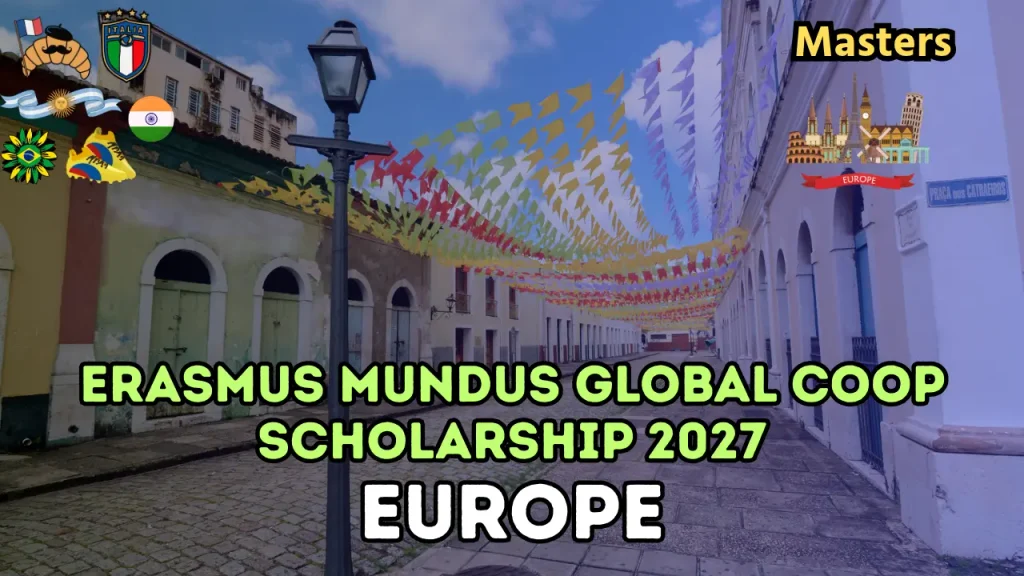
International economics is undergoing a massive transformation. Supply chains are shifting, global financial systems face ongoing instability, and governments everywhere are racing to manage a fair green transition. If you want to be at the forefront of solving these complex challenges—while earning a fully funded master’s degree across multiple continents—the Erasmus Mundus Global COOP Scholarship 2027 is one of the strongest opportunities available.
Backed by the European Union, the GLOBAL COOP (Economic Policies for New Global Cooperation and Alliances) Erasmus Mundus Joint Master (EMJM) allows ambitious graduates from around the world to study at top universities in Europe, Latin America, and Asia. Below is a complete breakdown of the program structure, funding coverage, partner universities, eligibility rules, and step-by-step application instructions for the 2027–2029 intake.
Basic Information about the Scholarship
The Erasmus Mundus Global COOP Master’s program is a two-year (120 ECTS) interdisciplinary postgraduate degree designed to train the next generation of international economists, policy analysts, and researchers. Unlike traditional single-campus master’s degrees, students move between consortium institutions across semesters, gaining firsthand exposure to diverse economic perspectives across both the Global North and the Global South.
- Host Organization: European Union (Erasmus+ / EACEA)
- Program Name: GLOBAL COOP – Economic Policies for New Global Cooperation and Alliances
- Degree Level: Master’s (Erasmus Mundus Joint Master Degree)
- Program Duration: 2 Years (4 Semesters / 2027–2029 academic intake)
- Language of Instruction: 100% English
- Financial Coverage: Fully Funded
- Application Deadline: 27 January 2027 at 13:00 Paris time (CET)
- Late English Proficiency Proof Deadline: 10 June 2027 (for candidates applying with a pending test declaration)
University and Institution Details
The Global COOP program is delivered by a prestigious international consortium spanning six countries across Europe, Latin America, and Asia. It operates closely alongside the well-known EPOG (Economic Policies in the Age of Globalisation) consortium network.
Participating Universities and Their Specialisations
Argentina
Universidad Nacional de San Martín (UNSAM)
- Located in Argentina.
- Specialises in:
- Economic development.
- Energy transition.
- Industrial policy.
- International green governance.
- Digital transformation.
- Offers expertise in political economy and development economics.
Brazil
1. Universidade Estadual de Campinas (UNICAMP)
- Coordinator of the GLOBAL COOP programme.
- One of Latin America’s leading universities.
- Specialises in:
- Political economy.
- Economic development.
- International trade and finance.
- Climate change economics.
- Industrial policy.
- Global economic inequalities.
- Conducts research on climate change and the Amazon rainforest.
2. Universidade Federal do Rio de Janeiro (UFRJ)
- One of Brazil’s leading federal universities.
- Specialises in:
- Development economics.
- Macroeconomics.
- Agriculture and industrial economics.
- Finance and monetary systems.
- Structural economic change.
- Sustainability.
Colombia
Universidad Nacional de Colombia (UNAL)
- One of the leading universities in Latin America.
- Specialises in:
- Environmental conflicts.
- Climate change.
- Environmental sustainability.
- Social and environmental justice.
- Inequality and alternative development models.
- Amazon rainforest and biodiversity research.
France
1. Université de technologie de Compiègne (UTC)
- A leading French engineering institution.
- Specialises in:
- Technology and innovation.
- Digital transformation.
- Sustainable development.
- Technology’s role in economic and social change.
- Maintains strong connections with industry and research institutions.
2. Sorbonne Université (SU)
- A prestigious multidisciplinary research university.
- Specialises in:
- Climate change.
- Ecology and environmental sciences.
- Ocean sciences.
- Environmental transition.
- Social sciences and humanities.
3. Université Sorbonne Nouvelle (USN)
- Specialises in:
- Arts and humanities.
- Social sciences.
- Languages and literature.
- Latin American studies.
- Hosts the Institute for Advanced Studies on Latin America (IHEAL).
Italy
Università degli Studi di Siena (University of Siena)
- Founded in 1240.
- Specialises in:
- Microeconomics.
- Social and economic interactions.
- Economic growth and development.
- Development challenges in the Global South.
- Alternative economic models.
- Integrated Assessment Modelling (IAM).
India (Associate Partner)
Jawaharlal Nehru University (JNU)
- One of India’s leading universities.
- Hosts students during Semester 3 for Track 3.
- Specialises in:
- Informal labour markets.
- Labour economics.
- Informal employment.
- Social and ecological transition.
- Important: JNU is an associate partner and does not award the GLOBAL COOP degree.
Programme Structure and Mobility
The Master’s programme consists of four semesters.
Four-semester study pathway
- Semester 1 – EuropeStudents study in either Paris, France, or Siena, Italy.
- Paris: Option SFC
- Siena: Option IAM
- Semester 2 – Latin AmericaStudents move according to their selected track.
- Track 1: Buenos Aires, Argentina.
- Track 2: Rio de Janeiro, Brazil.
- Track 3: Medellín, Colombia.
- Semester 3 – Brazil or India
- Tracks 1 and 2: Campinas, Brazil.
- Track 3: Delhi, India (JNU).
- Semester 4 – Master’s ThesisStudents complete their Master’s thesis through:
- Research at a relevant laboratory.
- A professional internship.
- A research project related to their chosen field.
Semester 1: Two Study Options
Students can choose between two methodological options.
| Option | Location | Main focus |
|---|---|---|
| SFC | Paris, France | Stock-Flow Consistent Modelling |
| IAM | Siena, Italy | Integrated Assessment Modelling |
- SFC: Focuses on understanding economic relationships through financial flows, stocks, and economic models.
- IAM: Focuses on analysing the relationships between economic activities, environmental changes, and sustainability.
5. Semesters 2 and 3: Three Specialisation Tracks
Students choose one of three major specialisation areas.
Track 1: Reassessing International Trade
- International trade policies.
- Global value chains.
- Economic relationships between developed and developing countries.
- Sustainable international trade.
- Economic challenges facing the Global South.Buenos Aires → Campinas
2nd Track: Reframing the International Monetary and Financial System
- International monetary systems.
- Global financial systems.
- International finance and monetary power.
- Economic inequalities.
- Financial sustainability and development.Rio de Janeiro → Campinas
Track 3: Collaborating for a Just Socioecological Transition
- Climate change and environmental sustainability.
- Social and environmental justice.
- Ecological transition.
- Labour markets and informal employment.
- Inequality and sustainable prosperity.Medellín → Delhi
Study Areas and Available Program Tracks
When applying for the Erasmus Mundus Global COOP Scholarship 2027, candidates must select and rank their preferred specialization direction. All three tracks fall under the umbrella of International Economics and Global Policy, focusing on how nations cooperate amid geopolitical shifts:
The programme combines different areas of economics and development studies:
- Macroeconomics and microeconomics.
- Economic institutions and organisations.
- Critical approaches to economic development.
- International trade and finance.
- Climate change and environmental economics.
- Sustainable development.
- Economic policies in the Global South.
Important Things to Understand
- Students do not study at only one university; they move between partner universities.
- The selected track determines the main academic specialisation and mobility pathway.
- Semester 1 offers two methodological options: SFC and IAM.
- Semesters 2 and 3 provide specialised training through three tracks.
- Semester 4 is dedicated to the Master’s thesis.
- Students may complete their thesis in a research laboratory or through a professional internship.
- The degree awarded depends on the student’s mobility pathway and the programme’s degree policy.
Erasmus Mundus Global COOP Scholarship Benefits
Selected Erasmus Mundus Global COOP scholarship holders receive comprehensive financial support throughout the entire 24-month program:
- Full Tuition Fee Waiver: 100% of university participation and tuition fees across all host institutions are covered directly by the consortium.
- Generous Monthly Stipend: Scholars receive €1,400 per month (approximately $1,500–$1,550 USD, depending on exchange rates) for all 24 months—totaling €33,600 over two years. This stipend is intended to cover housing, food, local transport, travel, and installation costs.
- Comprehensive Health and Accident Insurance: Health and accident insurance that meets the European Commission’s minimum requirements.
- Joint/Multiple Degrees: Graduates earn recognized master’s qualifications from the partner universities where they complete their coursework.
Health and Accident Insurance Coverage
The scholarship includes insurance covering the following:
- Medical treatment, hospitalisation and surgery.
- Doctor’s fees, prescribed medicines and medical examinations.
- Pregnancy and childbirth, subject to the stated conditions.
- Emergency dental treatment.
- Certain mental health conditions.
- Serious illness or accident, including medical repatriation.
- Permanent disability resulting from an accident.
- Death-related expenses, including transportation of remains and funeral costs.
- Third-party liability for physical or property damage.
- Theft or loss of personal belongings, including passports, identity documents, travel tickets and luggage.
Insurance duration:
- Starts when students begin their journey to participate in the Master’s programme.
- Continues throughout the entire enrolment period, including mobility periods.
- Remains valid until two months after the programme ends, unless the student leaves earlier.
Family members: Students’ family members can purchase the same insurance coverage separately at their own expense.
Special Support for Students with Disabilities
- Students with disabilities may receive additional financial or practical support.
- This support may cover:
- Special equipment.
- Personal assistance.
- Workplace or study-environment adjustments.
- Additional travel and transportation expenses.
- Both scholarship holders and non-scholarship students may qualify, provided they meet the relevant conditions.
Other Scholarship Opportunities
- Students who are not selected for an Erasmus Mundus scholarship may apply for other scholarships.
- These alternative scholarships may be available through different funding organisations.
- Applicants can apply for other scholarships alongside their GLOBAL COOP application.
- Applicants may request conditional admission depending on whether they receive alternative funding.
- Many alternative scholarships have early deadlines, sometimes before or at the same time as the GLOBAL COOP application.
Benefits Not Included
While the Erasmus Mundus Global COOP package is one of the most generous scholarships in the world, applicants should understand how the funding is structured and what is not paid separately:
- No Separate Relocation or Flight Lump Sum: Under the current Erasmus+ funding model, travel, visa application fees, and installation costs are folded into your €1,400 monthly allowance rather than paid as separate top-up grants.
- Dependent or Family Allowances: The scholarship only funds the enrolled student; it does not provide extra stipends, visas, or insurance for spouses or children.
- Pre-Arrival Out-of-Pocket Costs: Expenses incurred before your first stipend installment arrives—such as English language test fees, document notarization/translation, passport renewal, initial flight bookings, and upfront housing security deposits—must be paid by you initially.
- Self-Funded Admission Offers: Applicants who pass academic screening but miss the scholarship cutoff may be offered a self-funded place. In that case, tuition fees and living costs are not covered.
Eligibility Criteria for the Erasmus Mundus Global COOP Scholarship
To qualify for the Erasmus Mundus Global COOP Scholarship 2027, applicants must satisfy academic, subject-specific, language, and funding rules:
1. Academic qualification
- A Bachelor’s degree or equivalent qualification worth at least 180 ECTS.
- Bachelor’s GPA must be at least 70% of the maximum grading scale.
- Normally, applicants need:
- At least 24 ECTS (or equivalent) in Economics.
- At least 6 ECTS in Statistics or Econometrics.
- Applicants from other academic backgrounds can apply if they meet these subject-credit requirements.
- Applicants graduating by July 31, 2027, may receive provisional admission but must submit their degree certificate by August 31, 2027.
Special requirement for Track 1 – Reassessing International Trade:
- A four-year Bachelor’s degree; or
- A three-year Bachelor’s degree plus one year of Master’s education.
2. English language proficiency
Applicants must demonstrate English proficiency through one of the following:
| English test | Minimum score |
|---|---|
| IELTS Academic | 7.0 |
| TOEFL iBT | 95 |
| CEFR | C1 |
| PTE Academic | 67 |
| Cambridge C1 Advanced | Grade B |
| Cambridge C2 Proficiency | Grade C |
- English test results must be submitted by June 10, 2027.
- Applicants whose entire higher education was taught in English may be exempt.
- Native English speakers are also exempt.
- A GRE score may be accepted as proof of English proficiency if it meets the specified minimum scores.
3. Motivation
- Applicants must demonstrate a strong interest in the programme.
- They should show an understanding of alternative or heterodox approaches to Economics.
- Their academic background, experience, and future career goals should align with the programme.
Additional language skills:
Knowledge of French, Italian, Portuguese, Spanish, or Hindi is not compulsory but may strengthen an application.
Nationality and Scholarship Selection
- Applicants with dual nationality must select one nationality when submitting their scholarship application.
- They are encouraged to mention both nationalities in their application.
- To ensure geographical diversity, normally no more than 10% of scholarship recipients should have the same nationality.
- Applicants beyond this 10% limit may still be admitted to the programme but without an Erasmus Mundus scholarship.
- The 10% nationality restriction does not apply to additional scholarships for targeted regions.
Important Restrictions
- You cannot receive another EU-funded scholarship for the same Erasmus Mundus Master’s programme.
- You cannot receive an Erasmus Mundus scholarship again if you have previously received one.
- Admission to the Master’s programme does not automatically guarantee a scholarship
Selection Criteria
Applications are evaluated based on the following criteria:
| Selection criteria | Weight |
|---|---|
| Educational background and relevant experience | 15% |
| Academic performance (Bachelor’s GPA) | 35% |
| Motivation and recommendation letters | 20% |
| English and additional language proficiency | 30% |
| Total | 100% |
Minimum academic requirement:
– Bachelor’s GPA must be at least 70% of the maximum grading scale.
Required Documents for the Application
Applicants must upload the following documents through the online application portal:
- Completed online application form.
- Full CV: Europass format is recommended but not compulsory.
- Bachelor’s degree certificate: Scanned copy of the original diploma.
- Academic transcripts: Complete academic records of all higher education studies.
- English language proficiency certificate: IELTS, TOEFL, or another accepted test, unless exempt.
- Statement of Purpose: Maximum 500 words.
- Two recommendation letters: From university teachers/professors or employment supervisors.
- Valid passport: Scanned copy as proof of nationality.
- Other funding information: Details of any additional or expected scholarship funding (optional).
Statement of Purpose Requirements
The Statement of Purpose must not exceed 500 words.
It should explain:
- Why you want to join the GLOBAL COOP programme.
- Your relevant academic background and experience.
- Your research or professional interests.
- Your future career plans.
- Your preferred Major(s) and Minor(s), including their order of preference.
Important document requirements:
- Documents not issued in English must be accompanied by English translations.
- Initially, unofficial translations may be accepted.
- Selected students must provide certified English translations by June 10, 2027.
- Applicants expecting to graduate by July 31 must submit a sworn statement confirming their expected graduation date.
- Recommendation letters should include the referee’s name, position, institution, signature, official stamp (if available), and contact details.
Erasmus Mundus Global COOP Scholarship Application Process (Step-by-Step Guide)
The Global COOP program uses a single integrated application for both university admission and the Erasmus Mundus scholarship—no separate scholarship form is required.
- Review the Official Admission Instructions: Visit the official GLOBAL COOP / EPOG consortium portal and download the 2027–2029 Admission Guidelines to verify track-specific credit and degree conditions.
- Choose and Rank Your Study Tracks: Decide which of the three specialization tracks aligns best with your academic background and rank your preferred Semester 1 host university (France or Italy).
- Create an Account on the Joint Application Platform: Register on the unified EPOG and GLOBAL COOP online admissions portal and select the GLOBAL COOP two-year 2027–2029 programme.
- Fill Out Academic and Personal Details: Enter your educational history, GPA/percentage scores, credit breakdown, and language qualifications accurately without inventing custom GPA conversions.
- Upload Supporting Documents: Attach all required transcripts, degree certificates, ID, CV, and your 500-word Statement of Purpose.
- Register Your Referees Early: Submit your referees’ institutional email addresses well ahead of the deadline so they have plenty of time to upload their recommendation letters.
- Submit Before the Deadline: Double-check every section and submit your completed file before 27 January 2027 at 13:00 Paris time.
- Attend the Selection Interview (If Shortlisted): Shortlisted candidates will be invited to an online video interview to discuss their economics preparation and research motivation.
Important Instructions
- Applications must be submitted online only.
- Do not send application documents by email.
- Prepare recommendation letters early because collecting them can take time.
- Carefully select your preferred tracks and Major/Minor combinations.
- All students must participate in compulsory physical mobility, whether they receive an Erasmus Mundus scholarship or not.
- Outstanding candidates who do not strictly meet certain minimum requirements may still apply under specific conditions. If accepted, they may be required to complete additional courses.
Tips for a Successful Application
- Anchor Your 500-Word Statement in a Real Policy Question: With a strict 500-word limit, avoid vague clichés about “wanting to change the world.” State the quantitative and economic tools you already know, name a concrete policy challenge (such as carbon border adjustments, sovereign debt restructuring, or supply-chain reshoring), and explain why your chosen track is the exact vehicle to answer it.
- Prove Your Quantitative Readiness Clearly: Even if your bachelor’s degree isn’t titled “Economics,” highlight every course in macroeconomics, microeconomics, calculus, statistics, or econometrics on your transcript and attach a clean credit-conversion sheet.
- Clarify Final-Year Graduation Dates Early: If your university issues final degrees in August rather than July, email the consortium admissions team for written confirmation before submitting your file.
- Think Carefully About Self-Funded Options: The application form asks whether you want to be considered for a self-funded place if you do not win the scholarship. Only select this option if you genuinely have the financial means to pay tuition and living expenses without EU funding.
Monthly Living Expenses for International Students (in USD)
Because Global COOP takes you across Europe (France or Italy) and emerging global hubs (Argentina, Brazil, Colombia, or India), your living costs will shift each semester. Your monthly Erasmus Mundus stipend of €1,400 (approx. $1,520 USD) comfortably covers student expenses in every consortium country when budgeted wisely.
| Expense Category | Europe (Paris / Siena) | Latin America & India (Buenos Aires, Rio/Campinas, Bogotá, New Delhi) |
| Student Housing / Shared Apartment | $550 – $850 USD | $250 – $450 USD |
| Groceries & Daily Meals | $250 – $350 USD | $150 – $250 USD |
| Local Public Transportation | $45 – $95 USD | $20 – $50 USD |
| Utilities, Internet & Mobile Data | $60 – $100 USD | $35 – $65 USD |
| Books, Study Materials & Personal | $100 – $150 USD | $80 – $120 USD |
| Estimated Monthly Total | $1,005 – $1,545 USD | $535 – $935 USD |
Pro Tip: Many scholars save extra funds during their semesters in Latin America or India—where living costs are significantly lower—to help offset intercontinental flights and higher rent in Paris or Italy.
Why Choose the Erasmus Mundus Global COOP Scholarship?
- True Multi-Continental Perspective: Unlike programs restricted solely to Europe, Global COOP immerses you in both European economic institutions and major Global South economies (Brazil, Argentina, Colombia, or India), giving you unmatched insight into global North-South economic cooperation.
- Complete Financial Freedom: With tuition waived, comprehensive health insurance included, and €1,400/month ($1,520+ USD) in your pocket for two full years, you can focus 100% on academic excellence rather than financial stress.
- Cutting-Edge Economic Modeling Skills: Semester 1 equips you with high-demand quantitative methodologies—either Stock-Flow Consistent (SFC) modeling in France or Integrated Assessment Modeling (IAM) in Italy—skills heavily sought after by central banks, think tanks, and international organizations.
- High-Impact Career Launchpad: Graduates of Erasmus Mundus economics consortia regularly secure positions at the World Bank, IMF, OECD, European Central Bank, UN agencies, national ministries, and top PhD programs worldwide.
- Lifelong Global Network: Studying alongside an international cohort selected from dozens of countries builds a lifelong professional and personal network across three continents.
Frequently Asked Questions (FAQs)
1. Can I apply for the Global COOP Scholarship 2027 without IELTS? Yes. While the standard English requirement is IELTS Academic 7.0, TOEFL iBT 95, or PTE Academic 67, candidates who completed their entire previous university degree in English can apply for an English test exemption. You can also apply with a pending test declaration as long as your official score is submitted by 10 June 2027.
2. Is there an application fee to apply for Global COOP?No, the reviewed admission instructions do not list an application fee to submit your joint admission and scholarship application.
3. Can I apply if I already hold a Master’s degree?Yes. Having a previous or ongoing master’s degree does not disqualify you from admission or the scholarship, provided you have never previously received an Erasmus Mundus Joint Master scholarship.
4. Do I need to submit a separate application for the scholarship? No. Submitting your online application through the joint EPOG/GLOBAL COOP platform automatically enters you for both program admission and full Erasmus Mundus scholarship consideration.
5. What happens if I am not selected for the Erasmus Mundus scholarship? Strong candidates who meet academic standards but fall just outside the scholarship quota may be offered a self-funded spot in the program (if they opted into consideration on the application form).
6. Is the Europass CV format mandatory? No. While the consortium recommends using the Europass template, any clean, well-structured academic CV that clearly highlights your economics and quantitative coursework is accepted.
Important Dates
| Activity | Date |
|---|---|
| Application platform opens | October 2026 |
| Application deadline | January 27, 2027, 1:00 PM (Paris time) |
| Online interviews | March 2027 |
| Final selection results | End of March 2027 |
| English proficiency certificate deadline | June 10, 2027 |
| Degree certificate deadline for provisional graduates | August 31, 2027 |