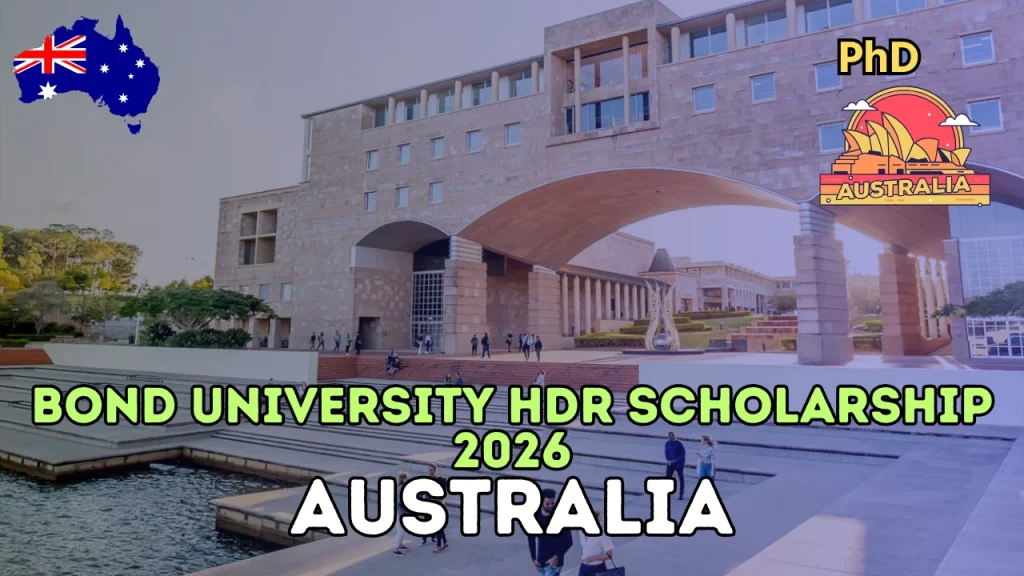
Bond University HDR Scholarship 2026 in Australia is a fully funded higher degree by research (HDR) opportunity for outstanding international and domestic students who want to pursue a PhD or professional doctorate in a top Australian university. This guide covers all key details you need for a strong, search‑optimized and successful application for the 2026 intake.
Basic information about Bond University HDR Scholarship 2026
The Bond University HDR Scholarship 2026 is designed for students enrolling in a Higher Degree by Research (PhD or eligible professional doctorate) at Bond University in Queensland, Australia. It is supported by the Australian Government Research Training Program (RTP) and combines a 100% tuition fee offset with a generous living stipend and additional research allowances.
Key points:
- Host country: Australia.
- Host institution: Bond University, Gold Coast, Queensland.
- Degree level: PhD and Professional Doctorate by Research (including Occupational Therapy).
- Scholarship type: Fully funded HDR scholarship (fee offset + stipend + allowances).
- Eligible nationalities: All countries, including international and domestic applicants.
Application rounds and deadlines for the 2026 HDR intake (Bond University HDR Scholarship 2026):
There are two scholarship rounds covering the 2026 academic year.
- Round 1: 1 February – 31 March 2025 (for early 2026 commencements).
- Round 2: 1 August – 30 September 2025 (for late 2026 commencements).
You must submit both your HDR program application and your scholarship application within these windows to be considered.
Bond University overview (university details)
Bond University is Australia’s first private, not‑for‑profit university and is consistently ranked number one in the country for student experience. The campus is located on the Gold Coast in Queensland, offering a modern, well‑equipped environment with strong links to industry and research partners.
Important university features for HDR students:
- Strong focus on personalised learning and close supervision for research students.
- Access to advanced laboratories, libraries, and research infrastructure across business, health, law, and design disciplines.
- Competitive HDR scholarship program administered by the Bond University HDR Scholarships Committee.
For HDR scholarships, Bond University uses a merit‑based selection process that considers academic excellence, research potential, and alignment with the university’s research priorities.
Study areas and available HDR programs
Bond University HDR Scholarships 2026 are open across most research‑active faculties at the university. Students can apply for PhD programs in the following broad fields:
- Doctor of Philosophy (PhD)
- Professional Doctorate of Occupational Therapy
- Bond Business School.
- Health Sciences and Medicine.
- Law.
- Society and Design.
Within these faculties, applicants can choose from a variety of PhD and professional doctorate research topics, depending on supervisor availability and faculty research strengths. A valid Letter of Offer for an HDR program at Bond is required before you submit the scholarship application.
Types of HDR Scholarships
1. Bond University Postgraduate Research Scholarship (BUPRS)
- Awarded by the HDR Scholarships Committee
- Based on:
- Academic excellence
- Research potential
- Stipend: Up to 3 years
2. Australian Government RTP Scholarship
- Covers:
- Living stipend
- Fee waivers
- Awarded through a competitive, merit-based process
- Governed by:
- Commonwealth Scholarship Guidelines (Research) 2017
- Stipend: Up to 3 years
3. HDR Indigenous Scholarship
- For Aboriginal and/or Torres Strait Islander students
- Based on:
- Merit
- Meeting eligibility criteria
- Includes:
- Living stipend (up to 3 years)
- 100% fee waiver under RTP
- Additional requirement:
- Proof of Indigenous status (ABSTUDY definition)
Bond University HDR Scholarship benefits
The Bond University HDR Scholarship 2026 is often promoted as a fully funded PhD scholarship in Australia because it covers most major costs of undertaking a research degree. For high‑achieving international students, this makes studying in Australia significantly more affordable.
Main benefits:
- 100% tuition fee offset: Full fee waiver for up to 4 years of your doctoral program via the RTP Fees Offset scholarship.
- Living stipend: Annual tax‑free stipend $34,315 per year (indexed), paid for up to 3 years to support day‑to‑day living expenses.
- Overseas Student Health Cover (OSHC): Standard OSHC for international students covered under RTP allowances.
- Relocation allowance: Contribution towards relocation costs for eligible international HDR candidates.
- Research and publication support: Assistance with academic publication costs and access to high‑quality research facilities and supervisory support.
- Leave entitlements: Paid sick, parental, and maternity leave as per scholarship conditions.
The combination of fee waiver, stipend, and research support makes this one of the most attractive HDR scholarships in Australia for 2026.
Benefits not included
Although the Bond HDR Scholarship 2026 is generous, it does not cover every possible cost an international PhD student might face in Australia.
Common expenses not covered include:
- Visa application fees and associated biometrics or medical checks.
- Airfares to and from Australia (beyond any small relocation support).
- Personal expenses beyond the stipend, such as entertainment, luxury items, or family costs.
- Dependants’ school fees and additional health insurance not included in standard OSHC.
- Optional conferences or fieldwork that exceed available research support allocations.
You should plan a realistic budget and keep some personal savings to handle extra living or study‑related costs not covered by the scholarship.
Eligibility criteria for Bond University HDR Scholarship 2026
To be competitive for the Bond University HDR Scholarship 2026 in Australia, you must meet specific academic and administrative criteria.
Core eligibility requirements:
- Be applying for or enrolled in a PhD or Professional Doctorate
- Have submitted a Bond University program application
- Intend to study full-time
- Not hold an equivalent Australian Government HDR scholarship
- If previously unsuccessful:
- You may apply one more time, explaining changed circumstances
- No further applications allowed after a second unsuccessful attempt
- Scholarships are awarded based on:
- Competitive, merit-based selection
- Equity and fairness, regardless of discipline or funding source
Selection Criteria
- Academic merit
- Research potential
- Assessed by the Bond University Research Scholarship Panel
- The University selects the most meritorious applicants, considering factors such as:
- First Class Honours
- Indigenous background
- Industry experience
- First-time doctoral candidates
Required documents for the application
To submit a strong and complete application for the Bond University HDR Scholarship 2026, prepare all necessary documents early.
Typical required documents include:
- Research project proposal
- Academic transcripts (with grading scales and completion proof)
- Curriculum vitae (CV)
- Include publications and conference presentations (if any)
- Evidence of prizes or awards
- Contact details of two referees
- Proof of Indigenous status (if applying for HDR Indigenous Scholarship)
- Any prior publications, conference papers, or research outputs (if available).
Having these documents ready will help you meet the short scholarship windows in February–March and August–September 2025.
Bond University HDR Scholarship Step‑by‑step application process
The Bond HDR Scholarship application process occurs in several stages and must be followed carefully to avoid disqualification.
- Submit an Expression of Interest (EOI) to your faculty
- Contact the relevant Bond faculty (Business, Health, Law, Society & Design) and submit an HDR EOI form.
- Outline your proposed research topic and check supervisor availability.
- Receive feedback and proceed to formal HDR application
- If your EOI is successful, the faculty will invite you to lodge a formal application for admission into a PhD or professional doctorate program.
- At this stage, refine your research proposal and confirm supervision arrangements.
- Apply for admission to Bond University HDR program
- Complete the online HDR application form and upload all required documents (transcripts, CV, proposal, English test, etc.).
- Wait for a decision on your admission; if successful, you will receive a Letter of Offer.
- Apply for Bond University HDR Scholarship 2026
- Once you have a valid Letter of Offer, complete the separate online HDR scholarship application form during the open round.
- Ensure you apply between 1 February – 31 March 2025 or 1 August – 30 September 2025.
- Scholarship assessment by HDR Scholarships Committee
- Applications are assessed biannually on academic merit, research potential, and strategic alignment.
- Only a limited number of fully funded HDR scholarships are available.
- Receive scholarship outcome and accept offer
- Successful applicants receive a scholarship offer detailing stipend, fee waiver, and terms.
- You must formally accept both your HDR place and scholarship and then proceed with student visa and enrolment steps.
Tips for a successful Bond HDR Scholarship application
To increase your chances of winning the Bond University HDR Scholarship 2026 in Australia, focus on academic excellence and a clear, impactful research plan.
Practical tips:
- Start early: Begin preparing your EOI, research proposal, and documents at least a few months before the application window opens.
- Align with faculty strengths: Choose a topic that matches Bond’s existing research projects and supervisor expertise.
- Demonstrate research potential: Highlight publications, dissertations, conference presentations, or research work experience.
- Craft a clear, feasible proposal: Show clear objectives, methodology, and potential impact within a realistic timeframe.
- Secure strong references: Ask referees who know your research ability to provide detailed, positive recommendations.
- Meet all formal requirements: Double‑check English language scores, academic prerequisites, and document completeness before submission.
- Apply in the earliest round possible: This can give you more time for visa processing and planning your move to Australia.
Estimated monthly living expenses in Australia (in USD)
The stipend for Bond University HDR Scholarship 2026 is paid in Australian dollars, but planning in USD can help international students budget better. Costs vary by lifestyle, but the Gold Coast is generally slightly more affordable than Sydney or Melbourne.
Using typical international student expenditure, an approximate monthly budget might look like this (converted to USD using a reasonable recent exchange rate):
- Accommodation (shared apartment or student housing): 700–950 USD per month.
- Food and groceries: 300–450 USD per month.
- Local transport: 80–130 USD per month (public transport and occasional rideshare).
- Utilities and internet (if not included in rent): 80–120 USD per month.
- Mobile phone plan: 25–40 USD per month.
- Study materials and printing: 40–70 USD per month (average over the year).
- Personal expenses and recreation: 150–250 USD per month.
In total, many international HDR students on the Gold Coast might need roughly 1,375–2,015 USD per month to live comfortably, which is broadly in line with what a full‑time HDR stipend is intended to support when converted from AUD.
Why choose Bond University HDR Scholarship 2026? (at least 5 reasons)
The Bond University HDR Scholarship 2026 is one of the most attractive fully funded PhD opportunities in Australia for international students.
Key reasons to choose this scholarship:
- Fully funded package: 100% tuition fee waiver plus a competitive living stipend for up to 3 years makes a research degree financially accessible.
- World‑class supervision and facilities: HDR scholars work with experienced supervisors in modern labs and research environments across multiple disciplines.
- Strong international recognition: Bond University is known for excellent student experience and quality teaching, enhancing your CV and global career prospects.
- Supportive research environment: Scholarship benefits such as OSHC, relocation allowance, and publication support reduce stress and let you focus on your PhD.
- Ideal location: The Gold Coast offers a safe, vibrant, coastal lifestyle with a relatively lower cost of living than some other major Australian cities.
- Competitive but transparent selection: Clear eligibility criteria and structured rounds help applicants plan strategically for their HDR journey.
Frequently asked questions (FAQ)
1. Who can apply for the scholarship?
Both domestic and international students from any nationality can apply, provided they meet the academic and English language requirements for a PhD or professional doctorate at Bond University.
2. What stipend amount can I expect?
Recent scholarship rounds list a stipend of around AUD 33,511–34,315 per year, indexed annually, for up to 3 years. Exact amounts for 2026 will follow the latest RTP rates.
3. Can I work part‑time while on the HDR scholarship?
HDR students in Australia can typically work limited hours in line with visa conditions, but you must remain enrolled full‑time and maintain satisfactory progress. Always check current Australian student visa rules before relying on work income.
4. Do I need a supervisor before I apply?
Yes, you generally need faculty support and a viable supervision arrangement established through the Expression of Interest stage before lodging a full HDR and scholarship application.
5. Can I apply if I already hold another full HDR scholarship?
No, applicants who are receiving an equivalent scholarship from the Australian Government or another source designed to offset HDR fees are not eligible for this Bond HDR scholarship.
Application Deadline: The Application Portal is open from 1 February to 31 March 2026 & 1 August – 30 September 2026.
Official Link:
Central Queensland University RTP Scholarship 2026 in Australia