Sokendai KEK Summer Student Program 2026 in Japan is a fully funded research opportunity for talented undergraduate and early graduate students in physics and related fields who want hands‑on experience at a world‑class accelerator laboratory.
Basic Information about the Program
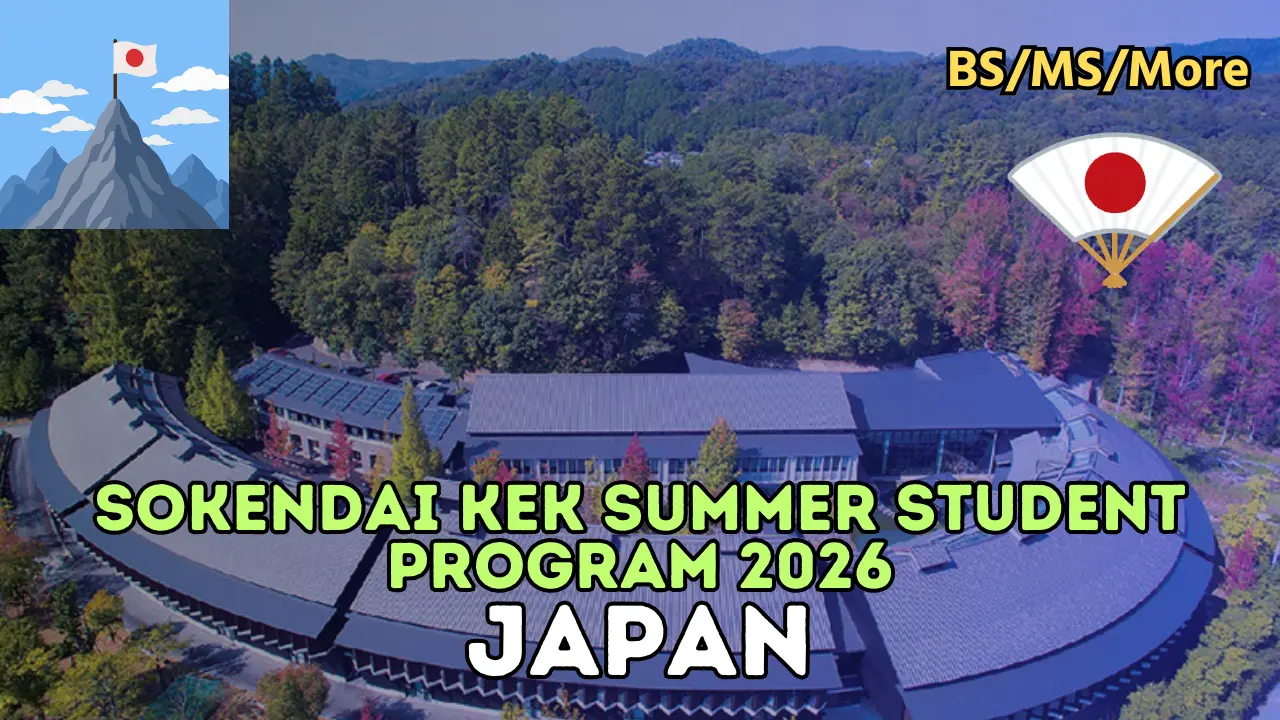
SOKENDAI KEK Tsukuba/J‑PARC Summer Student Program 2026 is a short‑term research program hosted by KEK (High Energy Accelerator Research Organization) in Japan and financially supported mainly by SOKENDAI, the Graduate University for Advanced Studies. Selected students join research groups at KEK Tsukuba campus or J‑PARC Tokai campus and work on cutting‑edge projects in particle physics, nuclear physics, materials science, and accelerator science.
Key points:
- Host country: Japan.
- Location: KEK Tsukuba campus and J‑PARC (Japan Proton Accelerator Research Complex) in Tokai.
- Duration: Up to 8 weeks, typically from mid‑June to mid‑August 2026 (up to 4 weeks for theory groups).
- Program type: Research‑oriented summer student program.
- Funding: Major part covered by SOKENDAI; the program is advertised as fully funded by many scholarship platforms.
Application deadline 2026
According to the official 2026 call, the application deadline is:
- February 27, 2026 (Friday) at 9:00 AM Japan time.
University / Institution Details
The program is jointly associated with:
- KEK (High Energy Accelerator Research Organization): Japan’s leading accelerator‑based research center, hosting large‑scale facilities for elementary particle physics, nuclear physics, materials and life sciences, and accelerator science.
- SOKENDAI (The Graduate University for Advanced Studies): A national university that offers advanced graduate programs in collaboration with inter‑university research institutes like KEK.
- About KEK
- KEK (High Energy Accelerator Research Organization) is a leading accelerator research institute in Japan
- Conducts research on:
- Origin of the universe
- Fundamental particles and matter
- Material and life sciences
- Uses high-energy particle beams and synchrotron light sources
- KEK Campuses
- Tsukuba Campus
- Belle II experiment with SuperKEKB collider
- Studies New Physics beyond the Standard Model
- Photon Factory for material and life science research
- Tokai Campus
- Hosts J-PARC (Japan Proton Accelerator Research Complex)
- World-class high-intensity proton beam facility
- Jointly operated by KEK and JAEA
- Tsukuba Campus
Program Purpose
- Part of KEK’s educational mission
- Offers hands-on research opportunities for:
- Japanese students
- International students
- Students work directly on ongoing experimental, theoretical, or technical research
Program Structure
- Students are assigned to a research group at:
- KEK Tsukuba Campus or
- J-PARC Tokai Campus
- Research conducted under KEK researchers’ supervision
- Possible collaboration with:
- SOKENDAI students
- Postdoctoral researchers
- This is the 5th edition of the program
- About 21 students participated last year
- Similar number of participants expected in 2026
Research Fields Available
- Particle Physics
- Belle II
- Neutrino (T2K, HK)
- Muon experiments
- ATLAS, ILC
- CMB/DM experiments
- Nuclear & Hadron Physics
- Material & Life Science
- X-ray and neutron diffraction
- Structural biology
- Crystallography
- Accelerator Science
- SuperKEKB accelerator
- J-PARC accelerator
- Advanced Detection Systems
- Sensors, electronics, computing
- Theory
- Computational quantum field theory (Lattice QCD)
Sokendai KEK Summer Student Program Benefits
The Sokendai KEK Summer Student Program 2026 is widely promoted as a fully funded summer program for international students in Japan.
For Non-Japanese University Students
- International airfare
- Dormitory accommodation
- Per diem: ¥1,500/day
- Domestic travel (airport ↔ KEK/J-PARC)
For Japanese University Students
- Dormitory accommodation
- Per diem: ¥1,500/day
- Domestic travel
- ❌ Insurance costs not covered
Because exact funding details can vary slightly by year, applicants should always confirm the latest benefits on the official program page.
Benefits Not Included
Although the Sokendai KEK Summer Student Program 2026 is highly generous, not every expense will be covered.
Typically not included:
- Personal leisure travel and tourism costs during your stay.
- Optional insurance upgrades or private health insurance beyond what the program specifies.
- Visa and medical insurance not covered
- Personal expenses such as shopping, entertainment, and non‑program meals.
Always read the official guidelines carefully to know exactly which items fall outside the fully funded package.
Eligibility Criteria for the Sokendai KEK Summer Student Program
The KEK Summer Student Program targets strong students with a background in physics or related areas.
Typical eligibility criteria for Sokendai KEK 2025/2026 (subject to official confirmation) include:
- Students in:
- Latter half of undergraduate studies
- Early Master’s course (PhD students not eligible)
- Status as of March 1, 2026
- Background in:
- Dynamics
- Electromagnetism
- Quantum mechanics (recommended, not mandatory)
- Eligibility depends on matching with host research group
Stay Period
- Duration: Up to 8 weeks
- Mid-June to mid-August
- Theory group: maximum 4 weeks
- Start date:
- Chosen from 3 options (mid-June to mid-July)
- Exact date not freely selectable
- Joint sessions:
- Held mid- to late July
- Students should attend at least one session
- No extension allowed for personal or other reasons
Selection & Results
- Based on application documents
- Interview may be conducted online if needed
- Results announced by April 17, 2026
Required Documents for the Application
Applicants to the Sokendai KEK Summer Student Program 2026 must prepare a set of academic and supporting documents.
Commonly required documents:
- Curriculum Vitae (CV) with academic background and research interests.
- Official transcript of academic records; if not in English or Japanese, an abridged English translation is often required.
- Application form (downloaded from the program website and filled in carefully).
- Copy of passport (for identification and travel arrangements).
- At least one recommendation letter from a supervisor or researcher familiar with the applicant’s recent work; the referee usually submits this directly via the specified system or email.
Applicants must include their assigned ID number in the filename of all uploaded documents, as explicitly requested in recent application guidelines.
Sokendai KEK Summer Student Program Application Process (Step‑by‑Step Guide)
The Sokendai KEK Summer Student Program 2026 application process is straightforward but competitive.
A typical step‑by‑step process:
- Registration
- Complete online registration
- Receive an applicant ID
- Arrange a recommender in advance
- Submission of Documents
- CV
- Academic transcript (English/Japanese)
- Application form (Word)
- Recommendation letter (submitted by recommender)
- File size limit: 5MB
- ID number must be included in all filenames
Following this process carefully is essential for a strong application to this fully funded summer program in Japan.
Tips for a Successful Application
To stand out in this competitive physics summer school in Japan, you should pay attention to details and show clear motivation.
Practical tips:
- Align your motivation statement with KEK’s research fields such as particle physics, nuclear physics, or accelerator science, and mention why KEK facilities like J‑PARC interest you.
- Highlight relevant coursework and projects in quantum mechanics, electromagnetism, programming, or data analysis in your CV and application form.
- Ask a recommender who knows your scientific potential and can write specific comments about your skills and research interest.
- Ensure your documents are well‑organized, clearly named with your ID, and free from spelling or formatting errors.
- Apply as early as possible so your supervisor has enough time to submit a strong recommendation letter before the deadline.
Monthly Living Expenses for International Students (in USD)
The Sokendai KEK Summer Student Program covers most major costs, but understanding typical living expenses in Japan is important for planning.
Approximate monthly living expenses for a student in Tsukuba/Tokai area:
- Food: 350–500 USD (eating mainly at cafeterias and cooking at home).
- Local transportation: 60–120 USD, depending on commuting needs and weekend travel.
- Personal expenses (phone, toiletries, occasional outings): 100–200 USD.
Accommodation is normally covered by the program, which significantly reduces total monthly costs. With the provided daily allowance (for example, about 1 500 JPY per day in some years), many students can comfortably cover a large part of their monthly expenses for food and transport during this fully funded summer research internship in Japan.
Why Choose This Scholarship? (At Least 5 Reasons)
Choosing the Sokendai KEK Summer Student Program 2026 can be a strategic step for any student interested in a research career in physics or engineering.
Key reasons:
- World‑class research environment
KEK and J‑PARC host some of the most advanced accelerator and detector facilities in the world, giving students direct exposure to real‑scale experiments in particle and nuclear physics. - Fully funded opportunity in Japan
With airfare, accommodation, and daily allowance provided, this program removes most financial barriers and lets you focus entirely on research and cultural experiences. - Hands‑on mentoring by experts
Participants work in active research groups, supervised by experienced scientists and often collaborating with SOKENDAI PhD students and postdocs. - CV and career boost
A summer research internship at KEK is impressive on any academic CV, particularly if you plan to apply for competitive PhD programs or research positions in physics, data science, or engineering. - International networking and cultural exchange
The program gathers students from all over the world, building a diverse community and giving you the chance to experience Japanese culture, language, and daily life. - Gateway to SOKENDAI graduate programs
Since SOKENDAI is a key partner and funder, participating in this summer program can be an excellent introduction to its graduate schools and long‑term study options in Japan.
These features make the Sokendai KEK Summer Student Program one of the most attractive fully funded summer research programs for international students in Japan.
Frequently Asked Questions (FAQ)
1. Who can apply for the program?
The program is open to both international and Japanese students who are in the latter half of their undergraduate studies or in an early master’s stage in physics or closely related fields.
2. Do I need an English test score like IELTS or TOEFL?
Recent calls do not require IELTS or TOEFL; instead, good working knowledge of English is expected because research activities, communication, and seminars are conducted in English.
3. Where will I stay during the program?
Accommodation is normally arranged by the organizers near KEK Tsukuba or J‑PARC Tokai, and the cost is covered as part of the fully funded package.
4. Can I choose my own research topic?
You can express preferred fields or groups, but the final assignment is decided by the program based on your background, the availability of supervisors, and ongoing projects.
5. When will I know the result of my application?
Selection results are generally communicated by mid‑April (for 2026, the guideline mentions notification by around April 17, 2026).
Application Deadline
- February 27, 2026
- 9:00 AM (Japan Time)
- All documents and recommendation letters must be submitted by this date