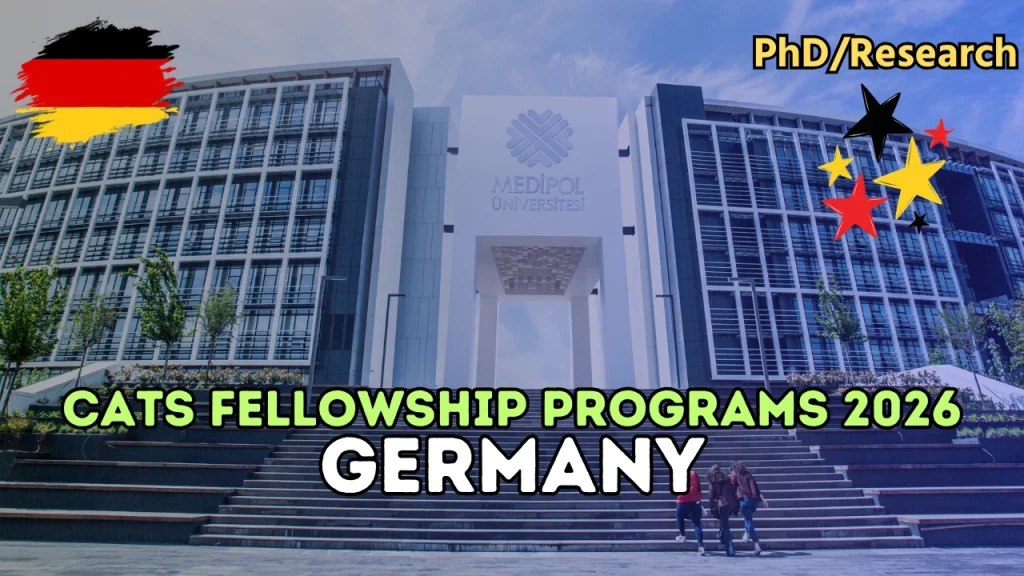
The CATS Fellowship Programs 2026 in Germany offer a fully funded research opportunity in Berlin for scholars, think tank professionals, and practitioners working on Turkey-related issues. Hosted by the Centre for Applied Turkey Studies (CATS) at the German Institute for International and Security Affairs (SWP), the fellowship runs for 6 to 12 months, provides a monthly grant of €2,800 to €3,000, and supports travel, research trips, and in some cases family-related costs.
Basic Information about the Fellowship
- Program name: CATS Fellowship Programs 2026 in Germany.
- Host country: Germany.
- Offered by: Centre for Applied Turkey Studies
- Location: Berlin
- Duration: 6–12 months (starting from September 2026)
- Monthly grant: €3,000 + travel & research budget
- Must stay in Berlin during fellowship
- Program type: Fully funded research fellowship.
- Application deadline:
- One 2026 source lists 30 April 2026.
- Several 2025/2026 cycle sources previously listed 12-15 May deadlines for earlier rounds, so applicants should verify the exact current cycle notice before submission.
University/Institution Details
The fellowship is not tied to a traditional university degree program. Instead, it is hosted by CATS, which operates within Stiftung Wissenschaft und Politik (SWP) in Berlin, one of Germany’s leading foreign and security policy think tanks. This makes the program especially valuable for applicants searching for Germany policy fellowship 2026, Berlin research fellowship, or Turkey studies fellowship in Europe, because it combines serious research with policy relevance in a major European policy hub
Fellowship Topics
- Digitalisation & AI
- Turkey’s AI strategy & global position
- AI in defence, cyber security, and governance
- Impact on politics, economy, labour
- Critical Raw Materials (CRMs)
- Turkey’s mineral resources & policies
- Role in foreign policy & global competition (US–China–EU)
- Economic and industrial implications
- Energy Transition & Climate Change
- Turkey’s energy roadmap & climate policies
- Water scarcity, climate risks, governance
- EU–Turkey cooperation
- Foreign & Security Policy
- Turkey’s geopolitical strategy
- NATO role, regional influence (Black Sea, MENA, Caucasus)
- Energy routes & security issues
CATS Fellowship Programs Benefits
- Monthly grant:
- €2,800 for junior fellows.
- €3,000 for senior fellows.
- Travel costs to and from Berlin are covered separately.
- Budget for research trips related to the project.
- Additional support for fellows with children is available.
- Access to SWP and CATS workspaces, libraries, and events.
- Opportunity to collaborate with policy researchers in Berlin, which can improve both academic and policy impact.
Benefits not included
- This is not a degree scholarship, so it does not fund bachelor’s, master’s, or PhD tuition.
- The fellowship is designed for residence in Berlin, so it is not intended as a remote research grant.
- The reviewed sources do not present it as an open-ended long-term employment contract, because the award lasts only 6 to 12 months.
- Standard family funding is not broadly described beyond additional child-related support, so applicants should not assume full family relocation coverage unless specifically confirmed.
- The public summaries do not indicate that unrelated non-Turkey-focused projects are funded, since the fellowship is clearly centered on Turkey-related topics.
Eligibility Criteria for the CATS Fellowship Programs
- Open to international applicants from around the world.
- Who Can Apply
- Postdoctoral researchers
- Think tank members Practitioners
- Advanced PhD researchers (with strong research record)
- Suitable for scholars, think tank members, and practitioners.
- Applicants should have strong expertise in Turkey-related issues.
- Research or professional work should be relevant to policy discussions, not only purely abstract theory.
- Applicants must be able to reside in Berlin during the fellowship period, except for planned research travel.
- Working languages may include English and/or German, depending on project scope and publication plans.
- Applicants should be able to contribute to the intellectual environment of CATS and SWP through research exchange and policy discussion.
Selection Criteria
- Academic/professional achievements
- Relevance of research topic
- Feasibility & clarity
- Public impact/outreach
- Preference: applicants without previous CATS funding
What Fellows Do
- Work with CATS & SWP researchers
- Publish research (peer-reviewed)
- Working languages: English or German
Required Documents for the Application
The search results do not provide a full official checklist, but publicly available summaries indicate applicants should be ready with the standard materials typically required for a research fellowship application:
- Completed application form or online submission materials.
- Cover letter
- Research proposal (max 5 pages) including:
- Topic & research questions
- Academic & policy relevance
- Literature review
- Methodology
- Bibliography
- CV (with publications)
- Academic transcripts/diplomas
Because document requirements can vary by annual call, applicants should review the current announcement carefully before submission.
CATS Fellowship Programs Application Process
- Step 1: Review the current CATS Fellowship call and confirm that your proposed topic clearly fits Turkey-related research or policy analysis.
- Step 2: Prepare a strong project concept that shows both research quality and policy relevance.
- Step 3: Update your academic or professional CV and gather any relevant writing samples or publications.
- Step 4: Complete the application materials required by the current fellowship round.
- Step 5: Submit before the stated deadline, with one 2026 source listing 30 April 2026.
- Email single PDF to:
 [email protected]
- Email single PDF to:
- Step 6: Wait for the review process by CATS/SWP, which evaluates fit, expertise, and likely contribution to policy-oriented discussion.
- Step 7: If selected, prepare to move to Berlin and begin the fellowship during the announced program period.
Tips for a Successful Application
- Choose a sharply focused Turkey-related topic, because broad or unfocused proposals are less compelling in a policy fellowship setting.
- Show policy relevance clearly, not just academic interest, because CATS sits inside a major policy institute.
- Explain why Berlin matters for your project, especially if access to SWP networks or European policy dialogue strengthens your research.
- Demonstrate subject expertise, whether through publications, fieldwork, think tank work, journalism, or professional practice.
- Write in clean professional English, and use German only if it genuinely supports your project goals.
- Apply early, especially because annual deadlines may vary slightly across calls and supporting documents can take time to prepare.
- Show what you will contribute to CATS, not only what you hope to gain from it.
Monthly Living Expenses for International Students in Berlin
Even though this is a fellowship rather than a degree scholarship, applicants still need a realistic idea of living costs in Berlin:
- Accommodation: Around USD 850 to USD 1,500 per month, depending on whether you rent a room in a shared flat or a private apartment in Berlin.
- Food and groceries: Around USD 250 to USD 450 per month.
- Transportation: Around USD 55 to USD 110 per month using Berlin public transport.
- Utilities and internet: Around USD 120 to USD 220 per month if not already included in rent.
- Phone and personal expenses: Around USD 100 to USD 220 per month.
- Estimated monthly budget: Around USD 1,375 to USD 2,500 for a moderate lifestyle in Berlin.
- Budget note: With a fellowship grant of €2,800 to €3,000 per month, many regular living costs in Berlin can be covered reasonably well, especially with separate travel support and research trip funding.
Why Choose This Fellowship?
- It is fully funded, with monthly grant support, travel coverage, and research funding.
- It is based in Berlin, one of Europe’s most important cities for policy research and international affairs.
- It is ideal for Turkey-focused scholars and practitioners, a niche area that does not always receive this level of dedicated support.
- It combines research and policy relevance, which can strengthen both academic and non-academic career paths.
- It welcomes global applicants, including researchers, analysts, and practitioners from multiple backgrounds.
- It supports research trips and family-related needs, which makes the fellowship more practical for many applicants.
- It offers access to SWP’s intellectual environment, which can significantly expand professional networks in Europe.
Frequently Asked Questions about the Fellowship
- Is the CATS Fellowship Programs 2026 in Germany fully funded?
Yes, the fellowship includes a monthly grant of €2,800 to €3,000, travel to and from Berlin, and a budget for research trips. - What is the duration of the fellowship?
The fellowship lasts between 6 and 12 months. - What is the application deadline?
One 2026 source lists 30 April 2026, although applicants should still confirm the exact deadline in the current call because previous cycles used different dates in May. - Do I need to live in Berlin during the fellowship?
Yes, fellows are expected to reside in Berlin during the fellowship except during approved research travel. - Who can apply?
The fellowship is open to scholars, think tank members, and practitioners from around the world whose work focuses on Turkey-related issues. - Is this a university degree scholarship?
No, it is a research fellowship, not a degree scholarship. - Does the fellowship support applicants with children?
Yes, additional support for fellows accompanied by children is mentioned in the available program summaries
Deadline
30 April 2026