The DAAD Procope Program 2026 is designed to promote scientific exchange and strengthen bilateral research cooperation. It is especially attractive for researchers, university faculty, and academic teams who want to build long-term international partnerships. Unlike general degree scholarships, the Procope program mainly supports academic mobility, networking, and collaborative research visits. That makes it highly valuable for people aiming to expand their research profile, publish jointly, and access Germany’s advanced research ecosystem.
Germany remains one of the top destinations for international students and researchers because of its world-class universities, strong research culture, and excellent scholarship opportunities. Among the most respected funding options is the DAAD Procope Scholarship Program 2026 in Germany, a prestigious academic mobility program that supports research collaboration between Germany and partner countries. If you are looking for a Germany scholarship 2026, a DAAD scholarship, or a funded academic exchange program in Germany, this guide will help you understand everything in a simple and practical way.
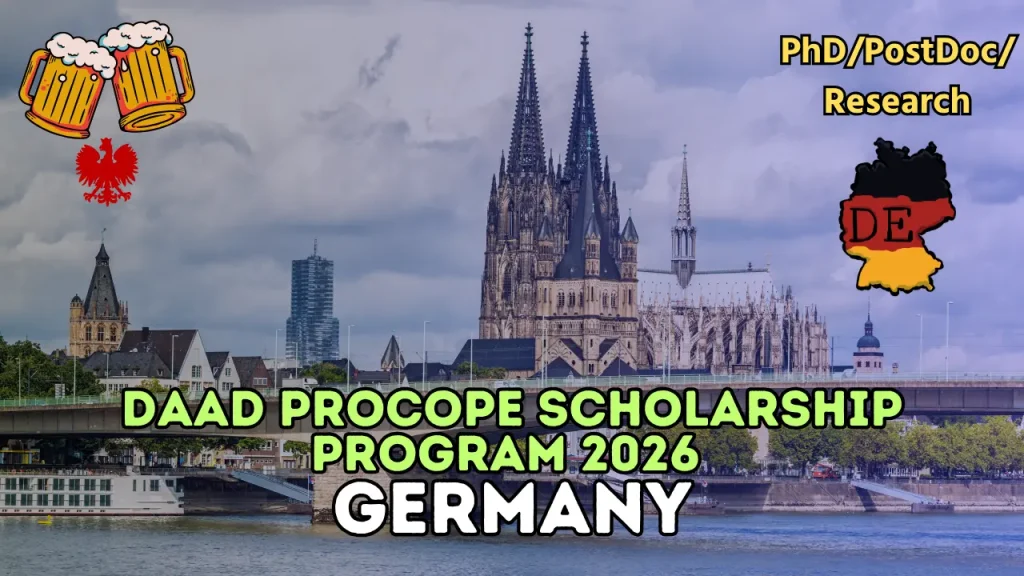
Basic Information About the Scholarship
- Scholarship name: DAAD Procope Scholarship Program 2026 in Germany.
- Host country: Germany.
- Administered by: German Academic Exchange Service DAAD.
- Program type: Bilateral academic exchange and research collaboration program.
- Target group: Mainly researchers, academic staff, university faculty, and research teams affiliated with eligible institutions.
- Purpose: To support scientific cooperation, research mobility, and institutional partnerships between Germany and the partner country under the Procope framework.
- Academic level: Primarily research and academic exchange level rather than a full degree scholarship.
- Funding scope: Usually supports short research visits, exchange travel, and collaborative academic activities.
- Application cycle: Annual or program-call-based, depending on the bilateral call.
- Application deadline: The deadline can vary by annual call and partner-country coordination. Applicants should always verify the exact DAAD Procope 2026 application deadline on the official DAAD portal and the partner institution’s announcement before applying.
- Best practice: Start preparing at least 2 to 4 months before the deadline because institutional approvals and joint proposals often take time.
Funding & Management
- 🇫🇷 France:
- Funded by MEAE & MESR
- Managed by Campus France
- 🇩🇪 Germany:
- Funded by BMFTR
- Managed by DAAD
Project Features
- Duration: 2 years
- Includes short-term research visits:
- French team: max 30 days
- German team: max 50 days
- Covers travel + daily allowances only
- Average funding: ~€6000/year (French side)
University/Institution Details
The DAAD Procope Scholarship Program 2026 is not limited to one single university. Instead, it is connected with recognized higher education institutions and research organizations in Germany that participate through academic cooperation projects. This means the host institution can be a public university, technical university, research center, or other eligible academic body in Germany, depending on the approved collaboration proposal.
On the German side, participating institutions are generally well-established universities and research organizations with strong international research networks. Germany is home to globally recognized institutions such as universities of excellence, applied sciences universities, and research institutes associated with major scientific bodies. In many cases, the German host institution and the foreign partner institution must jointly design and submit the project proposal. Because of this collaborative structure, applicants usually do not apply as isolated individuals; rather, they become part of an institutional or departmental exchange project.
The program is managed under the broader framework of DAAD’s international academic cooperation mission. DAAD is one of the world’s largest funding organizations for the international exchange of students and researchers. Its scholarship and cooperation programs are widely cited in higher education and mobility research as key tools for international scientific networking and capacity development (DAAD; Teichler, 2017, Higher Education). Applicants should therefore pay close attention to the official institutional call, because the exact rules may differ based on the participating universities and partner-country agreements.
Study Areas Available
- The Procope Program usually focuses on research collaboration rather than a fixed list of degree programs.
- Available study areas commonly depend on the joint academic proposal submitted by the partner institutions.
- In many calls, a broad range of disciplines may be eligible, including:
- Natural sciences.
- Life sciences.
- Microbiology and biotechnology.
- Engineering and technology.
- Environmental sciences.
- Medical and health-related research.
- Agricultural sciences.
- Computer science and data science.
- Social sciences.
- Humanities.
- Interdisciplinary research projects.
- Joint research project.
- Academic exchange project.
- Bilateral university cooperation project.
- Faculty mobility project.
- Research visit program.
- Laboratory collaboration initiative.
- Applicants should confirm discipline eligibility from the current official Procope call for 2026.
DAAD Procope Scholarship Program Benefits
- Covers:
- ✈️ Travel costs
- 💶 Daily allowance:
- French in Germany: ~€150/day
- German in France: €89–€130/day
- Support for short-term research visits and scientific exchange.
- Opportunity to collaborate with German universities and research institutions.
- Access to advanced laboratories, research infrastructure, and scholarly networks.
- Increased chances of co-authorship in international publications.
- Academic networking with professors, researchers, and institutional partners.
- Better career visibility in international academia.
- Improved potential for long-term institutional cooperation.
- Strong recognition because DAAD is a globally respected scholarship body.
- Exposure to Germany’s high-quality higher education and research environment.
Benefits Not Included
- Visa fee coverage may be excluded.
- Health insurance may not always be fully included.
- Accommodation arrangements may not be guaranteed.
Eligibility Criteria for the DAAD Procope Scholarship Program
- Open to:
- Tenured researchers in universities/research institutions
- All scientific fields
- Companies can join with academic partners
- Must be a new collaboration (priority given)
- Same project must wait 2 years before reapplying
- Key Conditions
- Funding must be used within each calendar year
- Cannot carry over unused funds
- Second-year funding depends on:
- Proper use of first-year funds
- Submitted report
- Applicants must usually belong to an eligible university or research institution.
- Candidates are generally researchers, lecturers, faculty members, doctoral researchers, or academic teams.
- The proposed project should align with the objectives of bilateral scientific cooperation.
- Applicants may need endorsement from their home institution.
- The German host institution usually must agree to participate in the project.
- Prior research experience is often an advantage.
- Applicants must meet any country-specific requirements stated in the official call.
- Ineligible or incomplete applications are usually rejected without review.
Reporting Requirements
- Year 1:
- Progress report (by Dec 15)
- End of project:
- Final scientific + financial report (within 3 months)
- Required to acknowledge funding in publications
Evaluation Criteria
- Scientific quality of project
- Strength of both teams
- Collaboration benefits & complementarity
- Involvement of young researchers (PhD/Postdoc)
- Potential for future larger funding (e.g., EU programs)
- Clear dissemination & impact strategy
Required Documents for the Application
- Completed DAAD Procope application form.
- Joint project proposal or cooperation proposal.
- Curriculum vitae CV of the applicant or participating researchers.
- Motivation letter explaining the academic purpose of the exchange.
- Research plan with objectives, methodology, and expected outcomes.
- Institutional endorsement letter.
- Invitation letter or confirmation from the German host institution.
- Proof of academic affiliation.
- List of publications, if applicable.
- Academic certificates or transcripts, if requested.
- Passport copy or identification document.
- Budget plan for mobility or exchange activities.
- Timeline of the proposed activities.
- Any country-specific supporting documents mentioned in the official call.
DAAD Procope Scholarship Program Application Process
- Step 1: Visit the official DAAD website and search for the latest DAAD Procope Scholarship Program 2026 call.
- Step 2: Read the full eligibility rules, funding scope, participating-country rules, and application deadline carefully.
- Step 3: Contact a German academic partner or confirm collaboration with an existing host institution.
- Step 4: Develop a joint research or academic exchange proposal with the partner institution.
- Step 5: Collect all required documents, including institutional letters and CVs.
- Step 6: Prepare a realistic activity plan and mobility budget.
- Step 7: Review the application instructions for formatting, signatures, and submission method.
- Step 8: Submit the complete application before the official deadline.
- Step 9: Monitor email communication for review updates or requests for additional documents.
- Step 10: If selected, complete post-award formalities such as travel planning, visa preparation, and institutional coordination.
Tips for a Successful Application
- Choose a research topic with clear international relevance.
- Build a strong partnership with a German institution before submitting.
- Make sure the proposal shows mutual benefit for both institutions.
- Write clearly and avoid vague project goals.
- Include measurable outcomes such as publications, workshops, data sharing, or future joint grants.
- Show how the exchange will continue beyond one short visit.
- Match your proposal to DAAD’s goals of academic cooperation and mobility.
- Submit a polished, error-free application.
- Ask a senior colleague or mentor to review the proposal before submission.
- Start early because institutional paperwork often takes longer than expected.
Monthly Living Expenses for International Students in Germany
- Although Procope may focus on short academic visits, applicants should still understand average living expenses in Germany.
- Estimated monthly living costs for international students or short-term academic visitors in Germany are usually around USD 950950 to USD 1,5001,500 depending on the city and lifestyle.
- Typical monthly expenses may include:
- Accommodation: USD 400400 to USD 850850.
- Food: USD 180180 to USD 300300.
- Local transport: USD 4040 to USD 9090.
- Health insurance: USD 130130 to USD 170170.
- Internet and phone: USD 3030 to USD 6060.
- Study materials and personal expenses: USD 8080 to USD 200200.
- Large cities such as Munich, Frankfurt, and Hamburg are usually more expensive than smaller student cities.
- Applicants should budget extra funds for visa processing, initial housing deposits, and emergency expenses.
Why Choose This Scholarship?
- It connects you with Germany’s globally respected research and academic system.
- It helps build long-term international research partnerships rather than only funding a short visit.
- It strengthens your academic profile through collaborative work and publication opportunities.
- It offers access to advanced research facilities and specialized expertise.
- It improves your chances for future grants, fellowships, and institutional projects.
- It adds strong international credibility to your CV.
- It supports meaningful scientific exchange, which can lead to future innovation and joint discoveries.
- It is funded under the highly trusted DAAD framework, which is recognized worldwide.
Frequently Asked Questions
- Is the DAAD Procope Scholarship 2026 fully funded?
It is generally a funded academic exchange program, but funding details vary by call. It may not cover every living or personal expense. - Can international students apply individually?
In many cases, the program is based on institutional cooperation, so applications are often linked to a joint university project rather than a purely individual application. - Is IELTS required?
Language requirements depend on the project and host institution. Some projects may use English, while others may expect German proficiency. - Can doctoral researchers apply?
Yes, doctoral researchers may be eligible if they are part of an approved academic collaboration and meet the official call requirements. - Does this scholarship cover full tuition fees?
Usually, Procope is not a traditional degree scholarship, so full tuition support is not the main focus. - What is the application deadline for DAAD Procope Scholarship Program 2026?
The exact deadline depends on the official 2026 call and partner-country announcement. Always check the DAAD website for the latest update. - Can I apply without a German host institution?
Normally, a German academic partner is essential because the program is built around bilateral cooperation. - What fields are accepted?
A wide range of academic disciplines may be considered, especially if the project demonstrates strong research value and bilateral collaboration.
Application Details
- Open every year: April – July
- Deadline: July 1, 2026 (11:59 PM Paris time)
- Apply jointly:
- French side → Campus France
- German side → DAAD
- Results: November 2026
- Project starts: January 2027
Official Link:
Japanese Government MEXT Scholarship 2026-27 in Japan
University of Science & Technology UST Scholarships 2026 in South Korea