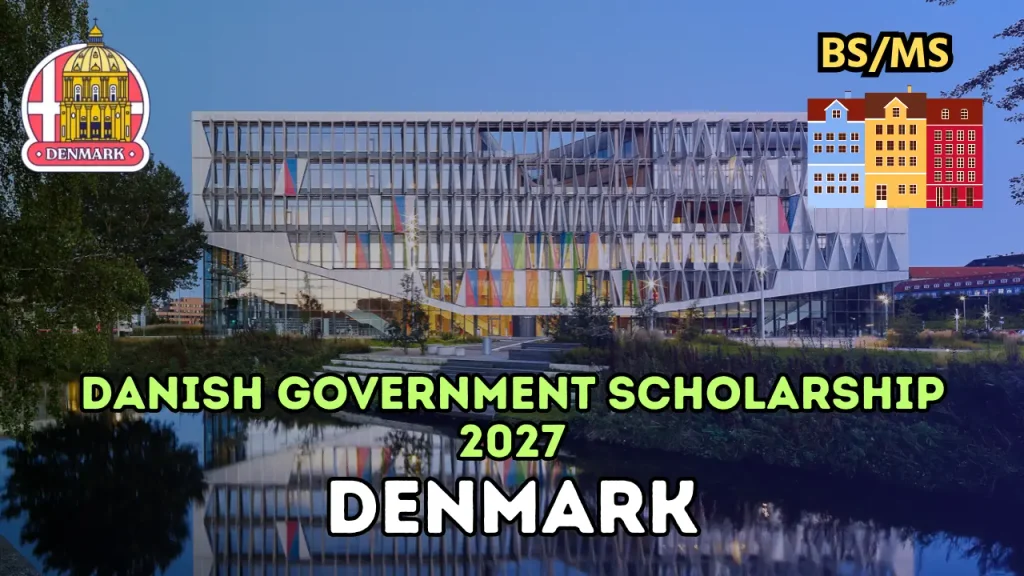
Are you an ambitious non-EU/EEA international student seeking to pursue higher education in one of Europe’s most innovative, progressive, and highly-ranked university systems? The Danish Government Scholarship 2027 in Denmark offers a prestigious pathway for top-tier international talent to access world-class master’s degree programs completely tuition-free, often paired with substantial living stipends. SDU offers a limited number of scholarships for highly qualified non-EU/EEA citizens. Scholarships can only be awarded for specific programmes offered on our campuses in Vejle and Sønderborg.
This guide breaks down everything you need to know about the 2027 application cycle, participating institutions, eligibility criteria, required documents, step-by-step application instructions, realistic living costs in USD, and expert application strategies.
Basic Information About the Scholarship
The Danish Government Scholarship is an elite, merit-based award funded directly by the Danish state.
- University: University of Southern Denmark (SDU).
- Country: Denmark.
- Scholarship type: Danish Government Scholarship.
- Eligible applicants: Highly qualified students from outside the EU/EEA.
- Funding Provider: Ministry of Higher Education and Science (Danish Government)
- Degree Level: Primarily Full-Time Master’s (MSc / MA) Degrees and Bachelor
- Target Audience: Non-EU/EEA/Swiss international candidates
- Application Deadlines: Deadlines are set individually by each university. For the September 2027 Autumn Intake, major deadlines typically close between January 15, 2027, and March 15, 2027:
- University of Copenhagen (UCPH), Technical University of Denmark (DTU), Aarhus University (AU), Copenhagen Business School (CBS), Aalborg University (AAU): January 15, 2027
- University of Southern Denmark (SDU): February 1, 2027 (MSc)
- Roskilde University (RUC): March 1, 2027
University and Institution Details
- University of Copenhagen (UCPH): Denmark’s oldest and largest university, globally celebrated for health sciences, natural sciences, and humanities.
- Technical University of Denmark (DTU): A European engineering powerhouse leading advancements in renewable energy, biotechnology, and computer science.
- Aarhus University (AU): Famous for multidisciplinary research, social sciences, agricultural technology, and high international student satisfaction.
- Copenhagen Business School (CBS): One of Europe’s top business institutions focused on sustainable business models, economics, and corporate governance.
- Aalborg University (AAU): Globally renowned for its pioneering Problem-Based Learning (PBL) model and engineering disciplines.
- University of Southern Denmark (SDU): Known for robotics engineering, life sciences, and international business management.
- IT University of Copenhagen (ITU): A specialized institute focusing on software development, data science, and digital design.
- Roskilde University (RUC): Celebrated for interdisciplinary studies, social policy, and environmental planning.
Study Areas & Available Programs
The scholarship covers a wide range of English-taught Master’s degree programs. Popular degree categories eligible for funding include:
These programs at the Sønderborg campus:
- MSc in Engineering – Electronics/Electrical Engineering
- MSc in Engineering – Mechanical Engineering
- MSc in Engineering – Mechatronics
Eligible Bachelor’s programs
These programs at the Vejle campus:
- BSc in Artificial Intelligence
- BSc in Computer Science
- BSc in Interactive Technology Engineering
- BSc in Software Engineering
Important: The scholarship is not available for every program at SDU.
Danish Government Scholarship Benefits:
Because the Danish government allocates funding directly to universities, the exact scholarship package varies by institution. Scholarships generally take one of two forms:
- Full tuition fee waiver for the eligible program.
- Master’s students: Tuition coverage for two years.
- Bachelor’s students: Tuition coverage for three years.
- The waiver covers up to 30 ECTS credits per semester.
- Students must maintain satisfactory academic progress.
- As a guideline, students should complete at least 30 ECTS credits each semester.
Important: The information provided does not include a monthly living allowance. Therefore, applicants should plan separately for living expenses, accommodation, food, and other personal costs.
Benefits Not Included
While tuition is fully or partially waived, candidates must plan for expenses not covered by standard packages:
- Application Fees: Most Danish universities require non-EU applicants to pay an initial administrative application processing fee (~€100 / $110 USD) when submitting through the central portal.
- International Travel Costs
- Residence Permit / Student Visa Fees: Mandatory fee charged by the Danish Agency for International Recruitment and Integration (SIRI) for processing your ST1 residence permit.
- Living Costs (if awarded a tuition-only waiver): Candidates awarded a full tuition waiver without a living allowance must show proof of personal funds (~DKK 6,300/month or ~$910 USD/month) to obtain a student residence permit.
Eligibility Criteria for the Danish Government Scholarship
To qualify for the Danish Government Scholarship in 2027, you must meet all core administrative and academic criteria set by Danish law and your target university:
Applicants must:
- Be a citizen of a non-EU/EEA country.
- Apply for an eligible program at the specified SDU campus.
- Meet the academic and admission requirements of the chosen program.
- Submit the admission application before the relevant deadline.
- Provide all required documents.
- Not be eligible for the Danish State Grant (SU).
Selection Criteria
Master’s level
- Bachelor’s degree GPA
- Performance during an online interview
- Responses to technical questions related to the Master’s program’s entry requirements
Interview period: 19–27 February.
Applicants receive interview invitations by email after their admission applications have been processed. Invitations may arrive at short notice.
Bachelor’s level
- Results in the online admission test (uniTEST)
- Performance during an online interview
- Motivation for studying at SDU
- Responses to basic mathematical questions
Interview period: Early June.
Applicants with the highest uniTEST scores are invited to interview. Invitations are generally sent in late May.
Required Documents for Application
Submitting complete, clear, and verified documentation is critical. Missing a single translation or verification seal can lead to instant rejection. Prepare digital copies of:
Your admission application must include:
- Application deposit fee receipt.
- Official Bachelor’s degree certificate or diploma.
- Official Bachelor’s academic transcripts.
- Transcripts showing grades and ECTS credits or equivalent course credits.
- Verified course descriptions for the courses listed on your transcripts.
- Completed self-assessment form, where required:
- Electronics
- Mechatronics
- Proof of English language proficiency.
Important document rules
- Documents must be in English, Danish, Swedish, or Norwegian.
- All required documents must be uploaded to the online application.
- Documents sent by email are not accepted.
- Your application must be complete when submitted.
Danish Government Scholarship Step-by-Step Application Process
Danish Government Scholarships do not typically require a separate, standalone scholarship application portal.
- Apply for admission to one or more eligible programs at SDU.
- Complete the online application.
- Upload all required documents before the deadline.
- Pay the required application deposit fee, where applicable.
- No separate scholarship application
- SDU considers eligible applicants for the scholarship based on the selection criteria.
Insider Tips for a Successful Application
- Highlight ECTS Compatibility: Danish admissions committees evaluate course syllabi rigorously. Ensure your previous undergraduate courses clearly map to the prerequisite requirements of the master’s program.
- Demonstrate Academic Excellence Early: Because candidates are ranked primarily by GPA and research caliber, target a GPA equivalent to the top 10% of your class.
- Tailor Your Statement of Purpose: Avoid generic essays. Explain why Denmark’s specific pedagogical structure (problem-based learning, flat hierarchies, group projects) matches your career trajectory.
- Apply Well Before the Hard Deadline: Do not wait until January 15. Server traffic on the central portal spikes near deadlines, and late document uploads will lead to disqualification.
Estimated Monthly Living Expenses in Denmark (in USD)
While Denmark offers an exceptional standard of living, Scandinavian cities require realistic budgeting. Here is a breakdown of estimated monthly expenses for international students in major cities like Copenhagen, Aarhus, or Odense:
| Expense Category | Estimated Monthly Cost (USD) | Notes |
| Accommodation | $500 – $900 | Student housing (Kollegium) vs. private rentals |
| Food & Groceries | $250 – $400 | Discount markets (Netto, Lidl, Rema 1000) |
| Public Transport | $50 – $80 | Biking is free and dominant; monthly commuter cards available |
| Study Materials & Books | $40 – $70 | Digital resources and second-hand university textbooks |
| Utilities & Internet | $60 – $100 | Often included in student dorm room rent |
| Socializing & Leisure | $150 – $300 | Cafes, campus events, and leisure activities |
| Total Monthly Cost | $1,050 – $1,850 / month | Varies between Copenhagen and smaller cities |
Why Choose the Danish Government Scholarship? (5 Core Reasons)
- Top-Tier Global Universities: Danish universities rank among the finest worldwide in engineering, life sciences, green technology, and business administration.
- Complete Financial Relief: A full tuition waiver saves international students between $14,000 and $22,000 USD per year in tuition fees, allowing complete focus on academic success.
- Problem-Based Learning (PBL) Model: Education in Denmark stresses real-world case studies, group problem-solving, and direct industry collaboration over passive lectures.
- Post-Graduation Work Opportunities: Denmark offers generous post-study work pathways for international graduates, permitting students to remain in Denmark to secure high-skill employment after finishing their degree.
- Exceptional Quality of Life: Enjoy studying in one of the safest, happiest, and most sustainable societies on the planet, with access to universal infrastructure and English-friendly social circles.
Frequently Asked Questions (FAQs)
Is a separate scholarship application required?
Usually, no. When you apply for admission to an eligible Master’s program at a Danish university, you are automatically evaluated for the Danish Government Scholarship. However, some universities (like CBS or DTU) require you to check a box on the portal or attach a short scholarship motivation statement.
Can undergraduate (Bachelor’s) or PhD students apply?
The Danish Government Scholarship is primarily designed for Master’s degree students. Bachelor’s scholarships are rare (with occasional exceptions at SDU), and PhD candidates in Denmark are usually funded as full-time paid university employees.
Are international students allowed to work while studying in Denmark?
Yes! Non-EU/EEA students holding a valid Danish student residence permit are legally permitted to work part-time up to 20 hours per week during academic terms, and full-time (40 hours per week) during June, July, and August.
What happens if I miss the January deadline?
If you miss the primary January 15 deadline, you will generally have to wait for the next annual intake cycle.
Application Deadlines
| Study level | Application deadline |
|---|---|
| Bachelor’s | 15 March |
| Master’s | 1 February |
. Check the relevant admission cycle for the exact dates.