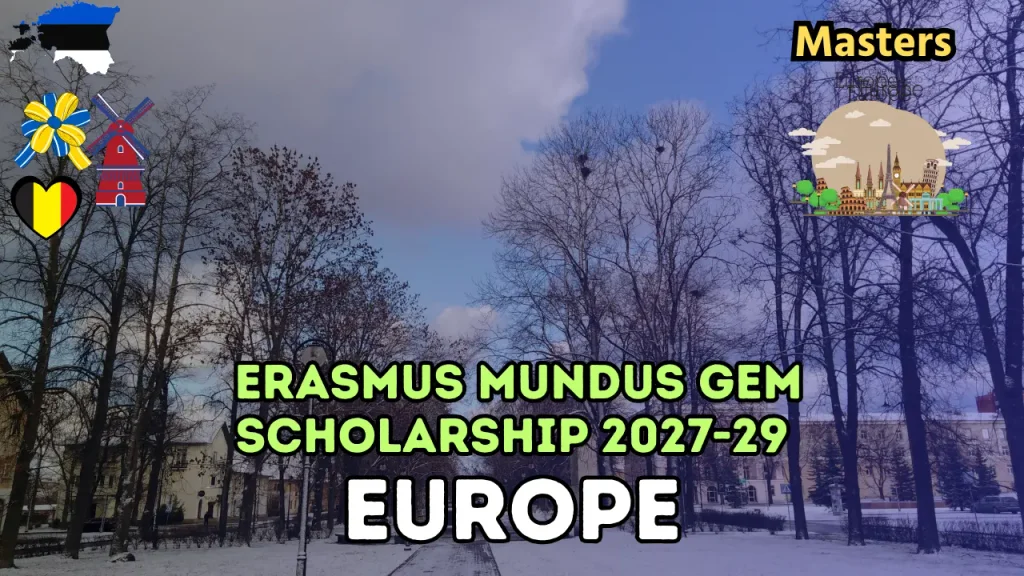
The Erasmus Mundus GEM Scholarship 2027–2029 (MSc in Geo-Information Science and Earth Observation for Environmental Modelling and Management) stands as one of the premier fully funded master’s programs funded by the European Union. Designed to equip future environmental leaders, data scientists, and geospatial planners with cutting-edge tools, this 2-year double degree program offers top-tier academic training combined with immersive living experiences across multiple European host countries.
The aim of GEM is to deliver top-class graduates from the EU and around the world, with the skills and networks to better manage socio-ecological systems for sustainable and equitable growth. New Earth observation data services, such as the European Union’s Copernicus Programme – provide access to the data. GEM provides the technical knowledge and professional skills to use it, communicate it, and act upon it.
Basic Information About the Scholarship
The GEM Erasmus Mundus Joint Master Degree (EMJMD) bridges the gap between Earth observation technology, spatial analysis, and global environmental sustainability. Below is a snapshot of the core details:
- Program Name: Geo-Information Science and Earth Observation for Environmental Modelling and Management (GEM)
- Degree Type: Double Master of Science (MSc) Degree from two partner universities
- Degree Award
- The programme lasts two years.
- Graduates receive a double Master’s degree.
- Both degrees are awarded in English.
- The degrees are issued through the participating European universities.
- Degree Duration: 2 Years (24 months, 120 ECTS)
- Funding Level: Fully Funded by the European Union
- Target Audience: Open to all nationalities across the world
- Language of Instruction: English
- Application Fee: €0 (Free to apply)
- Applications Open: October 1, 2026
- Application Deadline: January 15, 2027 at 23:59 CET
- Results Announcement: March 31, 2027
- Program Intake Starts: September 2027
Programme Objectives
- GEM aims to educate highly skilled graduates from Europe and other parts of the world.
- The programme focuses on managing natural resources and socio-ecological systems.
- It prepares students to address environmental and societal challenges.
- Students learn how to collect, process, analyse, and use geospatial data.
- The programme uses Earth Observation (EO) technologies and satellite data from sources such as:
- European Union’s Copernicus Programme.
- NASA Earth Data.
- The main goal is to promote sustainable and equitable development.
Programme Structure
- Students must choose one of four study tracks when applying.
- The programme involves studying at two different European universities.
- Each academic year is spent at a different university, depending on the selected track.
- Students receive specialised training in geospatial science, environmental management, and spatial analysis.
- The programme combines academic learning, practical training, research, and professional experience.
University & Institution Details
Partner Universities
The GEM programme is jointly organised by four European universities.
1. University of Tartu – Estonia
Focus: Socio-ecological systems and urban planning.
2. Lund University – Sweden
Focus: Earth and environmental sciences.
3. University of Twente – The Netherlands
Focus: Natural resources, Earth Observation, and geospatial innovation.
4. UCLouvain – Belgium
Focus: Agriculture and land-use planning.
Associate Partners
The programme also works with international organisations from academic, industrial, government, and NGO sectors.
Their responsibilities include:
- Providing internship and fieldwork opportunities.
- Supporting students with research ideas and thesis projects.
- Sharing real-world environmental and social challenges.
- Participating in workshops, meetings, and hackathons.
- Helping universities improve their academic curriculum.
- Developing international research and collaborative projects.
Study Areas & Available Program Tracks
Available Study Tracks
- Track 1: Geospatial Planner
- Track 2: Geospatial Analyst
- Track 3: Geospatial Developer
- Track 4: Geospatial Modeller
Track 1: Geospatial Planner
Universities: University of Tartu, Estonia + University of Twente, the Netherlands
- Focuses on using GIS and geospatial technologies for urban and environmental planning.
- First year covers:
- Spatial data analysis.
- Earth Observation (EO).
- 3D modelling.
- Spatial databases and GeoPython.
- Planning studios and internships.
- Second year covers:
- Digital participatory planning.
- Environmental assessment.
- Ecosystem service analysis.
- Suitable academic backgrounds:
- Urban Planning.
- Geography.
- Environmental Science.
- Civil Engineering.
- Possible careers:
- Urban Planner.
- GIS Consultant.
- Environmental Policy Advisor.
Track 2: Geospatial Analyst
Universities: University of Tartu, Estonia + UC Louvain, Belgium
- Focuses on using geospatial data for environmental monitoring and spatial planning.
- First year covers:
- Spatial analysis.
- Earth Observation.
- Geovisualisation.
- Elective courses and industry internships.
- Second year covers:
- Spatial modelling.
- Landscape ecology.
- Land monitoring.
- Suitable academic backgrounds:
- Geography.
- Environmental Science.
- Data Science.
- Computer Science.
- Possible careers:
- GIS Analyst.
- Spatial Data Scientist.
- Earth Observation Specialist.
Track 3: Geospatial Developer
Universities: Lund University, Sweden + University of Twente, the Netherlands
- Focuses on developing advanced geospatial technologies and software.
- Combines programming, geospatial AI, and Earth Observation.
- First year covers:
- Geospatial data analysis.
- Satellite data processing.
- Second year covers:
- Quantitative remote sensing.
- AI-based geospatial solutions.
- Suitable academic backgrounds:
- Computer Science.
- Geoinformatics.
- Engineering.
- Possible careers:
- GIS Developer.
- Spatial Software Engineer.
- Geospatial AI Engineer.
Track 4: Geospatial Modeller
Universities: Lund University, Sweden + UC Louvain, Belgium
- Focuses on spatial modelling and simulations to understand environmental challenges.
- First year covers:
- GIS programming.
- Geospatial AI.
- Earth Observation.
- Second year covers:
- Earth system monitoring.
- Spatial dynamics.
- Bioscience modelling.
- Suitable academic backgrounds:
- Environmental Science.
- Geoinformatics.
- Earth Observation.
- Ecology.
- Possible careers:
- Environmental Modeller.
- Climate Data Scientist.
- Earth Observation Specialist.
Erasmus Mundus GEM Scholarship Benefits
Selected Erasmus Mundus scholarship holders receive an extensive funding package designed to cover academic and living expenses for the entire 2-year duration:
Selected students receive:
| Benefits | Coverage |
|---|---|
| Tuition fees | Full tuition fee waiver |
| Monthly allowance | €1,400 per month |
| Scholarship duration | Up to 24 months |
| Insurance | Comprehensive student insurance |
What Does the €1,400 Monthly Allowance Cover?
The monthly allowance is intended to cover:
- Accommodation and living expenses.
- Travel costs.
- Visa and residence permit expenses.
- Study materials and laptop expenses.
- Other personal expenses.
Insurance Coverage
The scholarship includes insurance for:
- Emergency assistance.
- Medical and dental expenses.
- Accidents.
- Medical and social repatriation.
- Personal liability.
- Legal assistance.
- Home contents and luggage.
Important:
- Tuition fees and insurance are paid directly by the programme.
- The monthly allowance is provided to students to manage their other expenses.
- Students must budget their monthly allowance carefully to cover living, travel, visa and study-related costs.
Benefits Not Included
While the GEM scholarship is highly generous, scholars should be aware of financial responsibilities not directly fronted prior to arrival:
- Initial Upfront Outlays: Advance costs such as initial passport fees, embassy visa appointment fees, and preliminary flight bookings before receiving the first scholarship installment.
- Personal Luxury Travel: Non-academic personal trips outside the degree requirements.
- Family or Dependent Expenses: Financial support for accompanying spouses or children (stipends are strictly calculated for individual scholars).
- Security Deposits: Initial rental security deposits for student accommodation in host cities (reimbursable upon lease conclusion).
Eligibility Criteria for the Erasmus Mundus GEM Scholarship
To be eligible for admission and scholarship consideration, applicants must fulfill the following prerequisites:
1. Academic Qualifications
Applicants must:
- Hold a Bachelor’s degree from a recognised university.
- Have completed at least 3 years of full-time university education (180 ECTS credits or equivalent).
- Hold a degree that allows them to apply for Master’s programmes in their home country.
- Graduate from a university ranked within the top 10,000 universities worldwide according to Webometrics.
- Meet the recognition requirements of the GEM partner universities.
For final-year students:
- Students who are still completing their Bachelor’s degree can apply.
- They must provide an official university statement confirming their current student status and expected graduation date.
- Their Bachelor’s degree and final transcript must be submitted before 31 July 2027.
2. Academic Performance
Applicants must have:
- A First Class or Upper Second Class (2.1) Bachelor’s degree, or an internationally equivalent qualification.
- The minimum CGPA/GPA required by the country-specific admission rules of the partner universities.
Important conditions:
- A Lower Second Class (2.2) degree is not accepted.
- Applicants who do not meet the minimum country-specific CGPA requirement are not eligible.
- The minimum CGPA requirement cannot be waived.
- Work experience, publications, recommendations, or other achievements cannot compensate for a CGPA below the minimum requirement.
- Meeting the minimum CGPA does not guarantee admission. The consortium will also evaluate relevant academic courses and results.
Check the University of Twente country-specific admission requirements.
3. Relevant Academic Background
The Bachelor’s degree should be related to the objectives and content of the GEM programme.
Relevant academic disciplines include:
- Geography
- Geoinformatics and Geomatics
- GIS and Remote Sensing
- Earth Observation and Earth Sciences
- Environmental Sciences
- Ecology
- Natural Resource Management
- Agriculture and Forestry
- Land-use Planning
- Urban and Regional Planning
- Spatial Planning
- Civil and Environmental Engineering
- Computer Science and Data Science
Applicants from other academic backgrounds may also be considered if their previous studies, research, or professional experience demonstrate a relevant connection to:
- Geospatial Analysis
- Environmental Modelling
- Human–Environment Interactions
Additional advantages:
- Previous GIS or Remote Sensing courses.
- Relevant research or professional experience.
- At least 15 ECTS of GIS or Remote Sensing courses is highly recommended for Track 3 (Geospatial Developer) and Track 4 (Geospatial Modeller).
Work experience is an advantage but is not compulsory.
English Language Requirements
Applicants must demonstrate English proficiency through an approved test unless they qualify for an official exemption.
| English test | Minimum requirement |
|---|---|
| IELTS Academic | Overall 6.5, minimum 6.0 in each section |
| TOEFL iBT (before January 2026) | Overall 100, minimum 25 in each section |
| TOEFL iBT (after January 2026) | Overall 5, minimum 5 in Reading, Listening and Writing; 4.5 in Speaking |
| Cambridge C1 Advanced | Overall 176, minimum 169 in each section |
| Cambridge C2 Proficiency | Grade A, B or C; overall 176, minimum 169 in each section |
| PTE Academic | Overall 63, minimum 59 in each section |
| LANGUAGECERT Academic | Overall 70, minimum 65 in Reading and Listening, and 70 in Speaking and Writing |
Important conditions:
- English test results must normally be no older than two years.
- The official English certificate must be available by 15 January 2027.
- Applications without the required English certificate or an approved exemption will be considered incomplete.
English Tests Not Accepted
- IELTS General Training
- IELTS Online
- IELTS Indicator
- IELTS One Skill Retake
- TOEFL MyBest Scores
- Institutional TOEFL
- PTE Core
- PTE Academic Online
- Duolingo English Test
- Unofficial university English assessments
English Language Exemption
Applicants may qualify for an exemption if they meet the officially recognised conditions.
Generally, exemptions may be considered for applicants who have completed at least three years of higher education, physically attended and studied in English in countries such as:
- Australia
- Canada
- Ireland
- New Zealand
- United Kingdom
- United States
Some additional countries are also eligible, subject to the official exemption rules.
Important: Simply having an English Medium of Instruction (MOI) certificate from a Bangladeshi university does not automatically qualify an applicant for an exemption.
Check the official English exemption requirements.
Selection Procedure
The GEM Joint Programme Board, representing all partner universities, is responsible for selecting students.
Step 1: Eligibility Check
- Academic qualifications are checked.
- Administrative requirements are reviewed.
- Educational documents may be verified.
- Applicants who do not meet the requirements are rejected.
Step 2: Academic Evaluation
Eligible applications are evaluated based on:
- Academic performance.
- Relevance of previous education.
- English language proficiency.
- CV and professional experience.
- Motivation and suitability for the selected study track.
The highest-ranked applicants may be shortlisted for interviews.
Step 3: Online Interview
- Approximately the top 25 applicants per study track may be invited for an online recorded interview.
- Interview invitations are normally sent in February.
- Interviews are expected to take place in February and March.
- Only applicants who are invited to and complete the interview remain eligible for an Erasmus Mundus scholarship.
The interview evaluates:
- Motivation for the programme.
- Understanding of the selected study track.
- Academic and professional goals.
- Communication skills.
- Overall suitability.
Important: Applicants who are not invited for an interview may still receive admission without a scholarship, but they will not be eligible for Erasmus Mundus scholarship funding.
Step 4: Final Selection
Final ranking is based on:
- Academic merit.
- Suitability for the programme.
- Overall application quality.
- Interview performance, where applicable.
- Available Erasmus+ scholarship funding.
- Geographic balance and diversity considerations, where applicable.
Required Documents for the Application
Applicants must prepare the following documents:
Academic Documents
- Bachelor’s degree certificate (First Class or Second Class Upper Division, or equivalent).
- Official academic transcript.
- Certified English translations, if applicable.
- Additional degree certificates and transcripts, if applicable.
English Language Certificate
- A valid English language test certificate meeting the programme requirements.
- The test must be completed before the application deadline.
- Results received after the deadline will not be accepted.
Passport
– A copy of a valid passport.
Curriculum Vitae (CV)
- Must follow the official GEM CV Template.
- Maximum length: 2 pages.
- Include academic background, professional experience, international experience, language skills, achievements and relevant strengths.
Financial Plan
- Applicants must explain how they intend to finance their studies during the two-year programme.
- A separate financial plan document or proof of funds is not required.
- All financial information must be provided in Euros (€).
Erasmus Mundus GEM Scholarship Step-by-Step Application Process
Important Information Before Applying
- GEM is a highly competitive international Master’s programme.
- Applicants must carefully check the current admission and eligibility requirements before applying.
- Meeting the minimum requirements does not guarantee admission.
- Incomplete or ineligible applications will not be considered.
- Applicants must select only one study track.
- Changing the selected track after admission is not permitted.
Important Application Rules
- There is no application fee.
- All required documents must be submitted before the deadline.
- Do not upload unnecessary documents.
- Incomplete applications may be rejected.
- The University of Twente may verify academic documents directly with the issuing institution.
- Applications may also be checked for plagiarism.
Admission and Scholarship Results
Results: 31 March 2027
Applicants may receive one of the following decisions:
1. Not Admitted
– The applicant does not meet the requirements or is not selected.
2. Admitted with Erasmus+ Scholarship
– The applicant receives admission and an Erasmus Mundus scholarship.
3. Provisionally Admitted Without Scholarship
- The applicant may enrol as a self-funded student.
- They may apply for external scholarships or sponsorship.
- They may also be placed on the Erasmus+ scholarship reserve list.
Applicants on the reserve list may receive a scholarship if a funded place becomes available before the programme starts.
Number of Available Places
- Up to 100 eligible applicants per study track may receive provisional admission.
- A maximum of 8 students per study track can ultimately enrol.
- This limit applies to both scholarship holders and self-funded students.
- Places are allocated according to the order in which provisionally admitted applicants confirm their places.
- Once all places are filled, remaining applicants are placed on a waiting list.
Tips for a Successful Application
- Tailor Your Motivation to the Track: Clearly explain why you chose a specific track (e.g., Geospatial Developer vs. Geospatial Planner). Show how the host institutions fit your research goals.
- Use the Official CV Template: Do not use generic layouts. Adhere strictly to the official GEM CV format.
- Demonstrate Geospatial Familiarity: Highlight any experience with Python, R, QGIS, ArcGIS, satellite imagery, or spatial modeling algorithms.
- Secure English Certificates Early: Do not wait until the last week to take language tests; test processing delays can disqualify an application.
- Proofread Meticulously: Ensure all official document scans are completely legible and correctly uploaded to avoiding processing rejections.
Monthly Living Expenses for International Students
The €1,400 monthly stipend (equivalent to approximately $1,500 – $1,550 USD) easily covers standard living costs across all four partner countries. Below is a realistic monthly budget estimation presented in USD ($):
| Expense Category | Netherlands / Sweden (USD $) | Belgium / Estonia (USD $) |
| Accommodation / Rent | $450 – $700 | $350 – $550 |
| Food & Groceries | $250 – $350 | $200 – $300 |
| Local Transportation | $50 – $90 | $30 – $60 |
| Study Materials & Utilities | $60 – $100 | $50 – $80 |
| Leisure & Personal Expenses | $150 – $250 | $120 – $200 |
| Estimated Total Costs | $960 – $1,490 / month | $750 – $1,190 / month |
Because costs remain below the stipend threshold, scholars can comfortably live, travel, and save during their stay in Europe.
Why Choose the GEM Erasmus Mundus Scholarship?
- International learning: Study at two European universities and interact with students from different countries.
- Practical skills: Gain experience using GIS, satellite imagery, remote sensing, and geospatial technologies.
- Advanced technology: Work with real-world data from Copernicus, NASA Earth Data, and other sources.
- Research opportunities: Learn how to conduct scientific research and solve environmental problems.
- Industry connections: Interact with government organisations, industries, NGOs, and research institutions.
- Interdisciplinary education: Combine environmental science, geography, planning, technology, and social challenges.
- International exposure: Develop communication, language, and intercultural skills.
- Dual European Qualifications: You earn two distinct Master of Science degrees from top European universities within two years.
- Zero Financial Strain: The €1,400 monthly stipend combined with 100% tuition coverage eliminates educational debt.
- High-Demand Career Skillsets: Geospatial science, remote sensing, and environmental data science are critical sectors backing the UN Sustainable Development Goals (SDGs) and the EU Green Deal.
- Multi-Country Cultural Mobility: Living and studying in two different European countries enhances adaptability and intercultural communication.
- Unmatched Global Network: Access an international alumni network, leading research labs, and industry partners including space agencies and environmental organizations.
Frequently Asked Questions (FAQs)
1. Is work experience required to apply for the GEM scholarship?
No, relevant work experience is not mandatory, although professional or research experience in GIS, remote sensing, or environmental projects will strengthen your overall score.
2. Can final-year undergraduate students apply for the 2027–2029 intake?
Yes, final-year bachelor’s students are eligible to apply. You must provide a formal university statement confirming your enrollment status and expected graduation date, with final graduation certificates submitted by July 31, 2027.
3. Can I apply to more than one study track?
No, applicants are required to choose and apply for only one specific study track during the application process.
4. What is the deadline for the English language test results?
Your official English test results (such as IELTS or TOEFL) must be fully available and uploaded before the application deadline on January 15, 2027
Frequently Asked Questions (FAQ)
Important Dates at a Glance
| Event | Date |
|---|---|
| Application portal opens | 1 October 2026 |
| Application deadline | 15 January 2027 |
| Interview invitations | February 2027 |
| Interview period | February–March 2027 |
| Admission and scholarship results | 31 March 2027 |
| Tuition fee payment deadline | 1 May 2027 |
| Final certified documents deadline | 31 July 2027 |