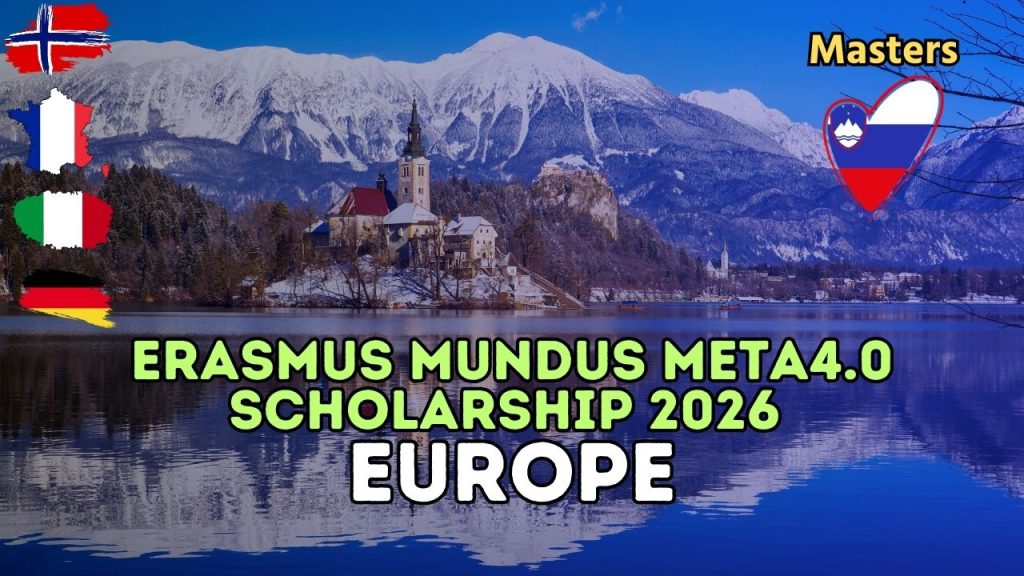
Erasmus Mundus Meta4.0 Scholarship 2026 in Europe is a fully funded Erasmus Mundus Joint Master’s program in Manufacturing 4.0 offered by a consortium of top universities in France, Italy, Germany, Norway, and Slovenia. It covers tuition, insurance, and a generous monthly stipend for outstanding international students who want to specialize in Industry 4.0, digital and sustainable manufacturing.
Basic Information and Application Deadline
The Erasmus Mundus Meta4.0 Scholarship (often written as “meta4.0 – Manufacturing 4.0 by intelligent and sustainable technologies”) is a two‑year (120 ECTS) Joint Master’s program funded by the European Union. It is fully taught in English and designed to train future experts in advanced, digital, clean, sustainable, and intelligent manufacturing for Industry 4.0.
For the current call, the program is recruiting for the edition starting around late August 2025, and the commonly published application deadline for scholarship applications is 15 February 2025 (23:59 French time). For a 2026 intake, applicants can expect a similar timeline (October–February), but should always confirm the official deadline on the Meta4.0 website before applying.
Scholarships
- Total: 90 scholarships
- 60 for Programme/Partner countries
- 3 for IPA
- 27 for NDICI
University and Institution Details
Meta4.0 is an Erasmus Mundus Joint Master coordinated by a network of six European universities. The consortium usually includes:
- 2-year European Master’s in Manufacturing 4.0.
- Year 1: Study in France (manufacturing technologies) + Italy (materials science).
- Year 2: Choose 1 of 4 specializations in Norway, Slovenia, France, or Germany.
- Graduates become skilled engineers/scientists in digitalization, sustainability, and advanced manufacturing.
- École Centrale de Lyon – ENISE (France) and Mines Saint‑Étienne (France) – core institutions for production engineering and sustainable manufacturing.
- Politecnico di Torino (Italy) – focus on materials science, materials for advanced manufacturing, and engineering processes.
- Chemnitz University of Technology (Germany) – host for intelligent manufacturing specialization.
- University of Ljubljana (Slovenia) – host for clean manufacturing.
- Norwegian University of Science and Technology – NTNU (Norway) – host for digital manufacturing.
Students study in at least two different countries within this consortium, benefiting from strong university–industry links and a highly international cohort.
Study Areas and Program Tracks
The Meta4.0 Erasmus Mundus Joint Master focuses on Manufacturing 4.0 by intelligent and sustainable technologies, combining mechanical, materials, production, and digital engineering. The program runs over four semesters: fundamentals in year one and specialization in year two.
Core study areas and specializations include:
- Year 1 Structure
- Semester 1 — France (Saint-Etienne)
- Focus: Fundamentals of manufacturing processes
Basics of production engineering
Additive manufacturing
Metalworking
High-temperature processes
Physical measurement
Research methods
French language course
Team building + company visits
- Focus: Fundamentals of manufacturing processes
- Semester 2 — Italy (Turin)
- Focus: Materials science & advanced materials
Materials for advanced manufacturing
Materials design
Materials forming
Surface science & technology
Italian language (non-credit)
- Focus: Materials science & advanced materials
- Semester 1 — France (Saint-Etienne)
- Year 2 Structure
- Students choose 3 preferred tracks → allocated based on interest + academic results.
- Semester 3 — Specializations (choose 1)
- 1. Digital Manufacturing — Norway
Modelling & simulation
Flexible automation & AI
Industrial communications
Aluminium lifecycle
Digital manufacturing project
2. Clean Manufacturing — Slovenia
Advanced machining
Quality engineering
Additive manufacturing
Micromanufacturing
Energy conversion
Laser processing
3. Sustainable Manufacturing — France
Wear & material removal modelling
Surface integrity
Functional properties
Component repair (additive)
Life-cycle assessment
Advanced French
Strategic management
4. Smart Manufacturing — Germany - Efficient process chains
Sensors & instrumentation
Digital manufacturing
Machining technologies
Composite hybrid technologies
(Note: may be credit mobility only, non-degree awarding)
- 1. Digital Manufacturing — Norway
- Semester 4 — Master Thesis & Internship
- 5-month work placement in:
Industry
Partner university labs
Applied research institutes
Master thesis based on the placement project.
- 5-month work placement in:
- Semester 3 — Specializations (choose 1)
- Students choose 3 preferred tracks → allocated based on interest + academic results.
- Awarded degrees
These tracks integrate cross‑disciplinary projects, labs, and an internship to build both technical and management skills for Industry 4.0.
Erasmus Mundus Meta4.0 Scholarship Benefits
The Erasmus Mundus Meta4.0 Scholarship is designed as a fully funded package that can reach around 51,600 EUR over 24 months, depending on the funding rules of the cohort. Key financial benefits usually include:
- Monthly stipend: About 1,400 EUR per month for 24 months as a lump sum to cover living, travel, and accommodation during the program.
- Full tuition waiver: Coverage of all participation costs for four semesters, including tuition fees, laboratory and library access, and other mandatory academic charges.
- Insurance coverage: Comprehensive health and accident insurance according to Erasmus Mundus/EACEA regulations.
- Lab + library fees
- Mobility support: Structured mobility across partner universities, including support for visas, registration, and integration, plus access to career networks and industrial partners.
- Special support available for students with disabilities
- 2 additional consortium scholarships (50% tuition fee reduction)
For many non‑EU students, this funding level is usually enough to cover basic living costs in Europe if they budget carefully.
Benefits Not Included
Despite being fully funded, some costs are typically not covered directly by the scholarship and must be planned by the student. These may include:
- Visa fees and residence permits: Application fees for Schengen or national visas, residence cards, and related administrative charges are usually paid by the student, although the stipend can indirectly cover them.
- Travel beyond the program structure: Personal trips, vacation travel, or journeys not essential to the study plan are not reimbursed separately.
- Extra housing costs: Deposits, premium accommodation, or early arrival before the official program dates are usually at the student’s own expense.
- Personal expenses: Mobile plans, leisure, clothing, personal electronics, and other discretionary spending must come from the student’s budget.
Applicants should check the official Meta4.0 financial rules for the exact list of covered and non‑covered expenses per intake.
Eligibility Criteria for Erasmus Mundus Meta4.0 Scholarship
While each Erasmus Mundus program can add specific requirements, Meta4.0 generally follows these core eligibility criteria:
- Bachelor’s degree in Mechanical Engineering, Materials Science & Engineering, or Mechatronics
- Degree must be 180 ECTS with minimum grade B
- At least 135 hours of math-related courses (proof required)
- Final-year students accepted conditionally (must graduate before 31 July)
- Other criteria:
- Strong academic record, motivation for Industry 4.0 and sustainable manufacturing, and respect for Erasmus Mundus mobility rules (such as not receiving a second Erasmus Mundus scholarship for the same period).
English Proficiency
Provide one of:
- IELTS 6.5 (min 6.0 each band)
- TOEFL 600/250/95
- CEF B2 / FCE grade A or B
- TOEIC 800
- Test must be ≤2 years old
No English test needed if previous studies were in English AND the institution is from eligible countries (Bangladesh included). Must submit an official letter.
Selection Process
- Eligibility check
- Pre-score (degree relevance, bachelor score, university ranking)
- Shortlist evaluation (top 100; max 10 per nationality)
- Academic strength
- CV + experience
- Motivation video
- +5 bonus points possible from questionnaire
- Final ranking (normalized scores)
- Main list + reserve list
- Max 10% same nationality on main list
Required Documents for the Application
Typical documents requested by the Meta4.0 Erasmus Mundus Meta4.0 Scholarship application include:
- Europass CV
- Passport + photo
- Degree certificates (or official letter if not yet issued)
- Academic transcripts + grading scale
- English proficiency proof
- Math hours evidence (transcript + your own hour calculation document)
- Proof of residence (≤3 months old, in English)
- Meta4.0 questionnaire (12 questions)
- 1 Recommendation letter (English, signed, stamped)
- Motivation video (max 3 min, mp4)
All documents usually need to be uploaded through the official online application portal before the deadline.
Erasmus Mundus Meta4.0 Scholarship Application Process (Step‑by‑Step)
The exact platform may vary by year, but the typical step‑by‑step Meta4.0 Erasmus Mundus scholarship application process looks like this:
- Check eligibility and deadlines
- Prepare required documents
- Create an account on the application portal
- Fill in the online application form
- Upload documents and answer program‑specific questions
- Submit the application before the deadline
- Selection, interviews (if any), and results
- Confirm acceptance and start visa process
Tips for a Successful Application
Strong applications to Erasmus Mundus Meta4.0 are competitive, so strategic preparation is crucial. Consider the following tips:
- Align your background with Manufacturing 4.0
- Write a powerful, specific motivation letter
- Demonstrate academic excellence and potential
- Show international and soft skills
- Prepare recommenders early
Monthly Living Expenses for International Students (in USD)
Living costs vary across France, Italy, Norway, Germany, and Slovenia, but a realistic average budget for a Meta4.0 student is often in the range of 900–1,500 USD per month, depending on the city and lifestyle. Below is an approximate breakdown:
- Accommodation:
- Food and groceries:
- Local transport:
- Health and insurance extras:
- Miscellaneous (phone, internet, clothing, leisure):
Since the scholarship provides about 1,400 EUR per month, that amount usually covers these expenses if you budget carefully, particularly in Slovenia, Italy, and parts of France and Germany; living in Norway may be more expensive but still manageable with disciplined spending.
Why Choose the Erasmus Mundus Meta4.0 Scholarship?
There are multiple strong reasons why motivated engineering and technology students target Erasmus Mundus Meta4.0 as one of their dream programs:
- Fully funded, generous support
- Study in multiple European countries
- Cutting‑edge focus on Industry 4.0
- Strong employability and industrial links
- Prestigious Erasmus Mundus branding
- International community and alumni network
- Structured mobility and support services
Frequently Asked Questions (FAQ)
1. Is the Erasmus Mundus Meta4.0 Scholarship fully funded?
Yes, Meta4.0 is generally structured as a fully funded Erasmus Mundus scholarship that covers full participation costs and offers a monthly allowance (around 1,400 EUR for 24 months), depending on the funding rules of the specific cohort.
2. How long is the Meta4.0 program?
The program is a two‑year (24‑month) Joint Master’s with 120 ECTS, typically starting at the end of August in the first host country.
3. Do I need IELTS to apply?
An internationally recognized English‑language certificate (such as IELTS or TOEFL) is usually required unless you qualify for a specific exemption (for example, full previous degree in English and accepted proof by the consortium).
4. Can students from any country apply?
Yes, the scholarship is open to applicants worldwide, including both EU and non‑EU countries categorized under Programme Countries and various Partner Country groups.
5. What are my career options after graduation?
Graduates often work as manufacturing engineers, process engineers, Industry 4.0 specialists, digital manufacturing analysts, or continue to PhD and R&D roles in universities, research centers, and high‑tech companies.
6. What is the application deadline for the current call?
For the latest publicly available call, the application deadline is 15 February 2025 for the edition starting in late August 2025; future 2026 calls are likely to follow a similar schedule, but applicants must always confirm the exact date on the official Meta4.0 website.
Final Note on Deadline
- Nov 15 – Feb 15: Applications open
- March: Possible interviews
- By March 24: Admission results
- March 25 – April 1: Deadline to confirm your seat
Official Link:
For the Erasmus Mundus Meta4.0 Scholarship 2026 in Europe, regularly check the official Meta4.0 program website and Erasmus Mundus announcements, because deadlines and details can change slightly each year.