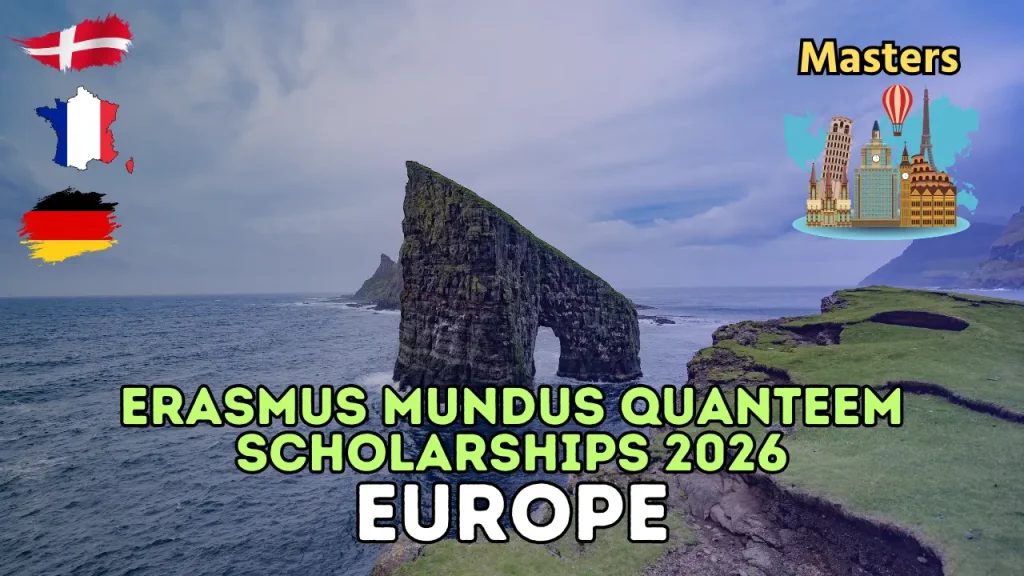
The Erasmus Mundus QuanTEEM Scholarships 2026 in the EU are a highly competitive, fully funded opportunity for international students who want to study quantum technologies and engineering across leading European universities. This guide covers all key details you need to apply successfully and optimize your chances of selection in 2026.
Basic information about the QuanTEEM scholarships 2026
QuanTEEM (Quantum Technologies and Engineering Erasmus Mundus Master) is a two‑year Erasmus Mundus Joint Master funded by the European Union and run by a consortium of three top European universities in France, Germany, and Denmark. The program focuses on advanced quantum technologies, quantum engineering, and related fields like nanostructures and quantum information science.
Key facts for 2026 intake:
- Program type: Erasmus Mundus Joint Master in Quantum Technologies and Engineering (QuanTEEM).
- Duration: 2 academic years (120 ECTS).
- Study locations: At least two universities in different EU countries during your studies.
- Scholarship coverage: Monthly stipend (around 1,400 EUR), full tuition fee waiver, insurance, and support for travel and visa costs for selected students.
- Application opening: Late 2025 / early 2026 for the 2026 cohort (QuanTEEM intakes typically open in Winter).
- Application deadline for scholarships: Many portals quote 6 April 2026 as the last date for QuanTEEM scholarship applications.
Always confirm dates and current funding status on the official QuanTEEM website, because scholarship availability can change by year.
University/institution details
A core consortium delivers the QuanTEEM Erasmus Mundus master of three full partner universities plus many associated industrial and academic partners.
Partner universities:
- Université Bourgogne Franche-Comté (UBFC) / Université Bourgogne Europe (UBE), France – Coordinates the program and hosts students on the Montmuzard campus in Dijon, with strong research in photonics, nanostructures, and quantum materials.
- Rheinland-Pfälzische Technische Universität Kaiserslautern-Landau (RPTU), Germany – Large technical university formed by the merger of TU Kaiserslautern and University Landau, known for cutting‑edge physics and engineering research.
- Aarhus University (AU), Denmark – One of Europe’s top 100 universities with internationally recognized research centers, strong in physics, quantum technologies, and engineering.
The consortium also involves 20+ associated partners, including start‑ups, SMEs, and large industries working in quantum technologies and high‑tech engineering. This gives QuanTEEM students exposure to internships, industry projects, and a strong professional network in Europe’s quantum ecosystem.
Study areas and available program tracks
QuanTEEM is fully dedicated to quantum technologies and engineering, with a multidisciplinary curriculum that combines physics, materials science, chemistry, and computer science. The program prepares students to become quantum engineers and researchers able to drive innovation in quantum computing, quantum communication, and quantum sensing.
Typical specialization areas within QuanTEEM include:
- Quantum technologies and quantum information.
- Quantum engineering for devices, materials, and nanostructures.
- Quantum materials and nanotechnology for advanced photonics and optoelectronics.
- Quantum simulation and computational quantum science.
Erasmus Mundus QuanTEEM Scholarships benefits
QuanTEEM is part of the Erasmus Mundus Joint Masters scheme, so top‑ranked applicants can receive a fully funded scholarship that covers almost all study costs in Europe.
Main benefits for QuanTEEM Erasmus Mundus scholarship holders:
- Erasmus Mundus scholarships not available this year
- Limited scholarships available: €680 net per month
- Mobility in Europe: Guaranteed study mobility across at least two European countries within the QuanTEEM consortium.
- Academic excellence environment: Access to high‑level labs, research centers, and industry partners across France, Germany, and Denmark.
These benefits make QuanTEEM one of the most attractive fully funded master’s opportunities in quantum technologies in Europe.
Benefits not included
- Additional personal expenses beyond the monthly stipend (entertainment, travel not related to studies, personal gadgets).
- Possible top‑up for very high‑cost housing in certain cities if rents exceed normal student budgets.
- Costs for bringing dependents or family members (Erasmus Mundus scholarships are designed for individual students).
- Extra language courses or certifications not part of the curriculum.
You should still budget carefully and be prepared with some personal savings, especially for visa deposits, initial accommodation, and emergencies.
Eligibility criteria for Erasmus Mundus QuanTEEM Scholarships
QuanTEEM targets strong students with a solid background in physics and related quantitative fields. General eligibility criteria include:
- Academic Requirements
- Bachelor’s degree in Science (minimum 180 ECTS) or equivalent
- Must have a strong background in Physics
- Math & Computer Science skills are a plus (but cannot replace Physics knowledge)
- English Language Requirements (for non-native speakers)
- One of the following:
- TOEFL: 600 (paper) / 95 (internet) / 250 (computer)
- IELTS: 6.5
- Cambridge FCE: Grade A or B
- University language certificate (minimum B2 level)
- One of the following:
- Other Rules
- Must clearly state your country of residence
- If you previously received an Erasmus Mundus scholarship, you cannot receive another for this program
- Compulsory physical mobility:
- At least 2 study periods in 2 different countries
- Countries must be different from your country of residence
- Each mobility = minimum 1 semester (30 ECTS)
- Virtual mobility is not allowed
Additional competitive factors include grades, research experience, motivation, and alignment of your profile with quantum technologies and engineering.
Required documents for the QuanTEEM application
To apply for the Erasmus Mundus QuanTEEM Scholarships 2026, you must prepare a complete and well‑structured application file. Typical required documents include:
- Passport or ID copy (passport must be valid at least 15 months beyond departure date)
- CV
- Motivation letter
- Full academic transcripts + grading scale
- Certified copy of diploma(s)
- English language certificate
- Professional experience certificates (if any)
- Optional but recommended: Recommendation letter(s)
- Any additional relevant documents
Erasmus Mundus QuanTEEM Scholarships Application process: step‑by‑step
Use this step‑by‑step guide to apply for Erasmus Mundus QuanTEEM Scholarships 2026 effectively:
- Apply online through the ‘e-candidat’ platform
Choose:
M1 STS physique fondamentale et applications parc. Quantum Technologies and Engineering – Erasmus Mundus Master (QuanTEEM) - Fill in:
- Personal information
- Educational background
- Selected master’s program
- Other relevant details
- You can save and edit before final submission
- Personal information cannot be changed after submission
- Make sure:
- Name, date of birth, place of birth match passport exactly
- All documents are uploaded before submission
- Incomplete applications will not be considered
Tips for a successful QuanTEEM application
Competition for Erasmus Mundus QuanTEEM Scholarships is intense, so you need a strong and well‑targeted application. Some practical tips:
- Emphasize your physics foundation: Clearly show advanced coursework in quantum mechanics, statistical physics, solid‑state physics, or related areas.
- Showcase quantitative and coding skills: Mention experience with programming (Python, C++, MATLAB), numerical simulations, or quantum‑related projects.
- Write a focused motivation letter: Explain why you want to work in quantum technologies, why QuanTEEM fits your goals, and how the mobility path supports your career plans.
- Align with research strengths: Refer to research topics and labs at UBFC/UBE, RPTU, and Aarhus University that match your interests.
- Get strong recommendation letters: Choose referees who know your academic work and can speak about your research potential and problem‑solving skills.
- Apply early: Do not wait until the last day; technical issues can occur, and early submission shows good planning.
Monthly living expenses for international students (in USD)
Living costs in France, Germany, and Denmark vary by city, lifestyle, and housing type.
- Accommodation (shared flat or student residence): 400–800 USD per month, depending on country and city.
- Food and groceries: 250–350 USD per month if you cook at home most of the time.
- Local transport: 40–80 USD per month with student discounts and monthly passes.
- Health insurance and utilities: Often partially covered by the scholarship; extra personal costs may be around 50–100 USD per month.
- Miscellaneous (phone, clothes, leisure, academic materials): 100–200 USD per month.
Overall, a realistic monthly budget is roughly 900–1,500 USD, which fits within the typical Erasmus Mundus living allowance (around 1,400 EUR) for most students if managed wisely.
Why choose the Erasmus Mundus QuanTEEM Scholarship? (5+ reasons)
There are many strong reasons why the QuanTEEM Erasmus Mundus master is an excellent choice for your graduate studies in quantum technologies:
- Fully funded, high‑value scholarship
- Tuition fees are fully covered, and you receive a generous monthly stipend plus insurance and support for travel and visa costs.
- Top European universities in quantum science
- You study at leading institutions in France, Germany, and Denmark, all with strong physics and engineering departments and high‑impact research.
- Cutting‑edge specialization in quantum technologies
- The curriculum is designed around quantum engineering, quantum information, nanostructures, and advanced materials, giving you skills that are in high demand in both academia and industry.
- International mobility and multicultural exposure
- You will live and study in at least two different European countries, experience different academic systems, and build a global professional network.
- Strong industry and research connections
- With more than 20 associated partners including start‑ups and large companies, you gain access to internships, joint projects, and potential employment in the European quantum ecosystem.
- Excellent career prospects
- Graduates are well positioned for PhD programs in quantum science, R&D roles in high‑tech industries, and careers in quantum computing, communications, and sensing.
- Recognized Erasmus Mundus brand
- Erasmus Mundus Joint Masters are internationally recognized for academic excellence and offer a strong, reputable credential on the global job market.
Frequently Asked Questions (FAQs) about Erasmus Mundus QuanTEEM Scholarships 2026
1. Do I need IELTS or TOEFL to apply?
Usually yes. QuanTEEM requires proof of English proficiency at a minimum B2 level or higher, demonstrated through an internationally recognized test such as IELTS or TOEFL or equivalent evidence accepted by the consortium.
2. Can students from any country apply?
Yes. The program is open to high‑level international students from all over the world, without geographical restriction, as long as they meet academic and language requirements.
3. What academic background is required?
You need a Bachelor’s degree in Science or equivalent (typically 180 ECTS) with a strong focus on physics; additional skills in mathematics and computer science are highly appreciated.
4. How many scholarships are available?
QuanTEEM indicates that approximately 20 Erasmus Mundus scholarships may be awarded per year, although the exact number can vary by funding cycle.
5. Can I apply if I have already received an Erasmus Mundus scholarship?
No. Candidates who have already benefited from an Erasmus Mundus Joint Master scholarship are normally not eligible for another EMJM scholarship.
Important Dates
- Applications open: 26 January 2026
- Application Deadline: 6th April 2026.
- Academic year starts: Second week of September 2026