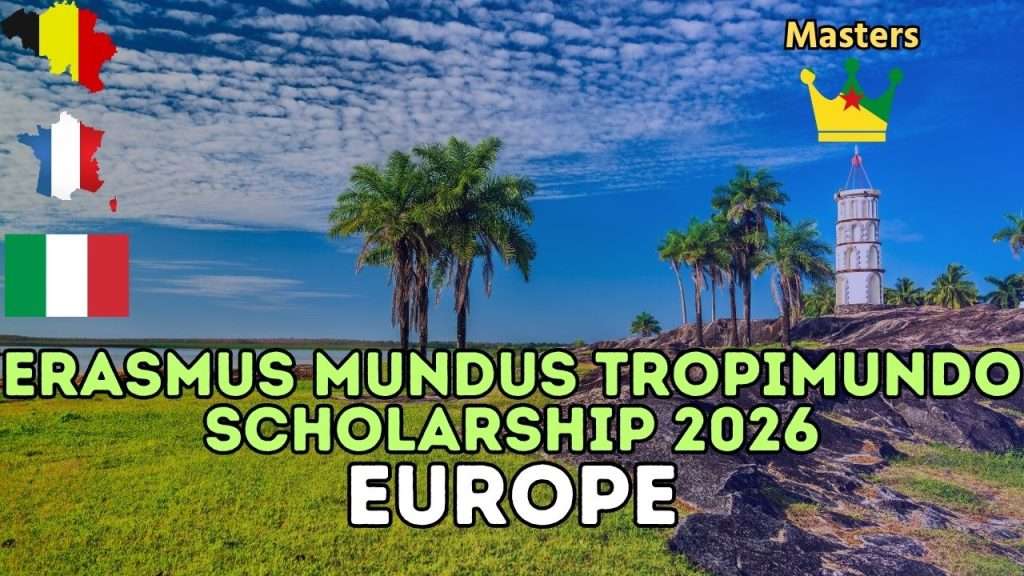
The Erasmus Mundus TROPIMUNDO Scholarship 2026 is a prestigious, fully funded joint master’s scholarship designed for aspiring students passionate about tropical biodiversity, conservation, and ecosystem management. Coordinated by the Université libre de Bruxelles (ULB), this program offers a unique international academic experience across leading European and tropical partner universities. This blog provides a comprehensive guide on the Erasmus Mundus TROPIMUNDO Scholarship 2026 including application deadlines, eligibility, benefits, study areas, and tips for a successful application.
Basic Information and Application Deadline
The Erasmus Mundus TROPIMUNDO Scholarship for academic year 2026-2027 is currently open for applications. The key deadline for scholarship applicants is 30 November 2025 for the first call. There may be a second call for self-funded applicants with deadlines extending into April and June 2026 depending on availability. The program officially starts in September 2026. Interested candidates should apply online via the official TROPIMUNDO Application, Information & Management (AIM) Tool on the program website.
- EC-funded Erasmus Mundus Joint Master in Tropical Biodiversity and Ecosystems.
- Co-financed by VLIR-UOS for “Mundus tropicalis” (Kenya & Philippines trajectories).
- Focus: Tropical rainforests, woodlands, and coastal ecosystems (mangroves, seagrass beds, coral reefs).
- Combines botany, zoology, ecosystem management, conservation, and ethnobotany.
- Includes one full semester in tropical regions (Caribbean, Amazon, Africa, Asia, or Oceania).
- Country: Belgium, France, Italy, and French Guiana.
University and Institution Details
The program is coordinated by the Université libre de Bruxelles (ULB) in Belgium and involves a consortium of nine European institutions and multiple partner universities in tropical regions including the Amazon, Caribbean, Central Africa, Asia, and French Guiana. Students get a joint master’s degree recognized by all partner universities they attend throughout the program. The academic journey spans four semesters with courses and fieldwork split between Europe and tropical field sites.
- UNIFI – Università degli Studi di Firenze (Italy)
- SU – Sorbonne Université (France)/MNHN – Muséum National d’Histoire Naturelle (France)
- UdG – Université de la Guyane Française (French Guiana)
- ULB – Université Libre de Bruxelles (Belgium)/VUB – Vrije Universiteit Brussel (Belgium)
Core Values
- Joint Master degree from multiple top universities.
- Mobility within Europe + full semester in the tropics.
- Study trajectory: from understanding ecosystems → research tools → conservation management.
- MSc Thesis in collaboration with partner universities.
- Exposure to multiple cultures and languages.
Consortium & Study Structure
- 8 European universities + 7 tropical partner universities.
- 4 semesters (2 years):
- Semester 1: Brussels – core training.
- Semester 2: Fieldwork in a tropical university.
- Semester 3: Specialisation at another European university.
- Semester 4: MSc thesis (return to starting point)
Study Areas and Programs Available
The Erasmus Mundus TROPIMUNDO Master’s program focuses on tropical biodiversity and ecosystem management offering an interdisciplinary curriculum including:
- Tropical Biodiversity and Ecosystem Management (MSc, 120 ECTS)
- Conservation and Restoration Ecology
- Biodiversity Informatics
- Tropical Botany and Zoology
- Sustainable Governance and Use of Natural Resources
- Ethnobotany and Tropical Ecology
Students spend second semester field schools in tropical rainforests, mangroves, seagrass beds, coral reefs, and other vital ecosystems to gain hands-on research experience.
Erasmus Mundus TROPIMUNDO Scholarship Benefits
The scholarship is fully funded covering:
- Tuition fees and consortium enrollment fees
- Monthly living allowance (~€1,400 or approximately $1,500 USD)
- Travel and visa costs including installation contributions
- Health and travel insurance
- Access to world-class research facilities, field courses, and expert supervision
- VLIR-UOS Scholarships for students from priority countries.
This comprehensive coverage allows students from all countries to focus on their studies and fieldwork without financial burdens.
Benefits Not Included
While the Erasmus Mundus TROPIMUNDO Scholarship covers most essential expenses, the following are generally not included:
- Personal expenses beyond monthly allowance
- Accommodation costs in some cases (though often subsidized)
- Visa application fees (may be partially reimbursed)
- Additional courses or certifications outside the program scope
Applicants should budget for any extra costs beyond the travel, tuition, and living allowance provided.
Eligibility Criteria for Erasmus Mundus TROPIMUNDO Scholarship
Applicants must meet the following:
- Bachelor’s degree (minimum 180 ECTS or equivalent) in Biology, Natural Sciences, Environmental Sciences, or related fields.
- Strong academic record and motivation for multidisciplinary environmental studies.
- Proficiency in English (typically CEFR B2 level; some trajectories may require French or Spanish proficiency).
- Experience or interest in tropical ecosystems, biodiversity, or conservation is advantageous.
- Open to candidates from all countries without restrictions.
- Applications reviewed by a Selection Committee of coordinators.
Required Documents for Application
Candidates must prepare and upload:
- Bachelor’s degree certificate and transcripts (English or certified translation)
- Curriculum Vitae (CV/Europass format recommended)
- Motivation letter explaining study trajectory choice
- Two or more academic/reference letters
- Proof of language proficiency (IELTS, TOEFL or equivalent)
- Copy of passport or official ID and a passport-sized photo
- Any additional documents such as publications, fieldwork proof, or work certificates if applicable
Erasmus Mundus TROPIMUNDO Scholarship Application Process: Step-by-Step Guide
- Create an account on the TROPIMUNDO official website’s AIM portal.
- Fill out the online application form with personal, academic, and trajectory details.
- Upload all required documents in PDF format.
- Submit your application before the 30 November 2025 deadline.
- Await the selection results; VLIR-UOS scholarships will be announced in January 2026, Erasmus Mundus scholarships by July 2026.
- If selected, complete any further steps required by the program coordination team.
- Prepare for program start in September 2026.
Tips for a Successful Application
- Start early and organize all documents in advance.
- Write a clear, concise, and compelling motivation letter showing passion for tropical biodiversity.
- Obtain strong recommendation letters highlighting academic excellence and relevant experience.
- Ensure language test scores meet or exceed requirements.
- Double-check all application entries and documents before submission.
- Follow up with the program coordinators for any clarifications.
Monthly Living Expenses for International Students (in USD)
The scholarship provides a monthly living allowance approximately equivalent to €1,400, which is about $1,500 USD. This amount comfortably covers:
- Accommodation and utilities
- Food and groceries
- Local transport
- Study materials and personal expenses
Some students manage on less, but budgeting around $1,200-$1,500 per month is advisable in major European cities.
Why Choose This Scholarship?
- Fully funded opportunity for international students with no tuition or major expenses.
- Study at top European universities and conduct fieldwork in pristine tropical ecosystems.
- Gain a joint master’s degree recognized across Europe and partner countries.
- Access to a global alumni network and sustainability professionals.
- Develop hands-on expertise in tropical biodiversity conservation and ecosystem management.
Frequently Asked Questions (FAQs)
Q: Who can apply for the Erasmus Mundus TROPIMUNDO Scholarship?
A: Bachelor’s graduates in biology, environmental sciences, or related fields from all countries are eligible.
Q: What is the application deadline?
A: The main scholarship application deadline is 30 November 2025.
Q: Does the scholarship cover living expenses?
A: Yes, a monthly stipend of about €1,400 (~$1,500 USD) is provided.
Q: Are language certificates required?
A: Yes, proof of English proficiency (or additional languages depending on trajectory) is mandatory.
Q: How long is the program?
A: It is a 2-year master’s program (4 semesters).
Official Link:
This detailed SEO optimized blog guide on the Erasmus Mundus TROPIMUNDO Scholarship 2026 uses relevant keywords such as “Erasmus Mundus Scholarship 2026,” “TROPIMUNDO Master program,” “fully funded scholarships,” “tropical biodiversity conservation,” “international master’s degree,” and “European universities for environmental studies” to help improve search rankings and attract scholarship seekers passionate about tropical ecosystems and international education.