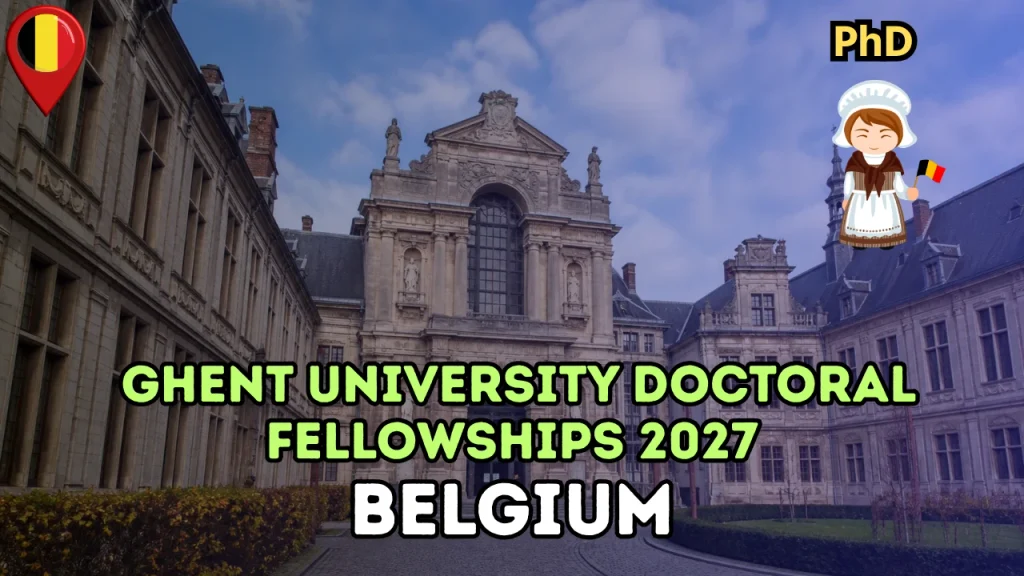
Securing a fully supported PhD position in Europe is a transformative milestone for any early-career researcher. The Ghent University Doctoral Fellowships 2027 in Belgium (funded through the university’s Special Research Fund / Bijzonder Onderzoeksfonds – BOF) represent one of Europe’s premier research funding opportunities. Designed as a joint “sandwich” doctoral program, this fellowship enables talented researchers—particularly from the Global South—to pursue a high-impact PhD split between Ghent University in Belgium and a partner institution in their home region.
This comprehensive guide provides an exhaustive breakdown of the Ghent University Doctoral Fellowships 2027. Below, you will find vital application deadlines, eligibility criteria, required documentation, step-by-step application instructions, living costs in Belgium, and actionable tips to submit a winning proposal.
Basic Information about the Scholarships
The Ghent University Doctoral Grants for Candidates from the Global South (BOF 2027) operate on a unique 48-month joint research framework. Under this “sandwich model,” PhD candidates spend a total of 24 months conducting research at Ghent University in Belgium and 24 months at their local partner university.
| Key Feature | Details & Information |
| Host Institution | Ghent University (Universiteit Gent), Belgium |
| Funding Body | Special Research Fund (BOF – Bijzonder Onderzoeksfonds) |
| Degree Level | Doctorate / PhD Position |
| Total PhD Duration | 48 Months (4 Years) |
| Funding Division | 24 Months funded by Ghent University; 24 Months co-funded locally |
| Number of Awards | 15 Fellowships per annual call |
| Exception Request Deadline | January 15, 2027 (for mobility/funding exceptions sent to [email protected]) |
| Main Application Deadline | February 9, 2027 at 23:59 Belgian Time (CET) |
| Results Announcement | From May 12, 2027 online |
| Earliest Research Start Date | October 1, 2027 (First Ghent stay: Oct 1, 2027 – Feb 28, 2028) |
University/Institution Details
Founded in 1817 by King William I of the Netherlands, Ghent University (UGent) is a top 100 global public research institution located in Flanders, the Dutch-speaking northern region of Belgium. Home to over 50,000 students and more than 15,000 academic and staff members, UGent consistently ranks among the top universities worldwide according to the Academic Ranking of World Universities (Shanghai Ranking) and the QS World University Rankings.
Ghent University is renowned for its motto, Dare to Think (Aude Sapere), encouraging open-minded inquiry, critical evaluation, and interdisciplinary innovation. Its eleven faculties span humanities, social sciences, natural sciences, engineering, bioscience, and medicine, offering a world-class environment equipped with state-of-the-art laboratories, libraries, and supercomputing hubs.
Research Focus (Available Program Names)
Position 1: PhD in Forest Disturbances and Recovery Using Satellite Data
- Study how drought, fire, cyclones, logging and climate change affect forests.
- Develop 3D digital twin models of forests.
- Use satellite data to monitor forest disturbances and recovery.
- Work with satellite missions such as ESA BIOMASS and NASA GEDI.
- Conduct research on tropical and temperate forest ecosystems.
- Possible fieldwork in Australia and other forest locations.
2nd Position: PhD in Machine Learning for Micro-CT Image Reconstruction
- Develop new methods for reconstructing micro-CT images using machine learning.
- Apply a technique called Implicit Neural Representations (INRs).
- Improve traditional CT image reconstruction methods.
- Conduct research in mathematics, signal processing, inverse problems and artificial intelligence.
- Design, implement and test new algorithms.
- Collaborate with researchers at Ghent University and CWI in Amsterdam.
Position 3: PhD in Lunar Resource Processing and Materials Research (LuMoCX)
- Develop technologies to produce metals, oxygen and construction materials from lunar soil.
- Study the use of lunar resources for future human settlements on the Moon.
- Conduct research on high-temperature processes and materials.
- Work with Computational Fluid Dynamics (CFD), molecular dynamics and numerical simulations.
- Investigate heat transfer, fluid flow and material properties.
- Participate in experimental research and scientific publications.
4th Position: PhD in Forest Structure and Microclimate Change
- Study how forest structures change over time.
- Investigate how forests regulate temperature and humidity.
- Examine the effects of climate change and natural disturbances on forest ecosystems.
- Use 3D terrestrial laser scanning technology to study forests.
- Analyse microclimate data, including temperature and relative humidity.
- Conduct research in tropical forests in Brazil and Australia and temperate forests in Belgium.
- Possible international fieldwork, including several-week research trips.
Position 5: Human–Robot Teamwork and Employee Well-being
- Investigate how employees experience working with robots in their daily workplaces.
- Explore how workers perceive robots as colleagues or team members.
- Examine cooperation, conflicts, and psychological challenges in human–robot teamwork.
- Study the effects of human–robot collaboration on employee well-being and job performance.
- Identify ways to create healthier and more sustainable workplaces.
- Research methods may include experiments, surveys, interviews, and literature reviews.
6th Position: Integrated Power Converters for Space Applications
- Research advanced power-converter architectures for space applications.
- Design highly integrated electronic circuits using Gallium Nitride (GaN) technology.
- Develop innovative electronic systems for spacecraft.
- Investigate circuit performance, temperature monitoring, short-circuit protection, and reliability.
- Collaborate with researchers at Ghent University, imec, and the University of Oviedo.
Position 7: Specialized Time-Sensitive Wireless Connectivity
- Research advanced wireless communication technologies for future 6G networks.
- Develop reliable and predictable wireless connectivity.
- Improve communication speed, latency, synchronization, and network reliability.
- Explore applications in industrial automation, robotics, autonomous systems, and critical infrastructure.
- Develop and test wireless networking solutions using advanced experimental platforms.
- Work with the IDLab research group and its Intelligent Wireless Networking (iWiNe) team.
Ghent University Doctoral Fellowships Benefits
All positions offer full-time doctoral fellowships at Ghent University.
Financial Benefits
- Full-time funded PhD positions for up to 48 months (4 years).
- Initially, a 12-month contract, which can be extended after a positive evaluation.
- Monthly fellowship equivalent to 100% of the net salary of an AAP member with comparable family circumstances.
- The fellowship is exempt from personal income tax if it meets the applicable regulatory conditions.
- Individual fellowship amounts depend on family circumstances and seniority.
Other Benefits
- 36 days of annual leave for full-time employees.
- Additional fixed holidays.
- Access to professional training and educational opportunities.
- Bicycle allowance.
- Eco vouchers.
- Opportunities to publish research papers.
- Opportunities to present research at international scientific conferences.
- Collaboration with experienced researchers and international research teams.
- Supportive research environment with attention to work-life balance.
Position 5: Human–Robot Teamwork and Employee Well-being
- Full-time PhD position for four years.
- Monthly net salary: €2,714.
- Doctoral training and research opportunities.
- Opportunity to publish research in international academic journals.
- Participation in international scientific conferences.
- Professional networking and collaboration with experts and organizations.
- Training in research methods, statistics, communication, and project management.
- Supportive research environment with experienced professors and other PhD researchers.
- 36 days of annual leave.
- Additional annual fixed holidays.
- Bicycle allowance and eco vouchers.
6th Position: Integrated Power Converters for Space Applications
- Fully funded, full-time PhD position for up to 48 months.
- Annual gross funding package: €56,640.
- Additional annual family allowance: €7,920, where applicable.
- Living and mobility allowances under the MSCA funding package.
- Full employment contract and Belgian social-security coverage.
- Joint doctoral degree from Ghent University and the University of Oviedo, Spain.
- International research training with leading universities, the European Space Agency, imec, and European space companies.
- Research secondments:
- Three months at imec in Leuven, Belgium.
- Six months at the University of Oviedo, Spain.
- Specialized training, summer schools, and international research experiences.
Position 7: Specialized Time-Sensitive Wireless Connectivity
- Full-time PhD position for up to 48 months.
- Initial 12-month contract, extendable after a positive evaluation.
- Fellowship equivalent to 100% of the net salary of an academic assistant with comparable family circumstances.
- Fellowship is tax-free under the applicable doctoral fellowship regulations.
- Training and professional development opportunities.
- Opportunity to work with an internationally recognized research group.
- Collaboration with researchers and industrial organizations.
- 36 days of annual leave.
- Additional annual fixed holidays.
- Bicycle allowance and eco vouchers.
Additional Research Opportunities
- Position 1: Collaboration with researchers from University College London.
- Position 2: Collaboration with the Centrum Wiskunde en Informatica (CWI), Amsterdam.
- Position 3: Interdisciplinary research in materials science, engineering and space technology.
- Position 4: International research and fieldwork in Brazil, Australia and Belgium.
Benefits Not Included
While generous, the Ghent BOF scholarship is a co-funded “sandwich” scheme and does not cover the following:
- Funding for the 24 Months in the Global South: Ghent University does not pay a stipend or research allowance during the 24 months the researcher spends at their home partner institution.
- Full Family Relocation Allowances: Additional stipends for dependent spouses or children are not directly included in the baseline fellowship grant.
- Local Living Costs Outside Belgium: Local housing, transport, and personal insurance during the research period spent at the partner institution must be covered by local co-funding.
- Visa Processing and Legalization Fees: Passport issuing, legal translation of academic documents, and embassy visa application administrative fees must be paid out-of-pocket initially by the candidate.
Eligibility Criteria for the Ghent University Doctoral Fellowships
To qualify for the Ghent University Doctoral Fellowships 2027, candidates must meet all the following conditions:
Position 1: Forest Disturbances and Satellite Data
- Master’s degree in a relevant field, such as:
- Environmental Sciences
- Remote Sensing
- Geosciences
- Physics
- Computer Science
- Bioscience-Engineering
- Surveying
- Programming proficiency in at least one of R, C++ or Python.
- Previous experience with satellite remote sensing and satellite data analysis.
- Knowledge of vegetation radiative transfer modelling is preferred.
- Experience with terrestrial laser scanning and 3D forest modelling is an advantage.
- Interest in nature, forests and forest ecology.
- Good written and spoken English.
2nd Position: Machine Learning and CT Image Reconstruction
- Master’s degree, preferably in:
- Engineering
- Physics
- Mathematics
- Computer Science
- Or an equivalent field.
- Strong knowledge of mathematics and linear algebra.
- Interest in signal processing and inverse problems.
- Knowledge or experience in machine learning.
- Strong programming skills in Python or C++.
- Experience with GPU computing and modern machine learning frameworks.
- Knowledge of medical image reconstruction or tomography is desirable.
- Strong analytical and research skills.
Position 3: Lunar Resource Processing and Materials Research
- Master’s degree in:
- Engineering
- Materials Science and Engineering
- Chemical Engineering
- Mechanical Engineering
- Metallurgical Engineering
- Chemistry
- Physics
- Or a related discipline.
- Strong interest in scientific research.
- Good analytical and problem-solving skills.
- Experience with programming, numerical modelling or simulations is an advantage.
- Experience with high-temperature experiments or materials characterisation is preferred.
- Ability to work independently and as part of a team.
- Excellent English communication skills.
4th Position: Forest Structure and Microclimate
- Master’s degree in a relevant field, such as:
- Environmental Sciences
- Remote Sensing
- Geosciences
- Physics
- Computer Science
- Bioscience-Engineering
- Surveying
- Programming proficiency in at least one of R, C++ or Python.
- Willingness to participate in fieldwork in tropical and temperate forests.
- Knowledge of radiative transfer modelling is an advantage.
- Experience with laser scanning and 3D forest modelling is an advantage.
- Interest in nature and forest ecology.
- Good written and spoken English.
Position 5: Human–Robot Teamwork
- A Master’s degree relevant to the research project is required.
- A research-based Master’s thesis is mandatory.
- Relevant academic backgrounds include:
- Human Resource Management (HRM).
- Organizational Behaviour.
- Management.
- Business Economics.
- Communication.
- Work, Organizational or Social Psychology.
- Good academic results.
- Experience with research methods and statistics.
- Experience with SPSS or R.
- Good scientific writing and speaking skills in both English and Dutch.
- Strong organizational, analytical, and interpersonal skills.
- Applicants with degrees from outside the EU must submit a NARIC certificate of equivalence.
6th Position: Integrated Power Converters
- A Master’s degree in Electronic Engineering, Electrical Engineering, or a closely related discipline.
- Strong knowledge of electronic systems and circuit design.
- Understanding of analogue electronics and power electronics.
- Knowledge of DC-DC converters and switching converters.
- Understanding of semiconductor devices.
- Experience with circuit modelling and simulation.
- Familiarity with SPICE, MATLAB/Simulink, or Python.
- Experience with analogue/mixed-signal IC design, Cadence tools, PCB design, or laboratory testing is an advantage.
- Strong research, analytical, and problem-solving skills.
- Excellent English communication skills.
Additional eligibility conditions:
- Must not already hold a doctoral degree.
- Must not have lived or carried out the main professional activity in Belgium for more than 12 months during the 36 months immediately before recruitment.
- Must meet the doctoral admission requirements of both Ghent University and the University of Oviedo.
Position 7: Wireless Connectivity
- A Master’s degree in Computer Science, Telecommunications, Electrical Engineering, or a closely related field.
- Excellent academic results, with at least distinction and preferably great distinction.
- Strong interest in wireless communication networks and 6G technologies.
Relevant technical skills may include:
- Digital communication and signal processing.
- FPGA design (VHDL, Verilog, SystemVerilog).
- Wireless communication and Wi-Fi technologies.
- C/C++ programming and Linux environments.
- Networking protocols and network management.
- Time-Sensitive Networking (TSN).
- Real-time systems and industrial communication.
- Software development and network algorithm design.
Additional requirements:
- Strong analytical and problem-solving skills.
- Ability to work independently and in a team.
- Excellent written and spoken English.
Required Documents for the Application
All application materials must be completed in English using official UGent templates:
- Official Joint Application Form: Completed application template detailing the candidate’s profile, joint research project, timeline, and methodology.
- Joint PhD Research Proposal: A detailed scientific proposal outlining research background, key objectives, methodology, work packages, gender impact, and societal development impact.
- Official Co-Funding Statement: Formal declaration signed by the authority of the partner institution confirming 24 months of full-time local PhD funding and exemption from excessive teaching or administrative duties during the research period.
- UGent Supervisor Advice Form: Written recommendation and evaluation completed directly by the Ghent University host professor.
- Partner Supervisor Motivation Letter: Detailed evaluation letter from the partner university co-promoter.
- Academic Transcripts & Certificates: Certified copies of Master’s and Bachelor’s degree diplomas along with full transcripts of records (with official English or Dutch translations).
- Curriculum Vitae (CV): Standardized academic CV highlighting publications, research experience, academic honors, and language proficiency.
- Copy of Valid Passport: Identification page confirming nationality in an eligible country.
Ghent University Doctoral Fellowships Application Process (Step-by-Step Guide)
Position 1: Forest Disturbances and Satellite Data
- Apply through the Online Application Form.
- Required documents:
- Updated CV.
- Motivation letter.
- Use Google Chrome to complete the application form.
- Mention your favourite animal in the motivation letter.
- Check your spam folder for the application confirmation.
- Contact person: Prof. Kim Calders.
- Email: [email protected].
2nd Position: Machine Learning and CT Image Reconstruction
- Send your application by email.
- Required documents:
- Updated CV.
- Copy of Master’s degree certificate, if available.
- Motivation letter.
- Email: [email protected].
- Contact person: Prof. Jan Aelterman.
- Late applications will not be accepted.
Position 3: Lunar Resource Processing and Materials Research (LuMoCX)
- Download and complete the official application form.
- Required documents:
- Completed application form.
- Copies of all higher-education degree certificates.
- Academic transcripts.
- Names and email addresses of three referees.
- Submit the documents electronically to [email protected].
- Write “LuMoCX Vacancy” in the email subject line.
- In the motivation letter, explain your experience with:
- Modelling and simulations.
- Programming.
- High-temperature processes.
- Materials characterisation.
- Experimental research.
- Mention which research topics interest you most.
- Incomplete applications will not be considered.
- Contact person: Prof. Inge Bellemans.
- Email: [email protected].
4th Position: Forest Structure and Microclimate
- Apply through the Online Application Form.
- Required documents:
- Updated CV.
- Motivation letter.
- Mention your favourite animal in the motivation letter.
- Check your spam folder for the application confirmation.
- Contact person: Prof. Kim Calders.
- Email: [email protected].
Position 5: Human–Robot Teamwork and Employee Well-being
Required academic qualifications:
- A Master’s degree relevant to the research project.
- A research-based Master’s thesis is mandatory.
- Relevant fields include:
- Human Resource Management.
- Organizational Behaviour.
- Management.
- Business Economics.
- Communication.
- Work, Organizational, or Social Psychology.
- Good academic performance.
- Experience with SPSS or R and good statistical skills.
- Good English and Dutch communication skills.
- Strong research, analytical, writing, and problem-solving abilities.
- Applicants with non-EU degrees must submit a NARIC certificate of equivalence.
Required application documents:
- Motivation letter.
- CV highlighting relevant qualifications and experience.
- Master’s diploma, if available.
- Academic transcripts for each year of study.
- English summary of the Master’s thesis (1–2 pages).
- Contact details of two academic referees, preferably including the Master’s thesis supervisor.
Application method:
- Submit all documents together in one PDF file.
- Send the application by email to: [email protected].
- The position involves research on human–robot teamwork, employee well-being, and workplace performance.
6th Position: Integrated Power Converters for Space Applications
Required academic qualifications:
- Master’s degree in Electronic Engineering, Electrical Engineering, or a closely related discipline.
- Strong knowledge of electronic systems and circuit design.
- Knowledge of analogue electronics, power electronics, and DC-DC converters.
- Understanding of semiconductor devices.
- Experience with circuit modelling and simulation.
- Familiarity with SPICE, MATLAB/Simulink, or Python.
- Good English communication skills.
- Experience with IC design, Cadence tools, PCB design, or laboratory testing is an advantage.
Additional eligibility conditions:
- Applicants must not already hold a doctoral degree.
- Applicants must not have lived or carried out their main activity in Belgium for more than 12 months during the 36 months before recruitment.
- Must meet the doctoral admission requirements of Ghent University and the University of Oviedo.
Required application documents:
- Detailed CV in Europass format.
- Bachelor’s academic certificate and transcripts.
- Master’s academic certificate and transcripts.
- Copy of a valid passport or European identity card.
- Contact details of two academic referees.
Application method:
- Submit all documents in English or with English translations.
- Send the application by email to: [email protected].
- Email subject: Application BESCAPE PhD position DC6.
Position 7: Specialized Time-Sensitive Wireless Connectivity
Required academic qualifications:
- Master’s degree in Computer Science, Telecommunications, Electrical Engineering, or a closely related field.
- Strong academic results, preferably distinction or great distinction.
- Knowledge of wireless communication systems and networking.
- Programming skills in C/C++ and Linux environments.
- Knowledge of networking protocols, Wi-Fi, and network management.
- Experience with FPGA design, digital communication, signal processing, or Time-Sensitive Networking is an advantage.
- Strong analytical, research, and communication skills.
- Fluent written and spoken English.
Application method:
- Apply through the official online vacancy portal: Apply for Position 7.
- Late applications will not be accepted.
Tips for a Successful Application
- Start Early (3–6 Months Ahead): Finding a Ghent professor who is available and willing to co-write a grant application takes significant time.
- Demonstrate Clear Development Relevance: The BOF Research Council prioritizes projects that address critical local scientific or societal issues in the candidate’s home country or region.
- Ensure Local Institutional Capacity: Your proposal should clearly explain how the research will build scientific capacity, foster long-term institutional partnerships, and transfer skills to your home institution.
- Co-author the Proposal: Do not submit a generic proposal. Work directly with your Ghent supervisor so that the research plan aligns with current lab infrastructure and expertise.
- Double Check Supervisor Rules: Verify that your Ghent promoter has not submitted proposals for more than two candidates in the call, and that those two candidates comply with the required gender diversity rule.
Monthly Living Expenses for International Students in Belgium
Living costs in Ghent are moderate compared to larger European capitals like Paris or London, but proper budgeting is essential. Below is an estimated breakdown of monthly living costs in USD for an international PhD student living in Ghent:
| Expense Category | Estimated Monthly Cost (USD) | Notes & Details |
| Accommodation (Rent) | $550 – $850 | Student studio, private room, or shared apartment (kot) |
| Utilities & Internet | $100 – $160 | Electricity, heating, water, and high-speed Wi-Fi |
| Groceries & Food | $250 – $400 | Cooking at home and shopping at local supermarkets (Aldi, Colruyt) |
| Local Transport | $35 – $60 | Monthly bike rental (Swapfiets) and De Lijn bus/tram pass |
| Health Insurance & Medical | $15 – $35 | Belgian mandatory health insurance policy (Mutualiteit) |
| Books & Study Materials | $30 – $60 | Printing, scientific supplies, conference materials |
| Miscellaneous & Leisure | $150 – $250 | Personal activities, clothing, eating out |
| Total Estimated Expenses | $1,130 – $1,815 / month | Varies based on personal lifestyle choices |
Note: Ghent University’s monthly stipend comfortably covers all standard living expenses, leaving room for savings or local travel.
Why Choose This Scholarship? (Top 5 Reasons)
- Dual Research Footprint (Sandwich PhD Model): You earn a prestigious PhD degree from a top-100 European university while maintaining strong academic, professional, and personal links in your home country.
- Dedicated Operational & Travel Budgets: Beyond personal living stipends, the fellowship grants €8,000 in international travel funds and €310/month in lab operational funds, ensuring you are never stalled by a lack of research consumables.
- Capacity Building for the Global South: The program actively supports international scientific cooperation, transferring advanced lab techniques, methodology, and technology directly back to partner institutions in developing nations.
- Access to World-Class Facilities: Researchers gain full access to Ghent University’s cutting-edge scientific infrastructure, high-performance computing centers, expert doctoral schools, and international networks.
- No Ghent Tuition Fees: The fellowship provides a complete waiver of Ghent University tuition fees, allowing 100% of awarded funds to go toward research, travel, and personal living costs.
Frequently Asked Questions (FAQs)
1. Is the Ghent University BOF Doctoral Scholarship fully funded?
Ghent University funds 24 months of research spent in Belgium (including stipend, bench fee, and travel allowance). The remaining 24 months spent in the Global South must be funded by the partner institution through a local salary or scholarship.
2. Can I apply if my home university does not provide local PhD funding?
No. Mandatory local co-funding is a strict eligibility requirement. The home institution must formally sign a commitment statement confirming 24 months of full-time research funding.
3. Do I need an English proficiency test (e.g., IELTS or TOEFL)?
Ghent University departments generally require proof of English proficiency (such as an IELTS Academic score, TOEFL iBT, or an official university certificate confirming prior instruction in English). Requirements should be confirmed directly with your UGent host department.
4. What is the deadline for the 2027 call?
The main electronic application deadline is February 9, 2027 at 23:59 Belgian time (CET). Exception requests regarding mobility or prior funding must be submitted earlier, by January 15, 2027.
5. When will scholarship selection results be announced?
Official selection outcomes will be published on the Ghent University website starting May 12, 2027. Unsuccessful applicants receive written feedback within six weeks of the results release.
Application Deadlines and Important Dates
Position 1: Forest Disturbances and Satellite Data
- Application deadline: November 15, 2026, at 23:59 CEST.
- Interview notification: Late November 2026.
- Tentative online interview dates: December 21–23, 2026.
- Earliest starting date: January 1, 2027.
2nd Position: Machine Learning and CT Image Reconstruction
- Application deadline: December 18, 2026, at 23:59.
- Earliest starting date: December 1, 2026.
Position 3: Lunar Resource Processing and Materials Research
- Application deadline: December 7, 2026, at 23:59.
- Starting date: As soon as the selection process and administrative formalities are completed.
4th Position: Forest Structure and Microclimate
- Application deadline: November 30, 2026, at midnight CEST.
- Interview notification: Mid-December 2026.
- Online interviews: Mid-January 2027.
- Earliest starting date: February 1, 2027.
Position 5: Human–Robot Teamwork
- Application deadline: November 18, 2026, at 11:59 PM.
- Shortlisted candidates notified: November 30, 2026.
- Interview: December 16–17, 2026.
- Expected starting date: February 1, 2027, at the earliest.
6th Position: Integrated Power Converters for Space Applications
- Application deadline: December 15, 2026, at 11:59 PM.
- Expected starting period: May–October 2027.
Position 7: Specialized Time-Sensitive Wireless Connectivity
- Application deadline: November 30, 2026, at 11:59 PM.
- Expected starting date: October 1, 2026, at the earliest, as stated in the vacancy announcement.