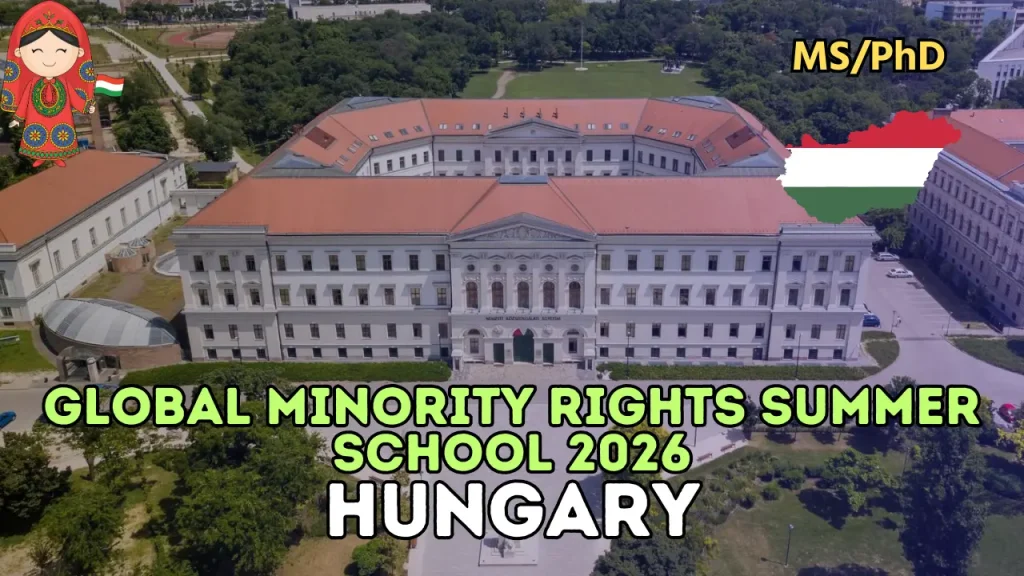
The Global Minority Rights Summer School 2026 in Hungary is a fully funded, one‑week, high‑level training program in Budapest focusing on self‑determination and minority rights, hosted at Ludovika University of Public Service. The Tom Lantos Institute (TLI), the Ludovika University of Public Service (Budapest), the Human Rights Consortium (Institute of Commonwealth Studies, School of Advanced Study, University of London) and the Unrepresented Nations & Peoples Organization (UNPO) invite applications for the fourteenth Global Minority Rights Summer School. The theme of the 2026 Summer School is “Self-determination and Minority Rights”.
Basic information about the summer school
The Global Minority Rights Summer School 2026 is an intensive 6‑day international summer school designed for students, researchers, practitioners, civil servants, journalists, and activists interested in minority rights, international law, and human rights. The 2026 theme is “Self‑Determination and Minority Rights”, offering academic and practice‑oriented sessions on legal, political, cultural, and economic dimensions of minority protection.
- Held in Budapest, Hungary
- Venue: Ludovika University of Public Service
- Dates: 5–10 July 2026 (6 days, in‑person).
- Number of participants: around 20–25 from around the world.
- Opportunities to:
- Present case studies
- Join panel discussions
- Engage in interactive Q&A sessions
- Opportunities to:
- Title: Global Minority Rights Summer School 2026
- Theme: Self-determination and Minority Rights
- Organized by:
- Tom Lantos Institute (TLI)
- Ludovika University of Public Service
- Human Rights Consortium
- Unrepresented Nations & Peoples Organization (UNPO)
- Edition: 14th Summer School
- Format: In-person (some hybrid lectures)
- Application deadline: Monday, 9 March 2026, 09:00 CET.
- Application fee: No application fee is charged.
Confirmed Speakers (Preliminary)
- UN Special Rapporteur on minority issues
- Professor Nicolas Levrat
- Hon. Dr. Litha Musyimi-Ogana
- Professor Mohammad Shahabuddin
University/Institution details
The Global Minority Rights Summer School 2026 takes place at Ludovika University of Public Service in Budapest, Hungary. Ludovika is a specialized public university focusing on public administration, law enforcement, international relations, and public service education, and it frequently hosts high‑level international summer schools and training programs.
Key institutional partners:
- Ludovika University of Public Service (NKE), Budapest – venue and academic host.
- Tom Lantos Institute (TLI) – an independent human and minority rights organization co‑organizing the school.
- Human Rights Consortium, School of Advanced Study, University of London – long‑term academic partner for the Global Minority Rights Summer School series.
Study areas and program focus
While this is a summer school (not a full degree), it offers a structured, advanced curriculum in minority rights and related fields.
Main thematic and study areas include:
- Understanding self-determination in international law
- Relationship between self-determination and minority rights
- Topics include:
- Internal & external self-determination
- Autonomy & secession
- Postcolonial contexts
- Mobilization strategies
- Cultural & economic dimensions
- Self-determination in digital spaces
- Decolonial approaches
- Self-determination as a peace strategy
Global Minority Rights Summer School benefits
Several fully funded or scholarship spots are available for eligible participants who demonstrate financial need. While the exact wording varies by announcement, key benefits for scholarship‑supported places generally include:
- Tuition Fee: €200
- Covers tuition, accommodation, breakfast & lunch
- Financial Support:
- Full Scholarship: Tuition + travel to Budapest
- Partial Scholarship: Tuition only
- Accommodation: Shared on-campus dormitories
- Meals: Breakfast & lunch included (dinner not included except gala dinner)
- Course materials and access to preparatory reading via an online platform.
- Participation in special events, including a closing gala dinner.
- High‑level lectures, workshops, and networking with world‑class experts and practitioners in minority rights.
Some communications describe the program as fully funded for selected participants, especially on scholarship promotion sites targeting international students.
Benefits not included
- International travel costs to and from Budapest (round‑trip airfare or other transport).
- Visa application fees and related consular costs, if required.
- Dinners on most days (only breakfast and lunch are included, except the gala dinner).
- Personal expenses: local transport, phone, leisure, health insurance, and other personal purchases.
- Travel insurance and medical insurance, which may be mandatory for entry or visa.
Eligibility criteria for Global Minority Rights Summer School
The Global Minority Rights Summer School is open to a broad, interdisciplinary international audience. According to recent calls, typical eligibility criteria include:
- MA & PhD students
- Academics & teachers
- Public servants & policymakers
- Journalists
- Civil society & minority rights activists
- Anyone interested in minority rights
- Strong English proficiency required
- Scholarship Priority:
- Applicants working in minority rights
- Those with financial need
- People belonging to minority or Indigenous communities
- Must show strong motivation & future plans
Required documents
While small variations exist between annual calls, the 2026 application process closely follows recent years. Applicants typically must prepare:
- Completed official application form (downloaded from the organizers’ site or linked in the call).
- Signed recommendation letter
- No additional documents accepted
- Late/incomplete applications will not be considered
- Contact: [email protected]
- Proof of English proficiency (formal test is typically not strictly required, but you must show you can participate fully in English).
- For scholarship applicants: a brief financial need statement may be required, showing why you need financial support.
Global Minority Rights Summer School Application process (step‑by‑step)
The scholarship and program application is straightforward but competitive, so following each step carefully is crucial.
- Read the official call carefully
Visit the official Global Minority Rights Summer School or institutional partner pages and read the 2026 call for applications, including eligibility, deadlines, and scholarship notes. - Download and fill out the application form
Obtain the official application form from the organizers’ website or via the link provided in partner announcements and complete all sections accurately (personal details, education, experience, motivation, and scholarship request if applicable). - Obtain a signed recommendation letter
Ask a professor, supervisor, or professional referee who knows your work to write and sign a recommendation letter specifically for the Global Minority Rights Summer School 2026. - Prepare your CV and motivation statement
Update your CV with relevant human rights, minority, academic, or civic experience, and write a concise motivation statement explaining your interest in self‑determination and minority rights. - Assemble the application package
Combine the application form, recommendation letter, CV, and any other required documents following the instructions (PDF is usually preferred). - Submit by email before the deadline
Send your complete application package to the designated Summer School email address before 9 March 2026, 09:00 CET; late submissions are not accepted. - Wait for the selection result
The organizers review all applications and notify selected participants by email shortly after the deadline. - Confirm participation and arrange travel
If accepted, confirm your participation quickly and start arranging your visa, travel, and insurance, especially if you need to travel from outside Europe.
Tips for a successful application
To stand out in a competitive international human rights summer school, your application should be focused, authentic, and aligned with the program’s goals.
- Clearly link your background to minority rights: Show how your studies, research, or work already engage with human rights, minority issues, or self‑determination.
- Connect your goals to the 2026 theme: Explicitly mention “Self‑Determination and Minority Rights” and explain how this theme fits your academic or professional plans.
- Highlight practical impact: Describe how you will use the knowledge in your community, institution, or country, especially if you work with minorities or marginalized groups.
- Choose a strong referee: Ask someone who knows your academic or professional work in depth and can comment on your commitment to human rights and your potential.
- Respect all formal instructions: Keep within word limits, submit only required documents, and meet the exact email and deadline requirements.
- Emphasize English skills: You do not necessarily need IELTS, but mention previous studies, conferences, or projects in English to reassure the selection committee.
A concise, well‑structured application that directly answers what the organizers are looking for will have a higher chance of success.
Monthly living expenses for international students in Budapest (USD)
Although the summer school lasts just one week, it helps to understand typical monthly living costs in Budapest as an international student. Average expenses per month (1 USD ≈ 350–380 HUF, figures are approximate):
- Student accommodation (shared dorm or room, if not covered): 250–400 USD.
- Food and groceries: 200–300 USD (less for one‑week stays, especially if breakfast and lunch are provided).
- Local transport (public transit pass): 25–40 USD.
- Mobile/internet: 15–25 USD.
- Personal expenses and leisure: 100–150 USD, depending on lifestyle.
For one week at the summer school with accommodation, breakfast, and lunch already covered, many participants can manage with roughly 150–250 USD for dinners, local transport, and personal costs, excluding international flights.
Why choose the Global Minority Rights Summer School 2026?
There are many summer programs in Europe, but this one has several strong advantages for your academic and professional profile.
- Unique focus on minority rights and self‑determination
Few programs address self‑determination and minority rights in such depth, combining legal, political, and cultural perspectives in one intensive course. - High‑level international faculty and partners
The summer school is organized with respected institutions like the Tom Lantos Institute, Ludovika University, and the Human Rights Consortium, bringing experienced academics, UN experts, and practitioners. - Fully funded or low‑cost participation for selected candidates
Scholarships cover the participation fee, accommodation, and meals for participants with financial need, making it accessible even if you come from low‑ or middle‑income countries. - Powerful networking and career value
With only about 20–25 participants, you can build close connections with peers from different regions and with global experts in minority protection, which is valuable for careers in NGOs, international organizations, and academia. - Experience in Budapest, a central European hub
Studying in Budapest gives you exposure to Central European history, culture, and minority issues, plus access to a vibrant city with rich academic and human rights networks. - Opportunity to present your own research
Participants are often invited to present research projects or advocacy work, which can strengthen your profile, improve your public speaking, and generate feedback from experts. - No application fee and flexible academic backgrounds
The absence of application fees and the openness to various professional profiles (students, officials, journalists, activists) make this opportunity more inclusive.
Frequently asked questions (FAQ)
1. Do I need IELTS or TOEFL to apply?
There is no explicit IELTS requirement for the 2026 summer school, and some calls specify that IELTS is not required, but you must be proficient in English to follow lectures and participate in discussions.
2. Who can apply for the 2026 Global Minority Rights Summer School in Hungary?
MA and PhD students, researchers, public servants, decision‑makers, journalists, civil society actors, and other professionals with a strong interest in minority rights and self‑determination are encouraged to apply, regardless of nationality.
3. How long is the program and where is it held?
It is a 6‑day, in‑person summer school running from 5 to 10 July 2026 at Ludovika University of Public Service in Budapest, Hungary.
4. How competitive is the selection?
The summer school typically accepts around 20–25 participants from many countries, so the process is competitive; strong motivation, relevant background, and a well‑structured application will help you stand out.
5. Will I receive a certificate?
Past editions of the Global Minority Rights Summer School have provided certificates of participation upon successful completion, which can be useful for your CV or academic records; you should check the 2026 call for precise wording.
Application Details
Deadline: Monday, March 9, 2026 (09:00 CET)