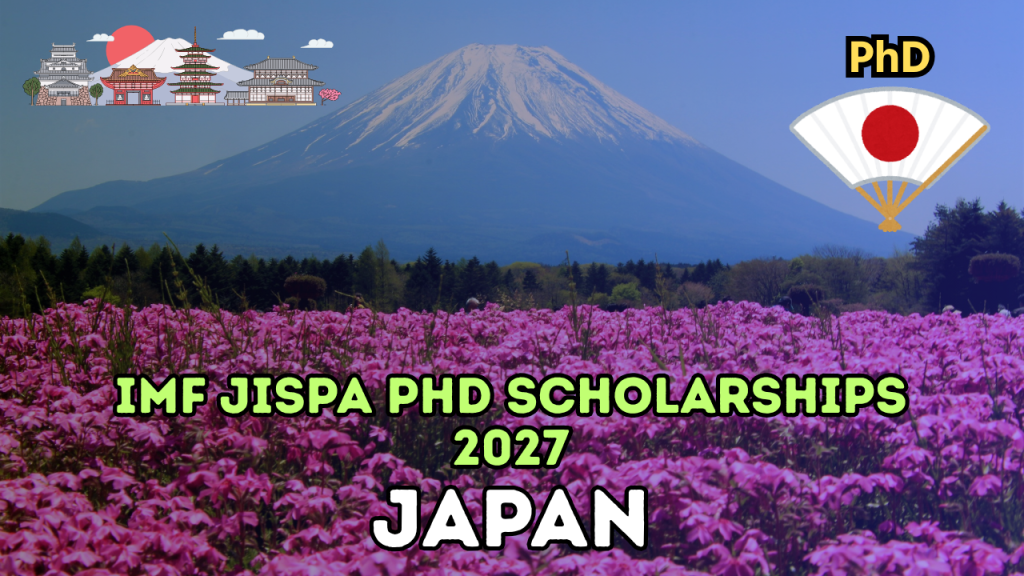
Are you a forward-thinking public sector professional eager to spearhead macroeconomic stability and development in the Asia-Pacific region? The IMF JISPA PhD Scholarships 2027 in Japan represent one of the most elite, career-defining fellowships available for government officials. The Ph.D. track offers highly motivated government officials the opportunity to pursue doctoral studies at any accredited university in Japan. The program is designed for scholars who seek to further advance research skills required for their future roles as prominent economic policymakers and institutional leaders who hold a strong commitment to address complex challenges in their home countries.
Funded by the International Monetary Fund (IMF) and supported generously by the Government of Japan, the Japan-IMF Scholarship Program for Asia (JISPA) PhD Track offers macroeconomists and institutional leaders the financial freedom and academic scaffolding to solve complex economic challenges facing their home countries.
Basic Information & Application Deadline
The JISPA PhD track is specifically engineered for key junior and mid-level government officials working directly within economic policymaking institutions.
- Host Country: Japan
- Funding Organizations: International Monetary Fund (IMF) & The Government of Japan
- Target Study Intake: September/October 2027 or April 2028
- JISPA PhD Track Application Window: May 1 – June 1, 2027
- Program: PhD scholarship in Japan under the Japan–IMF Scholarship Program for Asia (JISPA).
- Study level: PhD/Doctoral degree.
- Study location: Any accredited university in Japan.
- Important: You must apply to and secure admission from a Japanese university yourself. JISPA does not apply to universities on your behalf.
- Official Scholarship Application Deadline: June 1, 2027, at 23:59 Japan Standard Time (JST).
University & Institution Details
Unlike standard structured institutional scholarships, the JISPA PhD Track allows you to pursue doctoral studies at any accredited university in Japan that hosts a robust economics or public policy program.
Scholars frequently choose top-tier national and private research institutions across Japan, including:
- The University of Tokyo (Graduate School of Economics / GraSPP)
- Hitotsubashi University (School of International and Public Policy)
- National Graduate Institute for Policy Studies (GRIPS)
- Kyoto University
- Waseda University
These universities operate at the leading edge of global econometric modeling and development planning, providing a direct gateway into high-level collaborative networks consisting of international policy architects, central bankers, and seasoned academic advisors.
Targeted Study Areas & Available Programs
The research focus must explicitly tie back to macroeconomics, institutional leadership, and strategic policy engineering. Programs must be fully accredited PhD or doctoral paths conducted in either English or Japanese (English tracks are highly preferred by international fellows).
Core Eligible Areas of Research:
- Macroeconomics & Monetary Economics
- Public Finance, Economic Statistics, & Taxation
- Development Economics & International Trade
- Financial Regulation & Debt Sustainability
- Climate Economics & Institutional Reform
- Labor Economics & Quantitative Public Policy
IMF JISPA PhD Scholarships Benefits:
The JISPA framework provides full financial support, enabling scholars to concentrate entirely on complex mathematical frameworks and quantitative datasets.
- University admission fees
- Tuition fees
- Monthly living stipend
- One round-trip economy airfare
- Financial support for:
- Field research
- International academic conferences
(subject to JISPA conditions)
- Research & Academic Opportunities
- JISPA scholars may get opportunities to:
- Attend seminars and policy discussions
- Meet officials from Japan’s Ministry of Finance and Bank of Japan
- Participate in discussions with IMF economists
- Participate in policy dialogues
- Present their PhD research/dissertation
- Receive financial support for field research
- Attend international academic conferences
- JISPA scholars may get opportunities to:
Benefits Not Included
Applicants must factor the following individual financial exclusions into their personal preparations:
- University-required health insurance must be paid from your stipend.
- Expenses for accompanying family members are not covered.
- You cannot receive another scholarship at the same time.
Eligibility Criteria for IMF JISPA PhD Scholarships
To preserve its alignment with the IMF’s high capacity-development benchmarks, the selection committee enforces strict regional, institutional, and academic thresholds:
- Eligible Nationalities: You must be a citizen of one of the designated Asia-Pacific nations: Bangladesh, Bhutan, Cambodia, India, Indonesia, Kazakhstan, Kyrgyz Republic, Lao P.D.R., Malaysia, Maldives, Mongolia, Nepal, Pacific Island Countries, Papua New Guinea, Philippines, Sri Lanka, Tajikistan, Thailand, Timor-Leste, Turkmenistan, Uzbekistan, or Vietnam.
- Government Employee
- Central Bank
- Ministry of Finance
- Ministry of Economy
- Ministry of Planning/Development
- Ministry of Trade/Commerce
- Tax Administration
- National Statistics Bureau
- Financial Regulatory Agencies
- Other government agencies involved in macroeconomic policy
- Your government agency must provide an official nomination and certification confirming:
- They support your study.
- They will allow you to participate.
- You will return to your agency after completing the PhD.
- Educational Qualification:
- Have a Master’s degree or equivalent
- Have a strong academic record
- Normally have at least 17 years of formal education
- In exceptional cases, 16 years may be accepted with an official explanation.
- English Requirement
- You need English proficiency equivalent to approximately:
- TOEFL iBT: 79–80 or higher, OR
- IELTS: 6.0 or higher
- You need English proficiency equivalent to approximately:
- Commitment to Your Country
- You must show that:
- You genuinely want to contribute to your country’s development.
- Your PhD research can help address important problems in your country.
- After completing your PhD, you are expected to return to your government agency and use your knowledge there.
- You must show that:
- Priority Applicants
- JISPA gives preference to applicants who:
- Are under 38 years old
- Have at least 2 years of public-sector work experience
- These are priority criteria, so meeting them can strengthen your application.
- JISPA gives preference to applicants who:
Eligible Nationality
You must be a citizen of an eligible country, including:
- Bangladesh
- India
- Nepal
- Sri Lanka
- Bhutan
- Indonesia
- Malaysia
- Maldives
- Philippines
- Thailand
- Vietnam
- Cambodia
- Mongolia
- Kazakhstan
- Kyrgyz Republic
- Uzbekistan
- Tajikistan
- Turkmenistan
- Timor-Leste
- Lao P.D.R.
- Papua New Guinea
- Pacific Island Countries
Selection Process
JISPA is highly competitive.
They will consider:
- Academic excellence
- Research potential
- Quality of proposed PhD research
- Relevance of research to economic policymaking
- Commitment to public service
- Leadership potential
- Potential contribution to your home country
Shortlisted candidates may be called for an interview
Required Documents for the Application
Ensure your digital dossier is perfectly compiled before accessing the online portal:
- Completed JISPA Scholarship Form: Submitted via the official online application framework.
- Official Government Nomination & Certification Form: Officially stamped and signed by an authorized human resources executive at your employing ministry or central bank.
- Comprehensive Academic Transcripts: Master’s and bachelor’s degree transcripts showing detailed course grades.
- Rigorous Doctoral Research Proposal: A clear, methodologically sound blueprint highlighting how your targeted research directly supports your country’s national macroeconomic framework.
- Master’s Thesis Copy: Your original master’s thesis or equivalent major research paper submitted as a separate document.
- Language Certificates: Official TOEFL or IELTS reports satisfying the minimum criteria.
- Professional Reference Letters: Detailed endorsements sent directly by your academic mentors or senior institutional supervisors.
IMF JISPA PhD Scholarships Step-by-Step Application Process
Securing a spot requires managing your academic admissions and scholarship components simultaneously. Follow this structural layout:
1.Secure Japanese University Admission:Pre-Application Phase.
Research accredited Japanese universities with strong doctoral programs in economics or policy. You must apply to and secure admission from the target university independently, as the IMF does not manage university matching.
2.Obtain Official Employer Nomination:April – May.
Present your research roadmap to your central bank or ministry leadership. Complete and secure the authorized signature on the official JISPA Nomination and Certification Form.
3.Execute the IMF Online Application:May 1 – June 1.
Access the official Japan-IMF online application interface. Fill out the profile fields carefully, verify the entries, and save a full record of your input.
4.Assemble PDF & Submit Final Dossier via Email:Late June.
Combine all required documents into one clean, ordered PDF file. Email this package along with a separate copy of your master’s thesis directly to [email protected].
5.Complete Selection Panel Interviews:Late Summer.
If shortlisted by the IMF-JISPA committee, attend the rigorous technical interview panel. The selection process evaluates both academic competence and public service commitment.
Tips for a Successful Application
- Design a High-Impact Research Proposal: Do not offer general, abstract theories. Frame your research around an immediate, tangible problem your home economy is dealing with—such as local fiscal deficits, exchange rate shocks, or inflation targeting.
- Highlight Your Data Capabilities: Demonstrate a strong command of quantitative tools (like R, Stata, or SPSS) within your methodology section. The IMF values candidates who can immediately manage complex statistical analyses.
- Coordinate with Your Referees Early: Ensure your academic referees explicitly speak to your research capabilities, while your institutional managers focus heavily on your leadership potential and long-term value to the state’s economic structure.
- Maintain Clear Service Focus: The selection panel wants to invest in public service leaders, not individuals looking to transition directly into private industry. Emphasize your absolute commitment to returning home and driving national economic growth.
Estimated Monthly Living Expenses in Japan for International Students
While your JISPA maintenance allowance is designed to cover your day-to-day needs, understanding the typical local cost landscape helps you budget effectively. Here is an estimated overview of typical monthly expenses in major Japanese university areas (e.g., Tokyo or Kyoto), converted into USD ($):
| Expense Category | Estimated Monthly Cost (USD) | Regional Context & Insights |
| Housing & Utilities | $550 – $850 | On-campus international student dormitories vs. private apartments |
| Food & Groceries | $280 – $420 | Balancing home cooking with campus cafeterias and local convenience dining |
| Local Transportation | $45 – $75 | Japan’s highly efficient train and bus systems (eligible for student discount passes) |
| Books & Academic Supplies | $40 – $70 | Econometric textbooks, research prints, and specialized software access codes |
| Personal Care & Insurance Gap | $60 – $100 | Routine personal care items and monthly university-designated health insurance premiums |
| Leisure & Networking | $120 – $220 | Exploring regional highlights, visiting cafés, and attending professional student mixers |
| Total Estimated Budget | $1,095 – $1,735 / month | Fully managed by the comprehensive JISPA stipend allocation! |
Why Choose the IMF JISPA PhD Scholarship? (5 Core Reasons)
- Elite Institutional Standing: Associating your doctoral journey with the International Monetary Fund immediately signals high-level policy credibility across international financial networks.
- Unrestricted Academic Freedom: The flexible “PhD Track” gives you the freedom to choose any accredited university in Japan that matches your precise research goals.
- Direct Policy Application: Your doctoral research directly informs the daily financial operations and policymaking frameworks of your central bank or home ministry.
- Bespoke Network Integration: Scholars gain exclusive access to specialized IMF capacity-development workshops, economic seminars, and elite regional policy discussions.
- Complete Career Protection: The mandatory government nomination process ensures your career path remains secure, guaranteeing immediate re-entry into a high-impact public service position.
Frequently Asked Questions (FAQs)
Can I apply if I work in a private bank or public university?
No. The program is strictly reserved for government officials building macroeconomic policy within central banks, finance ministries, planning departments, or national statistical agencies.
Does the scholarship guarantee university admission?
No. You must apply to and secure admission from your target Japanese university independently. The scholarship offer cannot be finalized without an official university admission letter.
Are there any age limitations for the JISPA PhD Track?
While there is no rigid age cap stated for the PhD Track, priority is given to junior and mid-level officials who have a long, productive career ahead of them in public service.
Can I change my employer immediately after graduating?
No. By accepting the award, you commit to returning to your nominating government agency to apply your advanced skills directly to your home country’s economic development.
Application Deadline:
For the 2027–28 intake:
- Application opens: May 1, 2027
- Deadline: June 1, 2027, 23:59 JST
- Intended admission:
- September/October 2027, or
- April 2028
The detailed 2027–28 Application Guidelines are expected to be released around early March 2027.