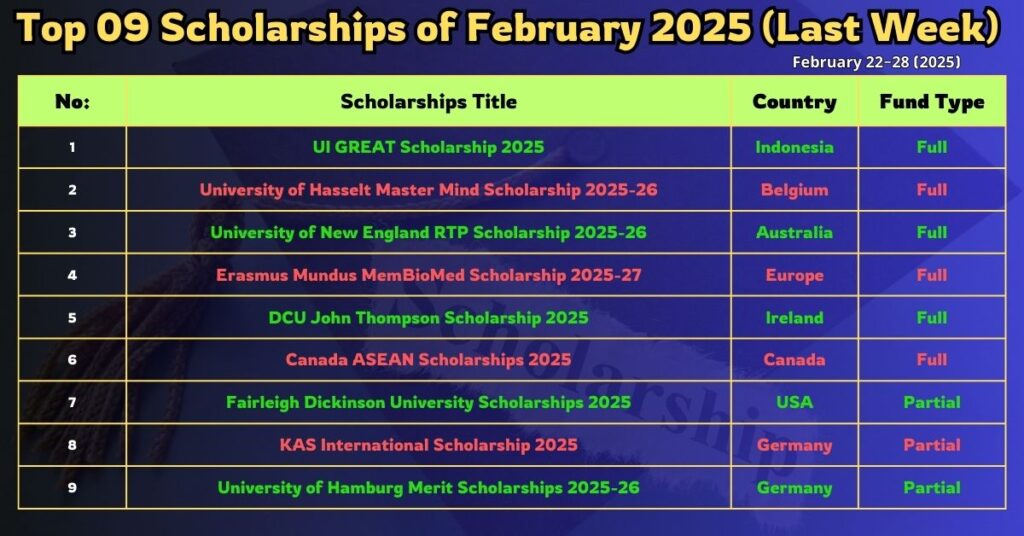
The KAS International Talent Development Scholarship 2026 in Germany is a highly competitive funding program offered by the Konrad-Adenauer-Stiftung (KAS) that supports outstanding international students and doctoral candidates with strong academic records, proficiency in the German language, and genuine community involvement. For the domestic (Germany-based) procedure, the official annual deadline is 15 July (12:00 noon CET). Applications are typically submitted via the KAS portal, while applicants in many regions apply through a local KAS office abroad.
Basic information and deadline
KAS (Konrad-Adenauer-Stiftung) has awarded scholarships to international students since 1970, supporting postgraduate/master’s studies, doctoral studies, and longer research stays at universities in Germany. The scholarship is designed for applicants who offer more than good grades—KAS looks for leadership potential, values-based thinking, and active volunteering or social engagement.
Important basic facts
- Scholarship name: KAS International Talent Development (International Scholarship Program / “Scholarship for international students and doctoral candidates”).
- Study destination: Germany (any university in Germany, depending on eligibility and admission).
- Deadline (domestic selection, Germany-based): 15 July each year, 12:00 noon (CET).
- Application route:
University/institution details
KAS is not a university; it is a German political foundation (Konrad-Adenauer-Stiftung e.V.) that funds scholars to study at universities across Germany. This means the scholarship is portable—you can study at many German universities as long as your program meets KAS rules and you meet admissions requirements.
Key institution facts to mention:
- Sponsor/host organization: Konrad-Adenauer-Stiftung e.V., Scholarship Program for International Students, based in Berlin.
- Study location: Any recognized German university (Germany has 400+ higher education institutions).
- Program focus: KAS emphasizes democracy, rule of law, human rights, and social market economy values, and expects scholars to engage with these themes through seminars and community life.
Study areas (available programs)
KAS scholarships are generally open across disciplines, because recipients study at German universities in many different fields (depending on admission and scholarship conditions). The program is often described as supporting postgraduate/master’s studies, doctoral studies, or longer research stays at German universities.
Common “program types” you can list in an SEO-friendly way:
- Master’s / postgraduate degree programs at German universities.
- Doctoral (PhD) programs at German universities.
- Research stays (minimum four semesters) at a German university in eligible cases.
Fields & Research Focus (for PhD)
- Social Market Economy
- Security & Development in the 21st Century
- Democracies in Europe since 1990
KAS International Talent Development Scholarship benefits (what you get)
KAS scholarships include financial support and a large non-financial development program, especially mentoring, seminars, and networking with other scholars. Being a KAS scholar also means joining an international network of thousands of scholars and alumni, with local activities at many universities in Germany.
Monthly stipend:
- Bachelor’s/Master’s/Postgraduate: up to €992/month (usually 2 years)
- Doctoral: up to €1,400/month (usually 3 years)
Possible extra allowances:
- Health insurance (up to €120/month)
- Family (€276/month) and child allowance (€250/child)
- Research travel grants
- Partial tuition reimbursement (up to €750/semester, exceptional cases)
Non-financial benefits (talent development)
- Interdisciplinary seminars
- Personal academic & career mentoring
- University group activities
- International alumni & scholar network (NIS)
Benefits not included
Even with a strong stipend, not everything is automatically paid. Also, scholarship coverage can vary by route (domestic vs. local office abroad) and your personal case, so applicants should read the official KAS instructions carefully.
Common items typically not fully covered or that may still apply:
- University semester fees/administrative costs in Germany (these vary by university; Germany is often tuition-free at public universities but still has semester contributions).
- Visa/residence permit fees and document translation/notarization costs for international applicants.
- Personal expenses (extra travel, shopping, entertainment) beyond the monthly support.
For trust and SEO, add a short reminder: always confirm the exact financial components for your application route on the official KAS page or through your local KAS office.
Eligibility criteria for KAS International Talent Development Scholarship
KAS looks for more than grades; it wants committed, socially engaged leaders who support democratic values and plan meaningful impact. Requirements can differ depending on whether you apply from abroad via a KAS office or within Germany, but some core expectations are consistently emphasized.
Common eligibility criteria include:
- Who Can Apply
- International Bachelor’s (from 2nd semester), Master’s, and PhD students
- Students planning to study or research in Germany
- Academically strong and socially engaged individuals
- Mandatory Requirements
- German language: Minimum B2 level (e.g., Goethe-Institut certificate)
- Master’s applicants: Plan to enroll in a 4-semester MA at a German university
- Bachelor’s applicants: Completed at least 2 semesters of a BA at a German university
- Apply only if all requirements are met
- What KAS Looks For
- Excellent academic performance
- Commitment to democracy, rule of law, human rights
- Regular volunteer/community involvement
- Initiative and leadership potential
- Motivation to strengthen ties between Germany and home country
Required documents for the application
Document lists can vary by application route (domestic portal vs. local office abroad), but the standard KAS scholarship expectations match what most competitive German scholarship applications require.
Commonly required documents:
- Completed application form (online, via the KAS portal or local office process).
- CV (academic CV; include volunteering/community engagement clearly).
- Motivation letter (why Germany, why the program, why KAS, and your long-term goals).
- Academic certificates and transcripts.
- Proof of German language proficiency (B2).
- Recommendation letters (usually academic; sometimes an additional character/personal reference depending on route).
- Proof of admission or enrollment at a German university (if applicable/required in your route).
- For PhD applicants: doctoral admission/confirmation and a research proposal are commonly expected in scholarship-style doctoral applications.
KAS International Talent Development Scholarship application process (step-by-step)
The process depends on where you are applying from, so a strong blog explains both routes clearly.
Step 1: Confirm your route (abroad vs. in Germany)
- If you live in your home country/region, check whether your region is covered by a local KAS office focus that year and apply through that office’s process.
- If you already live in Germany, use the domestic application procedure and submit before 15 July, 12:00 noon (CET).
2: Secure (or plan) admission in Germany
- Identify your German university and program, and confirm admissions requirements and deadlines separately from the scholarship.
Step 3: Prepare your documents
- Collect transcripts, language certificates, and recommendation letters early so you don’t miss the fixed July deadline.
4: Submit the application
- Submit via the KAS system for your route (portal for domestic procedure; local KAS office process for abroad route).
Step 5: Interview phase
- KAS notes that suitable candidates may be invited to interviews in autumn (for the domestic procedure timeline described in their international scholarship brochure).
6: Selection and onboarding
- Selection & Interviews
- Regional interviews in:
- Buenos Aires (South America)
- Nairobi (East Africa, May 2026)
Tips for a successful application
KAS is looking for people with academic excellence plus social responsibility—so your application must show both clearly and honestly.
Best tips to improve acceptance chances:
- Write a motivation letter that connects your studies to impact: explain what you will do with your German education for your home country/community and for Germany’s international cooperation goals.
- Prove B2 German properly and early: take Goethe-Zertifikat or an accepted equivalent well ahead of the deadline.
- Show consistent volunteering: list activities with dates, roles, outcomes, and leadership (not just “member”).
- Choose referees who can describe your character and leadership, not only your grades.
- Prepare for the interview by discussing your research/study plan, your values, and how you handle responsibility in real situations.
Monthly living expenses in Germany (USD)
Germany’s student living costs vary significantly by city, rent type, and lifestyle, but many guides estimate typical monthly costs for international students around €850–€1,200. Converting that into USD (approximate), that is roughly $930–$1,320 per month, depending on exchange rate and city choice.
A realistic monthly budget breakdown (USD ranges):
- Rent (student dorm/shared flat): $320–$750 (cheaper cities vs. Munich).
- Food/groceries: $200–$350.
- Health insurance: about $150–$180 (varies by status/provider).
- Transport: $35–$70 (often discounted student ticket).
- Internet/phone + personal costs: $70–$180.
Why choose this scholarship? (7 strong reasons)
KAS is not just “money for tuition”—it’s a leadership and values-driven development program that can shape your career and networks long term.
At least 5 strong reasons (here are 7):
- Strong monthly funding: €992/month for Bachelor’s/Master’s and €1,400/month for PhD (as listed in the DAAD database entry for KAS).
- Study at almost any German university: Germany-wide flexibility because KAS funds study/research at universities across Germany.
- Leadership and seminar program: interdisciplinary seminars help build political literacy, confidence, and a broader worldview.
- Powerful network: access to a large community of scholars and alumni for mentorship, referrals, and collaboration.
- Recognition and credibility: being a KAS scholar signals academic excellence plus civic engagement.
- Values-driven mission: clear focus on democracy, human rights, and rule of law—important for applicants who want meaningful social impact.
- Long-term personal growth: KAS emphasizes personal mentoring and active involvement, not passive funding.
Frequently asked questions (FAQs)
1) What is the deadline for the KAS International Talent Development Scholarship 2026?
For the domestic selection procedure, the annual closing date is 15 July at 12:00 noon (CET).
2) Do I need German language for the KAS scholarship?
Yes, KAS requires good German language skills, and the DAAD listing specifies B2 level as an application requirement.
3) How much is the KAS scholarship monthly stipend?
DAAD’s scholarship database states €992/month for Bachelor’s and Master’s students and €1,400/month for PhD students.
4) Can I apply from Bangladesh (or any country)?
KAS operates worldwide and often accepts applications via local KAS offices abroad, but the focus regions can vary by year, so applicants must check the official KAS page for their region’s route.
5) Is the KAS scholarship fully funded?
It provides substantial monthly funding plus mentoring, seminars, and network access, but applicants should confirm exact covered costs for their route (domestic vs. local office) on the official KAS guidance.
6) Which universities are eligible under KAS scholarships?
KAS funds study and research at universities in Germany, meaning many German universities can be eligible as long as your program and admission meet requirements.
7) What kind of students does KAS prefer?
KAS looks for above-average academic performance, German language ability, volunteering/social engagement, and commitment to democratic values and human rights