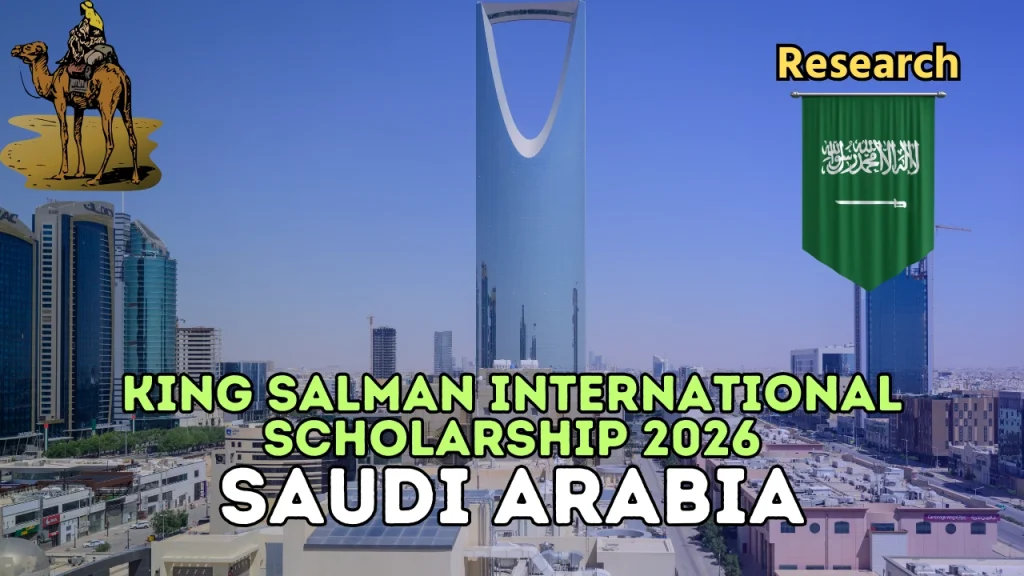
King Salman International Scholarship 2026 is a high-value, fully funded international research award worth 133,000 USD aimed at advancing disability research worldwide, with applications open to global researchers and institutions until March 31, 2026. It offers global recognition, a substantial cash award, and strong visibility in disability, health, education, rehabilitation, and assistive technology fields.
Basic information about King Salman International Scholarship 2026
The King Salman International Scholarship 2026 (often referred to in listings as the King Salman International Scholarship or King Salman International Award for Disability Research) is funded by the Government of Saudi Arabia and associated research and innovation authorities. It targets outstanding researchers, scientists, and institutions whose work transforms the lives of persons with disabilities in health, education, rehabilitation, technology, and universal access.
- Award amount: 133,000 USD for each winning category or branch.
- Focus area: Disability research and innovation with measurable real-world impact.
- Funding body: Government of Saudi Arabia with the Research, Development and Innovation Authority and disability-focused organizations.
- Application mode: Online nomination and application portal (submissions are fully digital).
- Goal: To recognize high-impact scientific research that improves the quality of life for people with disabilities.
- Prize: $133,000 USD, a certificate, and a commemorative medal (per category).
Award Categories
- Health & Medical Sciences: Early detection, diagnosis, and medical rehabilitation.
- Educational & Psychological Sciences: Special education, teaching techniques, and psychological support.
- Rehabilitation & Social Sciences: Employment, social inclusion, and speech/hearing therapy.
- Technical Applications: AI, software, and hardware designed for disability assistance.
- Universal Access: Best practices in creating accessible facilities and built environments.
University/institution details
This award is not restricted to a single study campus; instead it is a global research scholarship connected to Saudi Arabia’s national research ecosystem and disability-focused institutions. The program is linked to the King Salman Center for Disability Research and Saudi research authorities and hosts its main ceremony and activities in Riyadh, Saudi Arabia.
- Host country: Saudi Arabia (award ceremony and official recognition in Riyadh).
- Key institutional partners: Government of Saudi Arabia, Research, Development and Innovation Authority, King Salman Center for Disability Research, and related scientific committees.
- Eligible institutions:
- Universities and academic departments worldwide.
- Disability research centers and institutes.
- Organizations and entities working in disability health, education, rehabilitation, assistive technology, and universal access.
While the award is sometimes promoted alongside “study in Saudi Arabia” opportunities, its core purpose is to recognize completed or ongoing research in disability rather than to fund a traditional degree program at a specific university.
Study areas/research branches (program scope)
The King Salman International Scholarship 2026 is organized into several research branches instead of standard degree programs like “MBA” or “Computer Science.” Each branch focuses on a core dimension of disability research where applicants can submit their work:
- Health and Medical Sciences: Disability-related medicine, diagnostics, therapies, prevention, and clinical research improving health outcomes.
- Educational and Psychological Sciences: Inclusive education, learning support, psychological interventions, and mental health for persons with disabilities.
- Rehabilitation and Social Sciences: Physical and occupational rehabilitation, social integration, community inclusion, policy, and social care systems.
- Technical Applications: AI for disability, assistive technologies, digital accessibility, smart devices, diagnostic tools, and software solutions.
- Universal Access and Inclusive Environments: Accessible building design, transportation, urban planning, and universal design for public and digital spaces.
Researchers, teams, or institutions typically align their submission with the branch that best reflects the main impact of their published work or project.
King Salman International Scholarship benefits
Winning the King Salman International Scholarship 2026 brings both financial and non-financial benefits.
Key benefits include:
- 133,000 USD cash prize per winning category, paid to the winning researcher or institution according to the award’s rules.
- Official certificate of appreciation recognizing the scientific contribution at an international level.
- Prestigious commemorative medal from the award body in Saudi Arabia.
- Invitation to the award ceremony in Riyadh, with opportunities to present or highlight the winning work.
- Global visibility and media exposure for the winning research, increasing its reach among universities, policymakers, and industry.
- Strong career prestige that can support promotions, grants, and partnerships across disability, health, and technology sectors.
Benefits not included
- No guaranteed tuition coverage for a degree program (the award does not automatically enroll winners in a specific university program).
- No fixed monthly stipend for housing or food for the full year like typical graduate scholarships.
- No automatic travel coverage for dependents or family members; only the nominee may be invited officially.
- No comprehensive health insurance plan specified as part of the prize package.
- No promise of work permits or long-term residency in Saudi Arabia (the focus is recognition of research rather than immigration sponsorship).
Eligibility criteria for the King Salman International Scholarship
- Granted to scientists, researchers, and entities with distinguished contributions applied to research practices.
- Work must fall within one of the award’s five branches.
- Submission must adhere to recognized scientific methods.
- Characterized by authenticity, leadership, innovation, and significant impact.
- Must not have been previously submitted for a similar award.
- Previous winners are ineligible for 5 years and must submit different work.
- KSCDR employees and award committee members are ineligible.
Eligible nominators include:
- Scientific production published in refereed journals.
- List of published studies in reverse-chronological order (using the award’s CV template).
- Journal details: Impact Factor and Ranking (Q1, Q2, Q3) via Clarivate Analytics or Scopus.
- List of authored, edited, or translated books.
- List of professional contributions or community initiatives in disability.
- An essay (max 500 words) on the research’s national and global impact.
- Letter of support from an employer/entity or a professional colleague.
- Submissions made via research centers, academic departments, previous winners, or self-nomination.
Required documents for the application
Exact document requirements may vary slightly depending on the nomination type (individual researcher, team, or institution), but typical documentation includes:
- CV: Must use the award’s specific template.
- Publication List: Must include Journal Impact Factors and rankings (Q1/Q2/Q3) via Clarivate or Scopus.
- Books/Contributions: List of authored books and community initiatives in the disability field.
- Impact Essay: A maximum 500-word essay explaining the global and national impact of your work.
- Support Letter: A recommendation from your institution or a professional colleague.
King Salman International Scholarship application process (step-by-step guide)
To help you rank for “how to apply King Salman International Scholarship 2026,” structure your application using clear, logical steps:
- Check eligibility
Confirm that your research fits one of the disability-related branches and that you meet all eligibility rules (no prior recent win, no conflicts of interest, and high-quality scientific output). - Select the most relevant branch
Decide whether your work belongs in Health and Medical Sciences, Educational and Psychological Sciences, Rehabilitation and Social Sciences, Technical Applications, or Universal Access. - Gather your research outputs
Compile your main publications, projects, patents, or innovations that demonstrate your contribution to disability research, along with metrics like citations or implementation impact where possible. - Prepare your CV and impact statement
Update your CV with all disability-related work and draft a clear statement that explains how your work benefits persons with disabilities and contributes to global best practice. - Secure institutional endorsement (if needed)
If you are being nominated by a university or research center, coordinate with your institution so the endorsement letter and supporting documents match the official requirements. - Complete the online nomination form
Access the official application or nomination portal, create an account if needed, and fill in all required fields accurately. - Upload documents and submit
Attach your CV, research files or links, endorsement letters, and any requested declarations, then submit the application electronically before the March 31, 2026 deadline. - Track your application
Keep copies of confirmation emails and monitor any messages from the organizing body; processing typically follows internal review and evaluation timelines.
Tips for a successful application
To maximize your chances of winning this competitive 133,000 USD research scholarship, focus on clarity, impact, and alignment with the award’s mission.
- Highlight measurable impact: Emphasize concrete outcomes such as improved accessibility, implemented policies, clinical improvements, or widely adopted tools.
- Focus your narrative: Choose one main research theme and link all your outputs to that central contribution instead of submitting scattered, unrelated work.
- Use clear, non-technical explanations: Reviewers come from multiple disciplines, so explain your work in accessible language while still demonstrating scientific depth.
- Demonstrate innovation: Show what is new compared to previous approaches in disability health, education, technology, or universal design.
- Provide strong evidence: Include citations, user data, implementation statistics, or adoption examples that prove real-world benefits for persons with disabilities.
- Respect all formatting rules: Follow word limits, file formats, and any structural guidelines provided on the official portal.
- Submit early: Avoid last-minute technical issues and give yourself time to revise your documents for clarity and completeness.
Monthly living expenses for international students (USD)
Although the King Salman International Scholarship functions primarily as a research prize and not a traditional student stipend, many international researchers and students consider Saudi Arabia or similar regional destinations for study and collaborations.
- Accommodation (shared apartment or residence): 300–600 USD per month depending on city and housing type.
- Food and groceries: 200–350 USD per month.
- Local transportation (public transport, ride-share, basic commuting): 60–120 USD per month.
- Utilities and internet: 60–100 USD per month.
- Personal expenses (mobile phone, clothing, leisure): 100–200 USD per month.
Overall, a reasonable monthly budget range for an international student or researcher in Saudi Arabia is about 720–1,370 USD, though specific costs vary by city, lifestyle, and housing choices. The 133,000 USD award is large enough, if managed strategically, to support substantial research activity and multiple shorter research visits, conferences, or collaborations in addition to core project costs.
Why choose this scholarship? (minimum 5 reasons)
There are several strong reasons why ambitious researchers and institutions should target the King Salman International Scholarship 2026 in disability research.
- High-value 133,000 USD award
The financial prize is significantly larger than many academic awards, allowing winners to reinvest funds into further research, technology development, or institutional capacity. - Global prestige in disability research
This is one of the few awards dedicated specifically to disability-focused science, giving winners a unique and respected position in this growing field. - Strong international visibility
Winners receive worldwide recognition through official channels, media coverage, and academic networks, which can lead to new partnerships, grants, and speaking invitations. - Multi-disciplinary opportunity
With branches covering health, education, social sciences, technology, and universal design, researchers from diverse backgrounds can compete under a single international platform. - Boost to academic and professional careers
Receiving a prestigious international scholarship or award can support promotions, tenure decisions, and leadership roles in universities and research organizations. - Real-world impact on disability inclusion
The award specifically values projects that improve accessibility, rehabilitation, and quality of life, aligning career success with meaningful social impact. - Connection with Saudi Arabia’s innovation ecosystem
Attending the ceremony and engaging with organizers can open doors to collaborations in Saudi Arabia’s rapidly evolving research, technology, and health sectors.
Frequently asked questions (FAQ)
1. Is King Salman International Scholarship 2026 a fully funded degree scholarship?
It functions primarily as a research award rather than a traditional degree scholarship; it offers a 133,000 USD cash prize and recognition but does not automatically pay multi-year tuition and monthly stipends like standard master’s or PhD scholarships.
2. Who can apply for the King Salman International Scholarship 2026?
Eligible applicants include individual researchers, teams, universities, research centers, and disability-focused organizations with strong scientific contributions to disability research and no conflict of interest with the award organizers.
3. What is the deadline for applications in 2026?
The final date to submit nominations for the 2026 round is March 31, 2026, with online submission required before the stated closing time.
4. Can students without research experience apply?
The award targets high-level scientific production and established contributions, so applicants without substantial research outputs in disability fields are unlikely to be competitive.
5. Is the award limited to Saudi citizens or institutions?
No, it is an international program; researchers and institutions from any country can be nominated if they meet the eligibility and quality criteria.
6. Does the award cover travel and accommodation to Saudi Arabia?
Winners are formally invited to the award ceremony in Riyadh, and some event-related costs may be covered according to the organizers’ policy, but this is separate from standard multi-year funding for study.
7. Can I nominate myself?
Self-nomination may be possible if permitted under the official regulations, as long as all conditions are met and the submitted work complies with the award rules.
Deadline: March 31, 2026, at 10:00 PM.
Official Link:
By focusing your application on innovative, high-impact disability research and aligning it with one of the official branches, you can leverage this 133,000 USD opportunity to advance both your career and global disability inclusion.