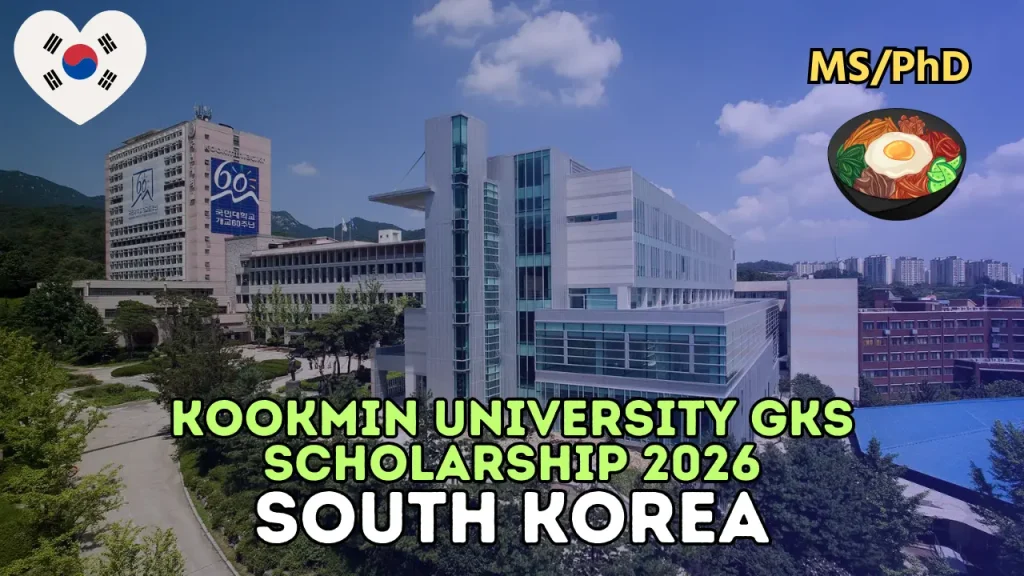
The Kookmin University GKS Scholarship 2026 (Global Korea Scholarship, funded by the Korean Government through NIIED) is a fully funded opportunity for international students who want to study in Seoul, South Korea, with major costs like tuition, airfare, and a monthly stipend covered. This guide explains the deadline window, programs, requirements, documents, and a step-by-step application process.
Basic scholarship information (Deadline included)
The Global Korea Scholarship (GKS) at Kookmin University is offered through either the Embassy Track or the University Track (Kookmin University), and you must choose only one route. If you apply via the University Track, you can choose only one university (Kookmin University), while Embassy Track applicants can choose up to three universities among participating institutions.
For Kookmin University’s University Track, the official application window is generally end of February to end of March (dates can change each year, so always confirm the current year’s guideline). The university document evaluation typically runs from end of March to early April, interviews are typically in early April, and final successful candidates are usually announced in mid-June, with entry to Korea by end of August.
Scholarship Duration
- Master’s: 1 year language + 2 years degree
- Doctoral: 1 year language + 3 years degree
Purpose
- Provides higher education opportunities in Korea for interna
- tional students.
- Promotes international educational exchange.
- Strengthens mutual friendship between countries
University/institution details
Kookmin University (KMU) is located in Seoul, South Korea, and it is one of the designated universities that can accept GKS applicants through the University Track. The Kookmin University admissions page for GKS lists the official University Track schedule, eligibility rules, selection steps, required documents, and scholarship benefits under NIIED.
If you need official clarification, Kookmin University provides direct contact details (email/phone) on the same GKS admissions page.
Study areas (available program names)
Kookmin University’s Graduate School includes a wide range of departments across humanities, social sciences, natural sciences, engineering, arts/physical education, and interdisciplinary fields. Example graduate departments listed by Kookmin University include Public Administration, Political Science and International Relations, Business Administration, e-Business, Computer Science, Mechanical Engineering, Civil and Environmental Engineering, Electronics Engineering, Architecture, Communication Design, and Integrative Biomedical Science and Engineering (among others).
Because GKS intake and participating departments can vary, confirm your exact department choice and availability using Kookmin University’s current graduate program/department information.
Kookmin University GKS Scholarship benefits
Kookmin University’s GKS page states the following benefits are offered via NIIED for GKS scholars at KMU.
- Round-trip airfare
- Monthly allowance: 900,000 KRW
- Settlement allowance: 200,000 KRW
- Full tuition coverage
- Korean language training (1 year, fully covered)
- Medical insurance: 20,000 KRW/month
- Research allowance:
- 210,000 KRW (Humanities/Social Sciences)
- 240,000 KRW (Natural/Engineering Sciences)
- Dissertation printing: 500,000–800,000 KRW
- Extra 100,000 KRW/month for TOPIK Level 5 or 6 holders
Scholarship duration is listed as 1 year Korean language + 2 years Master’s or 1 year Korean language + 3 years Doctoral.
Benefits not included (What you should budget for)
Even with a fully funded scholarship, you should plan for typical out-of-pocket costs such as personal shopping, extra travel, upgraded housing preferences, higher-cost meals, entertainment, and any costs not covered under “limited coverage” medical support. You may also need to cover document-related expenses in your home country (notarization, apostille/attestation, certified translations, courier shipping) because these are not listed as scholarship benefits on the KMU GKS page.
Eligibility criteria for Kookmin University GKS Scholarship
Kookmin University’s official GKS page lists these core eligibility conditions.
- Applicant and parents must hold foreign citizenship
- Korean citizens cannot apply
- Must be physically & mentally healthy
- Must be under 40 years old (in selection year)
- Must hold:
- Bachelor’s degree (for Master’s)
- Master’s degree (for Doctoral)
- Minimum GPA:
- 2.64/4.0 OR
- 2.80/4.3 OR
- 2.91/4.5 OR
- 80% or higher
- Cannot have previously studied at a Korean university
- Preference given to:
- Korean or English proficiency holders
- Natural science & technology applicants
- Professors from developing countries
KMU Selection Criteria
Evaluation based on:
- Academic transcripts
- Self-introduction
- Study plan
- Language certificates (Korean/English)
- Recommendation letters
- Research papers & awards
Required documents (Checklist for 2026)
Kookmin University provides a detailed required-document table by program type (Master’s/Doctoral/Research). The required documents commonly include:
For Master’s & Doctoral
- Application Form
- Self-Introduction
- Statement of Purpose
- 2 Recommendation Letters
- Applicant Pledge
- Medical Assessment
- Degree Certificates & Transcripts
- Proof of Citizenship (Applicant & Parents)
Optional Documents
- TOPIK certificate
- English proficiency certificate
- Published papers
- Awards
Kookmin University GKS Scholarship application process (Step-by-step)
Kookmin University outlines a two-stage selection structure (KMU first, then NIIED). Use this practical step-by-step approach aligned with the official flow:
- Choose your track: Embassy Track or University Track (KMU), and apply through only one institution to avoid disqualification.
- Prepare the required forms and supporting documents (transcripts, citizenship proofs, recommendations, study plan/SoP, etc.).
- Submit your application during the University Track window (generally end of February to end of March for KMU).
- KMU conducts document evaluation and may conduct an interview (phone/Skype is listed).
- If selected by KMU (1st selection), KMU recommends candidates to NIIED for the 2nd selection.
- NIIED announces 2nd selection results and final successful candidates via the Study in Korea (GKS) website timelines shown on KMU’s page.
- Final candidates enter Korea by the end of August to begin the scholarship pathway (including Korean language training as applicable).
Selection Procedure
1st Selection
- Conducted by:
- Korean Embassy OR
- Kookmin University (KMU)
- Includes:
- Document review
- Interview or performance test
- Selected candidates recommended to NIIED
2nd Selection
- Conducted by NIIED
- Final successful candidates announced on studyinkorea.go.kr
Main Notice
- Apply through either:
- Embassy Track, OR
- University Track (Kookmin University only)
- Applying to more than one institution = automatic disqualification
- Embassy Track applicants:
- Can choose 3 universities (out of 65).
- University Track applicants:
- Can choose only 1 university (Kookmin University).
- Applications accepted by:
- 116 Korean embassies worldwide
- 65 designated Korean universities
Tips for a successful application (Practical + human)
Kookmin University states it evaluates transcripts, self-introduction, study plan, language certificates, recommendations, papers, and awards. To improve your chances:
- Make your study plan department-specific: connect your goals to the exact KMU department and research direction you want.
- Treat recommendation letters as strategy documents: choose referees who can describe measurable achievements (projects, research, publications, leadership).
- Add proof of readiness: include TOPIK and/or English proficiency if you have it, because KMU notes language proficiency may be considered for preference.
- Keep eligibility and citizenship documentation flawless: citizenship proof for you and your parents is explicitly required.
- Aim for clarity over “fancy writing”: KMU evaluates the full document set, so consistency (dates, names, program choice) matters as much as style.
Monthly living expenses in South Korea (USD estimate)
GKS provides a monthly allowance of 900,000 KRW. Your actual monthly spending in Seoul will vary by lifestyle and housing type, but many international students typically budget for categories like rent/dorm fees, food, local transportation, phone/internet, and personal expenses.
A practical planning range many students use for Seoul is around USD 700–1,200/month depending on whether you live in a dorm or private housing and how you spend on food and transport (use this as a planning estimate, not an official figure). Because the stipend is defined in KRW, convert 900,000 KRW to USD using the exchange rate at the time you plan your budget.
Why choose Kookmin University GKS Scholarship? (At least 5 reasons)
- It is fully funded with tuition paid by NIIED and admission fees waived by the university.
- You receive a monthly stipend (900,000 KRW) designed to support living costs while studying.
- Round-trip airfare and a settlement allowance reduce the biggest “moving to Korea” expenses.
- Korean language training is fully covered, which helps you adapt academically and socially in Korea.
- You can strengthen your profile with research-related support such as research allowance and dissertation printing support.
- TOPIK high achievers can receive an additional Korean proficiency grant during the degree program.
Frequently asked questions (FAQ)
1) Can I apply to multiple Korean universities under the University Track?
No—KMU states that University Track applicants may choose only one university, and applicants who submit applications to more than one institution will be disqualified.
2) Do I need TOPIK or IELTS/TOEFL to apply?
TOPIK and English proficiency certificates are listed as optional documents, and language proficiency may be considered for preference.
3) What GPA is required?
KMU lists a minimum of 2.64/4.0 (or equivalent thresholds including 80% or higher).
4) What programs can I study at Kookmin University under GKS?
KMU’s graduate offerings include many departments (e.g., Business Administration, Computer Science, Mechanical Engineering, Public Administration, and more), but you should confirm your department’s current availability within the graduate program list.
University Track Application Schedule (Kookmin University)
- Application Period: End of February – End of March
- Document Evaluation: End of March – Early April
- Interview (Phone/Skype): Early April
- 1st Selection Result: Early April (via email)
- 2nd Selection (by NIIED): Mid April
- 2nd Result Announcement: Early May (www.studyinkorea.go.kr)
- Final Result: Mid June
- Entry to Korea: End of August