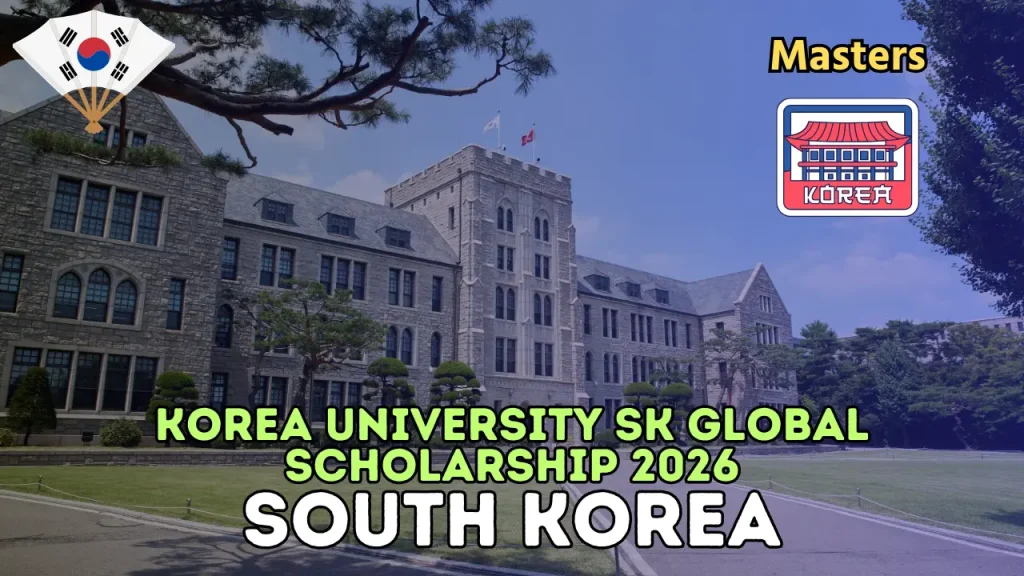
Korea University’s SK Global Scholarship 2026 is a competitive, fully funded graduate scholarship opportunity in South Korea, designed to bring outstanding international students to Korea University (KU) for advanced study. The commonly listed deadline for the 2026 call is March 31, 2026, but you should confirm the exact date and intake details on the official KU/partner announcement for your country/region before submitting.
Basic scholarship information (2026)
The Korea University SK Global Scholarship 2026 (often presented as an SK-funded global scholarship at KU) supports international students to pursue graduate study in South Korea, typically at Korea University’s Graduate School.
- Scholarship for international students to study graduate programs at Korea University.
- Focus on advanced technology fields.
- Goal:
- Promote international education exchange
- Strengthen friendship between South Korea and participating regions
- Many listings for the 2026 cycle show an application deadline of March 31, 2026, so treat March as your “action month” and prepare documents early
University/institution details
Korea University (KU) is a major research university in Seoul, and scholarship recipients typically study through KU’s Graduate School pathways and timelines.
KU’s graduate admission workflow commonly includes online application, document submission, and result notification windows, and KU also publishes application schedules and procedural notes (including mailing/in-person document submission guidance).
Study areas (available program names)
Program availability can vary by intake and department, so you should align your intended major with KU Graduate School admissions for the relevant semester.
Because KU offers a wide range of graduate programs, the safest approach is to shortlist your intended department(s) first, then confirm whether your program is eligible under the SK Global Scholarship track described in the 2026 call you are applying to.
AI / IT Track
Departments and majors include:
- Software
- Artificial Intelligence Applications
- Informatics
- Computer Science and Engineering
- Computer Security
- Radio Communications Engineering
- Artificial Intelligence
- Computer Education
Semiconductor Track
Available departments:
- Electrical Engineering
- Physics
- Materials Science and Engineering
- Chemical and Biological Engineering
Research areas include:
- Integrated Circuits
- Semiconductor & Nano Systems
- AI Hardware & 3D Integration
- Device and Circuit Engineering
- Condensed Matter Physics
- Nano Materials & Devices
- Solar Energy Conversion
- Optoelectronic Materials
- Quantum Semiconductor Materials
Korea University SK Global Scholarship benefits
- Round-trip Airfare
- Entrance Fees
- Tuition Fees
- Living Allowance
- Medical insurance
- Optional Korean Language Training Fees
Benefits not included (common exclusions to plan for)
Even with “fully funded” scholarships, applicants often still need to budget for items that may not be fully covered in every scholarship package, such as visa fees, document notarization/apostille, courier fees, and medical checks.
KU also notes that preparing required documents can take a month or more and may require express mailing or in-person submission, which can add cost and time—so plan your budget and timeline early.
Eligibility criteria for Korea University SK Global Scholarship
- A widely cited eligibility condition in 2026 listings is that both parents must be citizens of a country that is not South Korea, and applicants must meet nationality rules described in the call.
- Citizenship
- Must be from one of the eligible countries listed above.
- Parents must not be South Korean citizens.
- Education
- Must have Bachelor’s degree or
- Expected to graduate by September 2026.
- Language Requirement (one of the following)
- TOEFL iBT: 71+
- IELTS Academic: 5.5+
- CEFR: B2+
- New TEPS: 326+
- TOPIK: Level 3+
- ✔ Language certificate not required if bachelor’s degree was taught in English or Korean.
Eligible Regions (34 Countries)
Europe (19)
- Austria, Belarus, Bosnia & Herzegovina, Bulgaria, Croatia
- Czech Republic, Georgia, Hungary, Latvia, Lithuania
- Moldova, Montenegro, North Macedonia, Poland
- Romania, Serbia, Slovakia, Slovenia, Ukraine
Southeast Asia (11)
- East Timor, Laos, Malaysia, Myanmar, Vietnam
- Brunei, Singapore, Indonesia, Cambodia, Thailand, Philippines
East Asia (2) (Semiconductor field only)
- Japan, Taiwan
South Asia (2)
- India, Pakistan
Required documents (application checklist)
Document requirements vary by call/region, but commonly referenced documents for this KU SK scholarship track include academic records, identity/nationality documents, and application essays.
Mandatory Documents
- Application Form (online)
- Release of Information Form (Form A)
- Recommendation Letter (sent by professor)
- Bachelor’s Graduation Certificate or Expected Graduation Certificate
- Academic Transcript
- Language Proficiency Certificate
- CV / Resume
- Statement of Purpose (minimum 1500 characters)
- Passport Copy
- Parents’ Nationality Documents
- Parent-Child Relationship Certificate (birth certificate or similar)
Additional Documents (if applicable)
- Death certificate (if parent deceased)
- Divorce/custody documents
- Single parent confirmation (Form D)
- Adoption documents
Important Notes
- All documents must be scanned (not photographed).
- Documents not in English or Korean must be translated and notarized.
- False information or missing documents may result in rejection or admission cancellation.
Korea University SK Global Scholarship application process (step-by-step)
Because KU uses a structured graduate admissions workflow, plan for both online steps and physical/official document steps if required.
- Go to
https://www.studyinkorea.go.kr - Click Apply Online
- Search Korea University
- Create account & login
- Complete application form
- Upload required documents
- Submit application before March 31
- Recommender sends recommendation email before April 15
⚠ Personal information cannot be changed after submission.
Tips for a successful application
Start early because KU explicitly warns that document preparation can take a month or more, and late paperwork is one of the easiest ways to lose a strong application.
Write a statement of purpose that connects your academic background to KU’s research environment and shows a realistic study plan—reviewers tend to favor clarity, feasibility, and fit.
Also, treat your document package like a “compliance project”: consistent names, matching dates, correct translations, and timely courier planning matter because KU may require express mail or in-person submission for documents.
Monthly living expenses in South Korea (USD)
Your monthly cost depends heavily on housing type and lifestyle in Seoul, but many international students budget a “survival-to-comfortable” range that covers rent, food, transport, and basics.
To stay practical for planning, many applicants prepare a rough budget of USD 700–1,500/month (lower end with shared housing and strict budgeting; higher end with private housing and more flexibility), and then refine it once they know dorm/room options.
Why choose this scholarship? (at least 5 reasons)
- It’s often presented as a fully funded pathway to graduate study at Korea University, reducing financial stress compared to self-funded routes.
- Korea University provides a structured graduate admissions timeline with clear steps (online application, document submission, results), which helps you plan your year.
- Studying in Seoul places you in one of Asia’s strongest higher-education and innovation hubs, which can strengthen your career outcomes when paired with KU credentials.
- The scholarship’s international focus can place you in a diverse academic community and a strong global alumni network environment.
- Having scholarship support can free time for research, publications, labs, and internships—often the real “ROI” of a top graduate experience.
Frequently asked questions (FAQ)
1) What is the deadline for Korea University SK Global Scholarship 2026?
Many public scholarship listings show March 31, 2026 as the deadline, but always verify on the official call or KU/partner instructions for your route.
2) Is the Korea University SK Global Scholarship fully funded?
It is commonly described as “fully funded” in scholarship summaries, but the exact covered items (tuition, stipend, insurance, etc.) should be confirmed in your official 2026 document.
3) Who can apply (nationality rule)?
A commonly stated requirement is that both parents must be citizens of a country that is not South Korea, with additional nationality/eligibility rules defined by the call.
4) Do I need a Bachelor’s degree to apply?
Many listings state applicants must hold a Bachelor’s degree or be in the final year, since the scholarship targets graduate-level study.
5) Are language test scores required (IELTS/TOEFL/TOPIK)?
Some program summaries mention English or Korean proficiency requirements (with possible exemptions if your prior degree was fully taught in English), but requirements can differ by track—confirm in your official instructions.
6) Does KU require physical document submission?
KU’s graduate admissions guidance indicates applicants may need to send documents via express mail or submit them in person, and you should plan time for preparation and shipping.
Application Timeline
Online Application
- March 3 – March 31, 2026
- Apply via:
https://www.studyinkorea.go.kr
Document Submission
- March 3 – March 31, 2026
- Upload scanned documents during online application.
Recommendation Letter
- Must be emailed by recommender
- Deadline: April 15, 2026
Admission Result
- Expected: June 4, 2026
- Check online:
https://graduate2.korea.ac.kr