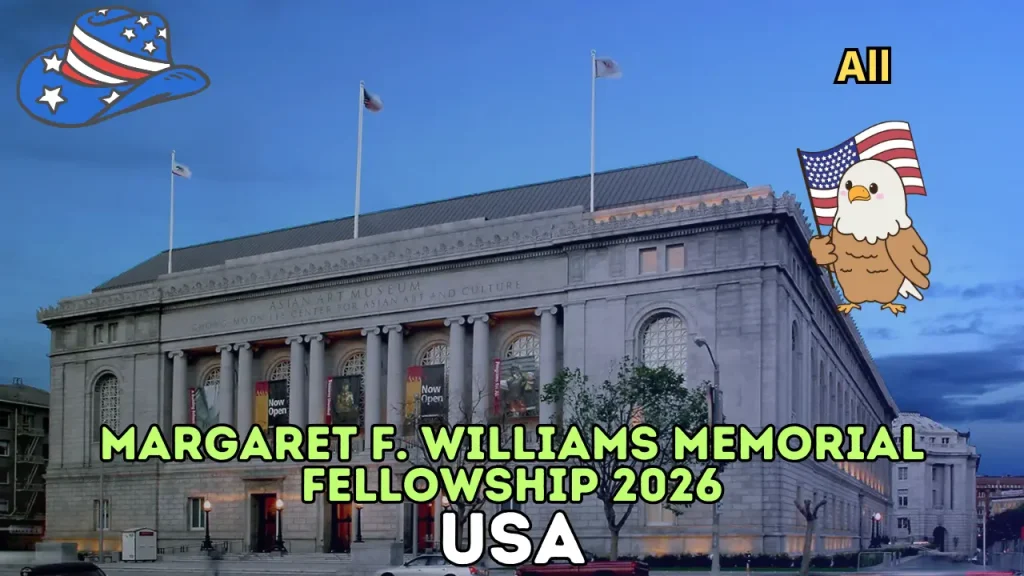
The Margaret F. Williams Memorial Fellowship 2026 in Asian Art (USA) is a competitive, fully funded summer residency that supports emerging curatorial voices working on Asian and/or Asian American art, hosted in San Francisco in partnership with The Asia Foundation and the Asian Art Museum. Applications open February 17, 2026 and close March 24, 2026, with the residency running June 1–August 31, 2026.
2026 Fellowship overview (deadline included)
If you’re an early-career curator (or someone doing curatorial work beyond traditional museums) and you want time, access, and support to research, build networks, and develop community-centered curatorial practice, this fellowship is designed for you. The 2026 theme emphasizes community-centered curatorial practice, meaning applicants who collaborate with communities and think about long-term engagement are especially relevant.
- Organized by The Asia Foundation in partnership with the Asian Art Museum.
- Supports two emerging contemporary art curators:
- One from Asia/Pacific
- One from the United States
- Residency Location: San Francisco, USA
- Host country: United States.
- Duration: June 1 – August 31, 2026 (3 months)
- Application Period: February 17 – March 24, 2026
- Final Selection Announcement: Mid-April 2026
- Hosted by the Contemporary Art Department under Abby Chen (Senior Associate Curator).
University/Institution details (host & partners)
This is not a “university scholarship” in the classic sense—it’s a professional fellowship/residency hosted at a museum.
- Organizer: The Asia Foundation (fellowship is announced through The Asia Foundation).
- Host institution: Asian Art Museum, San Francisco (on-site residency).
- Partnership model: The fellowship is offered in partnership with the Asian Art Museum to support exchange among emerging curatorial voices focusing on Asian and/or Asian American art.
Study areas and program focus (available program names)
Community-Centered Curatorial Practice
Focus areas:
- Community building as curatorial and institutional practice
- Lived experience and sustained relationships
- Shared knowledge production
- Participatory and socially engaged projects
- Archival and research-based work
- Performance, digital and AI-enabled platforms
- Educational and public programs
- Long-term community engagement (trust, reciprocity, accessibility)
Fellows will:
- Revisit past museum exhibitions and rethink them for today’s communities
- Explore local, regional, transnational, and online community models
- Develop proposals, public programs, written reflections, or experimental platforms
Margaret F. Williams Memorial Fellowship benefits
Benefits commonly listed for 2026 include:
- Round-trip travel to/from San Francisco
- Free housing during residency
- Per diem (living expenses)
- $7,500 study tour stipend
- For research visits across cities/institutions
- Must take place after or separate from residency
- Minimum four weeks
- Professional opportunity: a structured residency at the Asian Art Museum, including engagement with community-centered models and exhibition thinking (as described in the fellowship theme and activities).
Outcome of the Fellowship:
- writtenReflections
- Public events and programs
- Experimental Online projects
- Fresh concepts and suggestions for upcoming exhibitions
- The ultimate objective is to use exhibitions as links between networks, communities, and locations.
Benefits not included (plan ahead)
The public listings clearly name travel, housing, per diem, and a study-tour research stipend, but they do not clearly promise “everything else” (like visa fees, health insurance, or costs for family members).
- Visa application costs, SEVIS (if relevant), document translation/notarization, and embassy travel (not specified in the benefit list).
- Health insurance and medical costs (not specified).
- Personal travel outside program needs, entertainment, shopping, and optional tourism (not specified).
- Costs for dependents/spouse/children (not specified).
Eligibility criteria for Margaret F. Williams Memorial Fellowship
This fellowship targets “next generation” or emerging curators, and it takes a broad view of what curatorial work can be.
- Be from the U.S., Asia, or Pacific Islands
- Be fully fluent in English
- Commit to full 3-month residency (on-site)
- Be an emerging curator (broad definition — museum or non-museum background welcome)
- Demonstrate:
- Leadership and initiative
- Strong communication skills
- Ability to collaborate
- Creative and community-focused thinking
- Language: Must be fully conversant in English.
- Availability: Must be able to stay in San Francisco for the full residency period (June 1–August 31, 2026).
Required documents (application checklist)
- Updated CV (with curatorial roles, exhibitions, publications, talks, community projects).
- A statement of interest / cover letter (why this fellowship, why 2026 theme).
- A project or research proposal (your curatorial inquiry + community-centered approach).
- Portfolio or selected work (links to exhibitions, writing samples, digital projects).
- References/letters of recommendation (curators, directors, collaborators).
- Proof of English ability (if requested; not explicitly listed in the public snippet).
Practical note: Because the official document list can change, always follow the application portal instructions exactly once you open the form.
Margaret F. Williams Memorial Fellowship How to apply (step-by-step process)
You apply online via the official application link provided by the organizers.
Step-by-step guide:
- Confirm the deadline (March 24, 2026) and block time to write and revise.
- Draft your “theme fit”: show how your curatorial practice is community-centered and how you collaborate ethically and consistently with communities.
- Prepare your core materials (CV, proposal, work samples/links, references) in clean PDF format and ensure filenames are professional (e.g., “Name_CV.pdf”).
- Complete the online application form on the official website and upload documents before the deadline.
- Submit early (ideally 7–10 days before March 24) in case of file issues, time zone confusion, or last-minute edits.
- Watch for selection updates (final selections are expected by mid-April).
Tips for a successful application
This fellowship is competitive, and your application needs to feel both personal and practical.
- Write like a curator, not like a student: show what you’ve done (exhibitions, programs, community partnerships, writing, research methods) and what you’ll do next.
- Prove community-centered work with evidence: name a community partner, outline your listening process, and describe how shared decision-making appears in your practice.
- Keep your proposal realistic for a 3‑month residency: explain what you can research on-site in San Francisco and how the study-tour stipend supports the next phase.
- Make your work samples easy to evaluate: give 3–5 strong links with one-line context each (your role, impact, audience).
- Align with the residency dates: confirm you can be on-site June 1–Aug 31, 2026 without conflicts (jobs, classes, family obligations).
Monthly living expenses in San Francisco (USD estimate)
The fellowship provides housing and a per diem, but international students and fellows still like to plan a realistic budget for personal spending. The costs below are typical ranges for basic personal expenses (assuming housing is provided).
Estimated monthly out-of-pocket budget (USD):
- Food beyond per diem/extra meals: $300–$700
- Local transportation: $90–$150
- Phone + data: $30–$70
- Personal items/laundry: $50–$120
- Health/medication (variable): $50–$250
- Miscellaneous (museum outings, supplies): $100–$300
Practical planning range: about $620–$1,590 per month in personal expenses, depending on lifestyle and what the per diem covers day-to-day.
Why choose this fellowship? (at least 5 reasons)
- It’s fully funded, including travel, housing, and per diem—major barriers for international curators are reduced.
- You get a concentrated 3‑month museum residency at the Asian Art Museum in San Francisco, a strong platform for your CV and global network.
- The USD 7,500 study-tour research stipend supports deeper fieldwork and professional connections beyond the residency itself.
- The 2026 theme (community-centered curatorial practice) is highly relevant to contemporary museum practice, public engagement, and ethical exhibition-making.
- The fellowship is designed for emerging curators and welcomes candidates outside traditional museum structures, including independent and digitally focused curatorial practices.
- Selections are announced by mid-April, giving you time to plan travel, professional leave, and logistics before the June start.
Frequently asked questions (FAQ)
1) When does the fellowship take place?
The 2026 residency runs from June 1 to August 31, 2026.
2) Where is the fellowship hosted?
It is hosted at the Asian Art Museum in San Francisco, USA.
3) Is the fellowship fully funded?
Yes—public listings describe it as fully funded and include travel, housing, a per diem, and a USD 7,500 study-tour research stipend.
4) Who is eligible to apply?
Applicants must be from the United States, Asia, or the Pacific Islands, be emerging curators (broadly defined), be fully conversant in English, and be able to commit to the full residency period in San Francisco.
5) How many fellows are selected?
A commonly shared description is that the fellowship supports two emerging curators (one from Asia and one from the United States), though you should confirm the final cohort details in the official call text when applying.