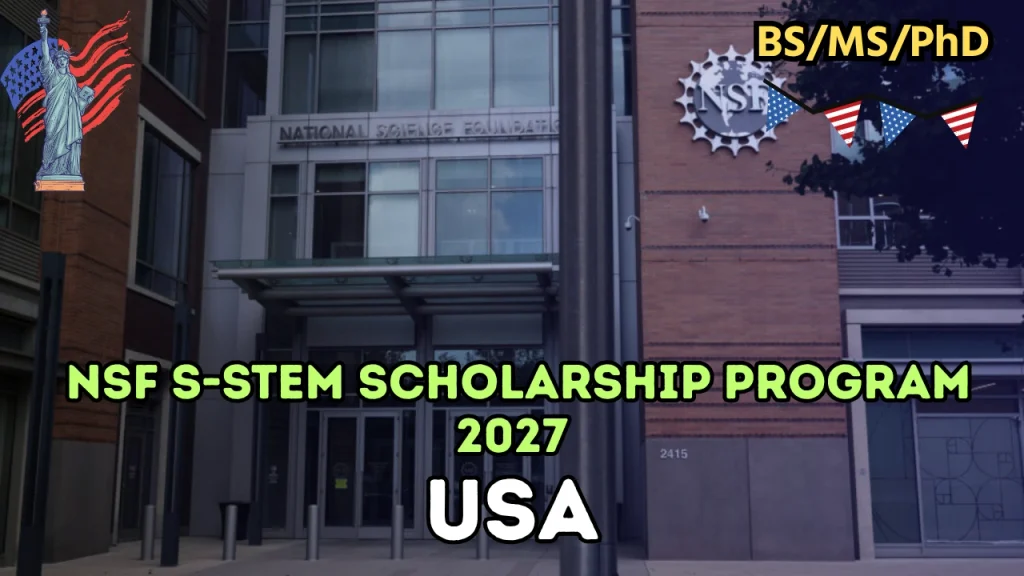
Securing financial support for higher education in Science, Technology, Engineering, and Mathematics (STEM) can completely transform your academic and professional trajectory. The NSF S-STEM Scholarship Program 2027 (National Science Foundation Scholarships in Science, Technology, Engineering, and Mathematics) stands out as one of the premier funding opportunities offered across United States higher education institutions.
The main goal of the S-STEM program is to enable academically talented, low-income students to pursue successful careers in promising STEM fields. Ultimately, the S-STEM program seeks to increase the number of academically promising low-income students who graduate with an S-STEM eligible degree and contribute to the American innovation economy with their STEM knowledge. Whether you are pursuing an associate, bachelor’s, master’s, or doctoral degree in a STEM discipline, this comprehensive guide covers everything you need to know about the NSF S-STEM Scholarship Program 2027 in USA, including eligibility criteria, participating institutions, application steps, and strategic application tips.
Basic Information about the Scholarship
The NSF S-STEM initiative is funded by the U.S. National Science Foundation. The program aims to enable academically talented students with demonstrated unmet financial need to successfully earn STEM degrees and enter the U.S. innovation economy workforce.
- Host Country: United States
- Funding agency: U.S. National Science Foundation (NSF).
- Expected number of awards: 60 institutional grants.
- Total estimated funding: $120 million.
- Award amount: $1 million–$5 million per institutional project, depending on the project track.
- Project duration: Up to 6 years.
- Institutional Proposal Deadline: March 2, 2027 (5:00 p.m. submitting organization’s local time) NC State University
- Student Application Deadlines: Set individually by host universities (typically ranging between February and May for the upcoming academic year, e.g., priority window around May 15).
Main Purpose
The S-STEM programme aims to:
- Help talented, low-income students study STEM subjects.
- Provide financial scholarships to students with demonstrated financial need.
- Increase student retention and graduation in STEM fields.
- Support students through academic mentoring, tutoring, workshops and other activities.
- Prepare graduates for careers in the American STEM workforce.
University/Institution Details
The NSF S-STEM program funds dozens of higher learning institutions across the United States. Grant awards are distributed across several types of educational environments:
Global South Opportunities
- Predominantly Undergraduate Institutions (PUIs): Focus heavily on undergraduate research and hands-on mentoring.
- Research I & II Universities: Top-tier research hubs (e.g., Northern Arizona University, University of Virginia’s College at Wise, North Carolina State University).
- Two-Year & Community Colleges: Institutions granting associate degrees with seamless transfer pathways to four-year degree programs.
- Public & Minority-Serving Institutions (MSIs): Urban, suburban, and rural public universities committed to supporting underrepresented student groups in technical fields. Global South Opportunities
Each participating institution customizes its S-STEM cohort structure, incorporating specialized faculty mentoring, undergraduate research opportunities, and career placement initiatives.
Study Areas & Available Program Names
The S-STEM program supports a broad array of core scientific, technical, and mathematical disciplines that fall within research fields funded by the NSF.
Eligible Academic Fields
The programme supports STEM disciplines funded by the NSF, including:
- Science.
- Technology.
- Engineering.
- Mathematics.
- Computer Science.
- Information Technology.
- Biotechnology.
- Chemical Technology.
- Engineering Technology.
The proposed degree must also demonstrate good employment prospects and relevance to the U.S. workforce.
Fields Not Eligible
The following programmes are excluded:
- Medicine and other clinical degrees.
- Nursing.
- Veterinary Medicine.
- Pharmacy.
- Physical Therapy.
- STEM teacher certification programmes covered by the Robert Noyce programme.
- Business Administration degrees (BBA, BSBA, BABA).
- MBA and other Master’s or Doctoral degrees in Business Administration.
Three Funding Tracks
The programme has three tracks for U.S. colleges and universities.
Track 1: Institutional Capacity Building
- Purpose: Help institutions develop the infrastructure and support systems needed for low-income STEM students.
- Eligible institutions: Institutions without an active S-STEM or STEP award during the five years before the application deadline.
- Maximum funding: $2 million.
- Duration: Up to 6 years.
- Scholarship allocation: At least 50% of the total project budget must be used for scholarships.
- Special requirement: The first 6–12 months must be used for institutional planning and capacity building before scholarships are awarded.
2 Track: Implementation Projects
- Purpose: Help institutions implement and improve existing strategies to support low-income STEM students.
- Eligible institutions: Any eligible U.S. higher education institution, regardless of previous S-STEM or STEP funding.
- Maximum funding: $2 million.
- Duration: Up to 6 years.
- Scholarship allocation: At least 60% of the total project budget must be used for scholarships.
Track 3: Inter-institutional Consortia
- Purpose: Support partnerships between multiple colleges and universities to improve STEM student success.
- Examples of partnerships:
- Two-year colleges and four-year universities.
- Undergraduate institutions and graduate universities.
- Multiple universities working together on common STEM education challenges.
- Maximum funding: $5 million.
- Duration: Up to 6 years.
- Scholarship allocation: At least 60% of the total project budget must be used for scholarships.
- Special requirement: Projects must include both an evaluation plan and an educational or social science research component.
- Review: NSF conducts a formal progress review during the third year.
Comparison of the Three Tracks
| Feature | Track 1 | Track 2 | Track 3 |
|---|---|---|---|
| Main purpose | Build institutional capacity | Implement support projects | Multi-institutional collaboration |
| Maximum funding | $2 million | $2 million | $5 million |
| Duration | Up to 6 years | Up to 6 years | Up to 6 years |
| Minimum scholarship budget | 50% | 60% | 60% |
| Initial planning period | 6–12 months | Not specifically required | Not specifically required |
| Research component | Not required | Not required | Required |
NSF S-STEM Scholarship Program Benefits
The NSF S-STEM programme provides financial support to eligible low-income students studying STEM subjects at participating U.S. colleges and universities.
- Undergraduate students: Up to $15,000 per year.
- Graduate students (Master’s and PhD): Up to $20,000 per year.
- Maximum scholarship duration: Up to 5 years at each institution or academic level.
- Covered expenses: Tuition, accommodation, food, textbooks, transportation, laptops and other costs included in the institution’s cost of attendance.
- Academic support: Faculty mentoring, tutoring, workshops, research opportunities and career guidance.
- Peer support: Students can join academic cohorts and receive support from fellow scholarship recipients.
Award Information (Funding)
- The programme expects to provide approximately $80–$120 million annually.
- Around 40–60 new awards are expected each year.
- The funding is provided to universities and institutions to support eligible students through scholarships.
- The funding amount depends on the project size and available budget.
Maximum funding by project type:
| Track | Project Type | Maximum Funding | Duration |
|---|---|---|---|
| Track 1 | Institutional Capacity Building | $2 million | Up to 6 years |
| Track 2 | Implementation Projects | $2 million | Up to 6 years |
| Track 3 | Inter-institutional Consortia | $5 million | Up to 6 years |
Important: These amounts are awarded to institutions for projects, not directly to individual students.
Benefits Not Included
While the scholarship offers substantial aid, applicants should plan for expenses that fall outside the standard S-STEM coverage scope:
- International Travel Coverage: S-STEM funding generally does not cover round-trip international airfare for study abroad or initial travel to the U.S.
- Visa & SEVIS Fees: Government administrative fees associated with student visas (F-1/J-1) or immigration processing are not covered.
- Personal Family Allowances: Funding does not extend dependent or family living allowances.
- Over-Budget Personal Luxuries: Expenses beyond standard room, board, and approved academic supplies must be self-funded.
Eligibility Criteria for the NSF S-STEM Scholarship Program
Who Can Apply for Funding?
Only eligible US higher education institutions can submit proposals.
- Two-year and four-year colleges and universities.
- Community colleges.
- Institutions must be accredited in the United States.
- Institutions must have a physical campus located in the United States.
International students or individuals cannot directly apply for this institutional funding.
Who Can Lead the Projects (Principal Investigator)?
The Principal Investigator (PI) is the person responsible for leading the project.
- Track 1 and Track 2: The PI must be a faculty member currently teaching an eligible subject or an academic administrator who has previously taught an eligible subject.
- Track 3: The PI may be a faculty member, an academic administrator, or a researcher working on low-income student success.
- The PI must have enough time and leadership capacity to manage the project.
- Faculty members from participating departments or institutions must also contribute.
Number of Applications Allowed
- Each institution can submit a maximum of two proposals for the same deadline.
- The two proposals must focus on different eligible academic disciplines.
- Institutions with an ongoing S-STEM award must generally wait until the end of the third year before submitting certain new proposals for the same disciplines.
- There is no limit on the number of proposals an individual PI or Co-PI can participate in.
To qualify for an NSF S-STEM scholarship, candidates must fulfill clear criteria established by the National Science Foundation and the administering U.S. institution:
Individual students cannot apply directly for this grant.
Students are selected by the participating US universities. However, they must meet the following conditions:
A. Nationality and Immigration Status
Applicants must be one of the following:
- US citizens.
- US nationals.
- Refugees legally admitted to the United States.
- Permanent residents (Green Card holders) of the United States.
International students holding only a foreign nationality, including Bangladeshi students, are not eligible.
B. Academic Requirements
- Must be enrolled at least half-time at an eligible institution.
- Must be pursuing an associate, bachelor’s, or graduate degree.
- The degree must be in an S-STEM eligible academic discipline.
- Must demonstrate academic ability or potential.
C. Financial Requirements
Applicants must:
- Come from a low-income background according to their university’s financial aid guidelines.
- Demonstrate unmet financial need.
- Meet the institution’s financial eligibility requirements.
- For undergraduate students, financial need is generally calculated using US federal financial aid rules (FAFSA).
- For graduate students, universities use the relevant financial eligibility criteria for graduate-level assistance.
Important: Student loans are not counted when calculating unmet financial need.
Important: International students are not eligible to receive S-STEM scholarships under this programme.
Eligible Degree Levels
Students may receive scholarships while pursuing:
- Associate degrees.
- Bachelor’s degrees.
- Master’s degrees.
- Doctoral degrees (PhD or equivalent).
Selection criteria
- Scholarships are intended for students who meet the institution’s definition of low-income.
- Students must be enrolled in degree programmes included in the proposal.
- All eligible students must receive fair consideration.
- Selection must be based on academic ability and potential.
- Students cannot be selected based on:
- Interest in a particular subject or specialization.
- Willingness to participate in project activities.
- Plans for future graduate studies.
- Demographic background or personal experiences, such as being a first-generation college student.
2. Support Based on Students’ Needs
- Each project must identify the specific challenges faced by low-income students.
- Institutions must conduct a needs assessment of their targeted students.
- Proposed support activities must be based on evidence and the actual needs of those students.
3. Student Groups and Faculty Mentoring
- Institutions are expected to create and maintain groups or cohorts of S-STEM scholarship recipients.
- Each scholarship recipient must have at least one faculty mentor.
- These groups should help students:
- Support each other academically.
- Develop social connections.
- Feel included in the academic environment.
- Institutions must ensure that enough qualified faculty members are available to mentor students.
- Mentoring arrangements for graduate students must also be explained in the proposal.
4. Financial Aid Office and Institutional Support
- Every institution awarding scholarships must submit a support letter from its Financial Aid Office.
- The letter must confirm that the institution understands the S-STEM requirements.
- S-STEM scholarships must be last-dollar scholarships.
Required Documents for the Application
When preparing your submission for a university S-STEM application cycle, gather the following essential documents:
- FAFSA Submission / Financial Aid Report: Current Free Application for Federal Student Aid (FAFSA) documentation confirming financial need. NAU – Northern Arizona University
- Official Academic Transcripts: High school or college transcripts demonstrating academic performance.
- Statement of Purpose / Personal Essay: A well-crafted essay detailing your passion for STEM, career objectives, and how the scholarship will help you succeed.
- Letters of Recommendation: 2 to 3 academic or professional recommendation letters from science/math instructors or lab supervisors.
- Updated Resume or Curriculum Vitae (CV): Highlighting research, projects, honors, and relevant extracurricular achievements.
NSF S-STEM Scholarship Program Application Process: Step-by-Step Guide
Important: This is an institutional grant, not an individual scholarship application. Universities and colleges apply for the funding, and eligible students subsequently apply for scholarships through participating institutions.
Step 1: Institutional Eligibility
- The applicant must be an accredited two-year or four-year higher education institution.
- The institution must have a campus located in the United States.
- The institution selects the appropriate funding track.
- An institution may submit up to two proposals for a given deadline, subject to the programme’s restrictions.
2nd Step: Prepare the Project Proposal
The institution must:
- Identify eligible STEM degree programmes.
- Identify the target population of low-income students.
- Analyse students’ academic potential and financial needs.
- Develop a scholarship budget.
- Design academic mentoring and student-support activities.
- Prepare an evaluation plan.
- Include faculty members and relevant administrators in the project leadership team.
Step 3: Prepare Supporting Documents
The proposal generally requires:
- Project description.
- Project budget and justification.
- Institutional information.
- Analysis of the prospective student population.
- Financial Aid Office support letter.
- Faculty and project leadership information.
- Evaluation plan and other required supplementary documents.
Track 3 proposals must also include a research plan.
4th Step: Submit the Proposal
Institutions can submit their applications through either:
The institution’s authorised representative must formally submit the proposal.
Step 5: NSF Evaluation
- NSF reviews the submitted proposals.
- Applications may undergo expert panel review or individual reviewer assessment.
- Reviewers evaluate the project’s intellectual merit and broader impacts, along with programme-specific requirements.
- NSF makes the final funding decision.
6th Step: Student Scholarship Applications
After an institution receives funding:
- It announces scholarship opportunities for eligible students.
- Students apply through the institution.
- The Financial Aid Office determines each student’s unmet financial need.
- Scholarships are awarded based on academic ability, potential and financial eligibility.
Tips for a Successful Application
Standing out among competitive scholarship applicants requires a strategic approach:
- Highlight Resilience alongside Academic Record: The S-STEM committee looks for talent and perseverance. Use your personal essay to explain how you have overcome challenges. Global South Opportunities
- Emphasize Career Aspirations in STEM: Clearly detail your post-graduation career path, whether entering industry innovation or pursuing advanced research degrees.
- Submit FAFSA Early: Financial aid budgets are time-sensitive. Submitting financial forms ahead of priority deadlines ensures full consideration. NAU – Northern Arizona University
- Secure Recommendations Early: Provide your academic references with ample time, along with your resume and personal statement draft.
Monthly Living Expenses for International Students in the USA
For students planning their budgets while studying in the U.S., understanding average cost-of-living metrics is vital for financial planning.
| Cost Category | Average Monthly Range (USD) | Key Details |
|---|---|---|
| Housing & Rent | $600 – $1,400 | Shared off-campus apartment or campus dormitories |
| Meals & Food | $300 – $550 | Campus meal plan or grocery budgeting |
| Utilities & Internet | $80 – $180 | Electricity, heating, water, high-speed internet |
| Transportation | $50 – $150 | Public transit passes, campus shuttles, or rideshares |
| Health Insurance | $100 – $250 | University student health insurance plan |
| Books & Supplies | $50 – $120 | Course text access, software, and lab gear |
| Total Estimated Expenses | $1,260 – $2,650 | Varies by city (e.g., suburban vs. major metropolitan areas) |
Why Choose This Scholarship? (5 Key Reasons)
- Substantial Financial Support: Up to $15,000 per academic year directly reduces out-of-pocket tuition and living costs.
- Comprehensive Mentorship Infrastructure: S-STEM scholars gain access to dedicated faculty advisors and industry mentors focused on student retention.
- Enhanced Career Pathways: Program participation opens doors to internships, research labs, and technical industry networks.
- Cohort Community Support: Scholars join a dedicated cohort of peers pursuing similar STEM goals, fostering collaborative learning.
- Prestige and Distinction: Holding a National Science Foundation-sponsored scholarship adds significant weight to your academic CV and future graduate school applications.
Frequently Asked Questions (FAQs)
Can international students apply directly for NSF S-STEM scholarships?
NSF S-STEM federal scholarship funds are designated by federal guidelines primarily for domestic low-income students (U.S. citizens, permanent residents, or eligible non-citizens). International students seeking STEM funding should look into university-specific merit awards, institutional assistantships, or private international scholarships.
How does NSF calculate financial need for the S-STEM award?
Financial need is determined by the financial aid office of the participating university. It is calculated by subtracting the student’s Expected Family Contribution (EFC/SAI) from the institution’s official Cost of Attendance (COA).
Is the scholarship renewable for multiple academic years?
Yes. S-STEM scholarships are typically renewable for up to four years for undergraduate degrees or throughout the duration of an eligible graduate degree, provided the student maintains required GPA standards and satisfies ongoing financial need criteria.
What is the deadline for the NSF S-STEM 2027 program cycle?
The NSF institutional proposal submission deadline is March 2, 2027. Individual student application deadlines vary by host university, typically falling between February and May 2027 for the upcoming academic year.
Important Deadline
March 2, 2027
Current deadline
- Submission deadline: 5:00 PM in the submitting organisation’s local time.
- The deadline applies to institutional proposals, not individual student applications.
- The NSF programme expects approximately 40–60 awards, subject to funding availability.