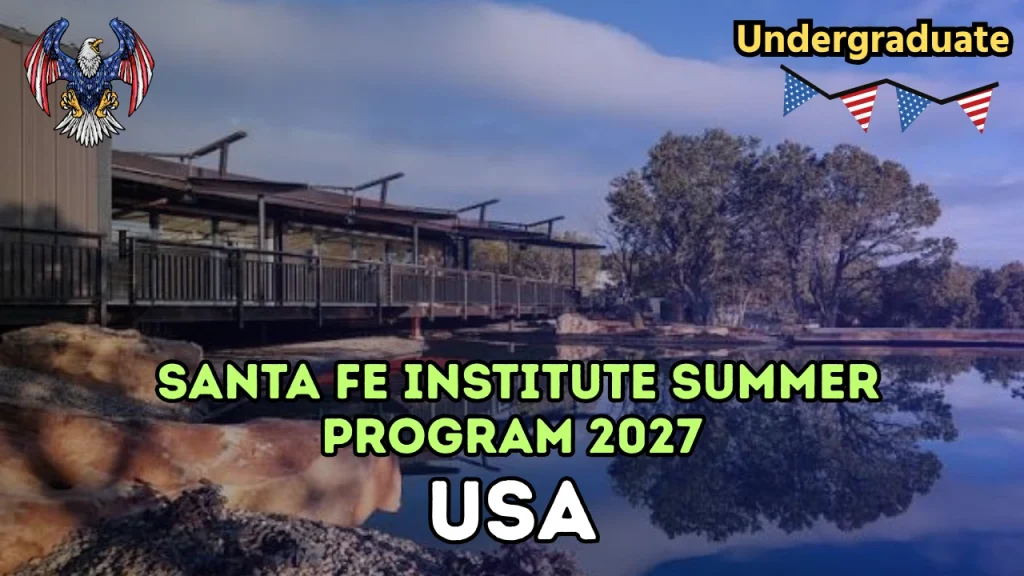
If you are looking to advance your academic career and gain hands-on experience in cutting-edge science, the Santa Fe Institute Summer Program 2027 in the USA offers a top-tier opportunity. Known officially as the Undergraduate Complexity Research (UCR) Program, this 10-week, fully funded research experience connects driven students from around the globe with world-class mentors at the forefront of complex systems science. The SFI Undergraduate Complexity Research (UCR) program is an immersive 10-week experience in complexity science research. Each student works closely with one or more SFI researchers to develop and pursue an original research project.
This guide details everything you need to know about the Santa Fe Institute Summer Program 2027—including key dates, financial coverage, eligibility criteria, required application materials, step-by-step instructions, and practical budget tips.
Basic Information About the Program
The Santa Fe Institute UCR program is an intensive 10-week residential research initiative located in Santa Fe, New Mexico, USA. Designed to bridge traditional disciplinary boundaries, the program gives undergraduates direct exposure to complex systems science—from computational biology and network theory to economics and social dynamics.
- Host Country: United States of America (USA)
- Host Institution: Santa Fe Institute (SFI)
- Program Name: SFI Undergraduate Complexity Research (UCR)
- Program Duration: 10 Weeks (May 30, 2027 – August 7, 2027)
- Funding Type: Fully Funded
- Target Audience: Domestic & International Undergraduate Students
- Application Opening Date: November 2, 2026
- Application Deadline: January 13, 2027, at 4:00 PM Mountain Standard Time (MST)
- Decision Announcement: March 2027
Program Overview
- A 10-week, full-time summer research programme in Complexity Science.
- Students work directly with one or more SFI researchers.
- Each participant develops and conducts an original research project.
- Students explore different research topics, meet researchers, and refine their research ideas.
- The programme focuses on understanding complex systems through mathematics, computation, statistics, and interdisciplinary research.
Goals:
- Conduct an independent research project under an experienced researcher.
- Learn about complexity science and complex systems.
- Develop mathematical, computational, and analytical skills.
- Improve research methods and scientific communication.
- Learn how to work collaboratively with researchers.
- Explore future academic and professional career opportunities.
- Build connections with international researchers and fellow students.
University / Institution Details
The Santa Fe Institute (SFI) was founded in 1984 as an independent, non-profit theoretical research institute dedicated to transdisciplinary science. Located in Santa Fe, New Mexico, SFI is renowned as the birthplace of complex systems science.
Unlike conventional research universities divided by departments, SFI brings together theoretical physicists, computer scientists, evolutionary biologists, economists, cognitive scientists, and anthropologists under one roof. Visiting scholars and resident faculty collaborate to uncover the universal principles governing complex adaptive systems—including neural networks, financial markets, ecosystems, and human societies. Participating in an SFI summer program grants you access to an intellectual environment unmatched in standard academic setups.
Program Location
- Location: Santa Fe, New Mexico, USA.
- Students conduct research at the Santa Fe Institute (SFI) during weekdays.
- Students stay at the Institute of American Indian Arts (IAIA) campus.
- The IAIA campus is approximately 30 minutes by car from the SFI campus.
- Each participant receives a private room and a private bathroom.
- The accommodation provides walking trails, outdoor spaces, artwork, and sports facilities.
- Guests not allowed
Study Areas (Available Program Track)
The core theme of the SFI Summer Program is Complex Systems Science. Rather than limiting students to a narrow academic track, SFI invites participants from a broad spectrum of majors to apply quantitative, analytical, and computational methods to complex real-world problems.
Available research areas and themes include:
- Computational & Theoretical Physics: Nonlinear dynamics, statistical mechanics, quantum information, and network theory.
- Computer Science & Artificial Intelligence: Machine learning, agent-based modeling, algorithmic complexity, and swarm intelligence.
- Biological Sciences: Evolutionary dynamics, computational biology, origin of life research, and ecological systems.
- Social & Economic Sciences: Behavioral economics, societal scaling laws, financial market dynamics, and cultural evolution.
- Cognitive Science & Neuroscience: Collective intelligence, brain network architecture, and decision-making dynamics.
- Applied Mathematics & Data Science: High-dimensional data modeling, differential equations, and dynamic system modeling.
Programme Structure and Activities
- Individual research: Most of the working week is dedicated to individual research projects.
- Weekly meetings: Students meet programme directors and education staff.
- Research tutorials: Sessions cover scientific literature reading, science communication, and research skills.
- Research seminars: Students attend seminars led by SFI researchers, professors, postdoctoral fellows, and invited experts.
- Networking: Participants interact with researchers and other academic professionals through daily activities and informal discussions.
- Research presentations: Each student delivers two presentations:
- A short presentation (flash talk) introducing their research project.
- A final research presentation during the last week.
Santa Fe Institute Summer Program Benefits
- Stipend: $7,000 for the 10-week programme.
- Accommodation: A private room with an attached bathroom at the Institute of American Indian Arts (IAIA) campus.
- Transportation: Free weekday group transportation between the accommodation and Santa Fe Institute.
- Research Experience: Opportunity to conduct research at the prestigious Santa Fe Institute.
- Mentorship: Work with experienced researchers and develop a research project with a mentor.
- Research Training: Learn new research methods, explore complex systems, and develop analytical and problem-solving skills.
- Collaboration: Work with students from different academic backgrounds and institutions.
- Networking: Opportunities to connect with researchers, mentors, and other talented undergraduate students.
- Campus Facilities: Access to walking trails, outdoor spaces, artwork, and athletic facilities.
- Dietary Support: Group meals make efforts to accommodate participants’ dietary needs.
- Travel Support: Eligible students who drive to Santa Fe may receive mileage reimbursement up to the programme’s specified limit.
This comprehensive funding ensures that students can focus on research without financial stress.
Benefits Not Included
While the SFI Summer Program is exceptionally comprehensive, applicants should keep in mind a few personal expenses that fall outside the standard fellowship package:
- Passport & U.S. Visa Application Fees: Standard government processing fees for non-immigrant visas (e.g., DS-160 and SEVIS fees) are typically the applicant’s responsibility.
- Personal Travel & Sightseeing: Personal weekend trips, regional exploration in New Mexico, or additional leisure travel outside official activities.
- Health / Travel Insurance (if extra):
- Personal Electronics
Eligibility Criteria for the Santa Fe Institute Summer Program
- The program is open to currently enrolled undergraduate students.
- Who Can Apply?
- Undergraduate students from different academic backgrounds are welcome.
- Eligible academic fields include:
- Physical Sciences
- Natural Sciences
- Social Sciences
- Mathematics
- Students with strong quantitative and mathematical skills are particularly encouraged.
- Experience with programming languages is an advantage.
- Applicants interested in interdisciplinary research and complex systems are encouraged.
- Students from both two-year and four-year colleges/universities can apply.
- Previous research experience is not required.
- Students must remain enrolled in an undergraduate degree programme for at least one additional academic term after the program ends in August.
- Students who complete their Bachelor’s degree before the program ends are not eligible.
- Students who will not return to undergraduate study after August are also not eligible.
- Transfer students can apply, including those transferring between institutions during the summer.
- Priority is generally given to students entering their third or fourth year.
- Applicants must be legally authorized to work in the United States.
International Students
- International students are welcome to apply.
- Students studying outside the USA can also apply.
- Applicants must be eligible to travel to the USA.
- Selected international students may receive limited visa assistance.
- The SFI may be able to sponsor a J-1 visa, depending on the applicant’s situation.
- International students studying at US universities may participate through CPT authorization arranged by their university.
Desired Applicant Qualities
The programme looks for students who can:
- Learn new topics independently.
- Develop and explore research ideas.
- Think logically and creatively.
- Communicate effectively.
- Work collaboratively in a team.
- Show curiosity, motivation, and interest in research.
Important: Students must arrive on the official first day. No late arrival because the first two weeks are essential for orientation, meeting mentors, and developing research projects
Required Documents for the Application
A complete application must include:
- Personal information: Basic biographical details submitted through the online portal.
- Academic CV/Resume: An updated academic and professional CV.
- Research statement: Written responses to two questions, including a short research project proposal.
- Academic transcripts: Unofficial transcripts from every college or university attended.
- Recommendation letter: One letter from a professor, academic mentor, or advisor familiar with the applicant’s work.
Important Application Details
Academic background
- Mention the subjects you have actually studied at university.
- List your major and minor academic disciplines accurately.
- List only the subjects you have actually studied, not those you are merely interested in.
Mathematics background
- Mention only mathematics topics you have completed through college-level coursework and passed.
- Do not include topics you have only partially studied.
Academic transcripts
- Unofficial transcripts are acceptable.
- You do not need to submit official transcripts.
- Transcripts should include completed and ongoing courses with grades.
- If your transcript is not in English, provide an English translation as a cover page.
- If your latest semester grades are unavailable, provide an official course-enrolment list.
- You cannot submit updated grades or additional documents after the deadline.
Research Statement / Project Proposal
- Applicants must submit a one-page research statement.
- It should explain the research topics or questions that interest them.
- You do not need previous research experience.
- Applicants do not need to provide advanced technical details or a complete research design.
Your research statement should explain:
- Research question: What do you want to investigate?
- Research approach: How might you investigate the question?
- Reasoning: Why is your proposed approach suitable for the research question?
For example:
- How does climate change affect the livelihoods of rural communities?
- How does urban expansion influence environmental sustainability?
- How do social networks affect entrepreneurship among university students?
Important: The proposed research topic is not a fixed commitment. If selected, students will spend the first few weeks meeting researchers, exploring research opportunities, and developing a suitable project with a mentor.
Santa Fe Institute Summer Program Application Process: Step-by-Step Guide
- Applications must be submitted through the official online application portal (SurveyMonkey Apply).
- Not consider late or incomplete applications.
- Selected finalists will be invited for short online interviews through Zoom.
- All applicants will receive an email about their application status in March 2027.
- Applicants should contact their recommenders early to ensure recommendation letters are submitted before the deadline.
- No updated documents will be accepted after the deadline.
Important Rules for Applicants
- Students must be available from the official first day.
- No late arrival
- Students with university examinations during the first weeks may arrange proctored exams or dedicated study space, but this must be approved in advance.
- Applicants should not contact individual SFI researchers or programme directors about their applications.
- All admission decisions are based on the submitted application materials.
- Application-related questions should be sent to [email protected].
Tips for a Successful Application
Competition for the SFI UCR program is global and intense. Here are actionable tips to make your candidate profile stand out:
- Highlight Transdisciplinary Curiosity: SFI values intellectual breadth. Demonstrate how you connect ideas across disciplines—such as using computer science models to analyze biological ecosystems or economics.
- Demonstrate Programming Competency: Mention specific programming languages, libraries, data analysis tools, or quantitative methods you have worked with in coursework or personal projects.
- Formulate a Clear Research Idea: Your project proposal does not need to be a fully polished paper, but it must showcase structured critical thinking, clear research questions, and reasonable scope for a 10-week timeframe.
- Coordinate with Your Referee Early: Provide your letter writer with your CV and draft research statement so they can tailor their letter to SFI’s focus on complexity science.
- Proofread for Human Clarity: Avoid generic academic buzzwords. Write clear, engaging prose that explains why you are excited about complex systems science.
Monthly Living Expenses for International Students (in USD)
Because the SFI UCR program provides free housing, meals, and a $7,000 stipend, your essential living costs during the program are fully covered. However, if you plan to travel independently, purchase extra supplies, or stay in the U.S. before or after the program dates, it helps to understand typical local costs in Santa Fe, New Mexico:
| Expense Category | Estimated Monthly Cost (USD) | Covered by SFI Fellowship? |
| Housing / Accommodation | $1,200 – $1,800 | Yes (100% Free) |
| Meals & Groceries | $400 – $600 | Yes (Provided / Allowance) |
| Local Public Transit / Rideshares | $80 – $150 | Stipend Covers |
| Cell Phone / Mobile Data Plan | $30 – $60 | Stipend Covers |
| Personal Expenses & Leisure | $150 – $300 | Stipend Covers |
| Total Out-of-Pocket Cost | $0 / Minimal | Fully Funded |
Why Choose This Scholarship? (Top 5 Reasons)
- Pioneer Institution in Complexity Science: SFI is world-renowned as the premier hub for complex systems research. A fellowship at SFI adds significant weight to any academic CV.
- Mentorship from Renowned Scientists: You will work side-by-side with leading theoretical scientists, postdocs, and researchers who are actively redefining their fields.
- Complete Financial Freedom: With a $7,000 stipend, free housing, meal allowances, and paid travel, you can focus 100% of your energy on your research without financial strain.
- Global Collaborative Network: You will join a international cohort of curious, driven student researchers, building lifelong professional connections and research partnerships.
- Pathway to Elite Graduate Programs: Alumni of SFI summer programs frequently earn admission into top-tier PhD programs at leading global universities, backed by strong recommendations from SFI faculty.
Frequently Asked Questions (FAQs)
1. Is there an application fee for the SFI UCR program?
No, submitting an application to the Santa Fe Institute Summer Program is completely free.
2. Can international students outside the USA apply?
Yes! The program welcomes applicants of all nationalities enrolled in universities anywhere in the world, provided they meet the basic eligibility criteria.
3. Do I need prior research experience in complex systems?
No prior published research experience is required. SFI seeks applicants with strong quantitative skills, creative problem-solving abilities, and a high enthusiasm for transdisciplinary study.
4. What if I graduate in May or June 2027?
If you complete your undergraduate degree before the program ends in August 2027, you are not eligible. You must be returning to at least one term of undergraduate study after August 2027 (graduation date in December 2027 or later).
5. When will application results be released?
Decisions are communicated via email to all applicants in March 2027.
Important Dates
| Event | Date |
|---|---|
| Application opens | November 2026 |
| Application deadline | January 13, 2027 |
| Deadline time | 4:00 PM Mountain Standard Time (MST) |
| Interview and selection updates | March 2027 |
| Programme period | Summer 2027; exact dates should be checked in the official programme information |