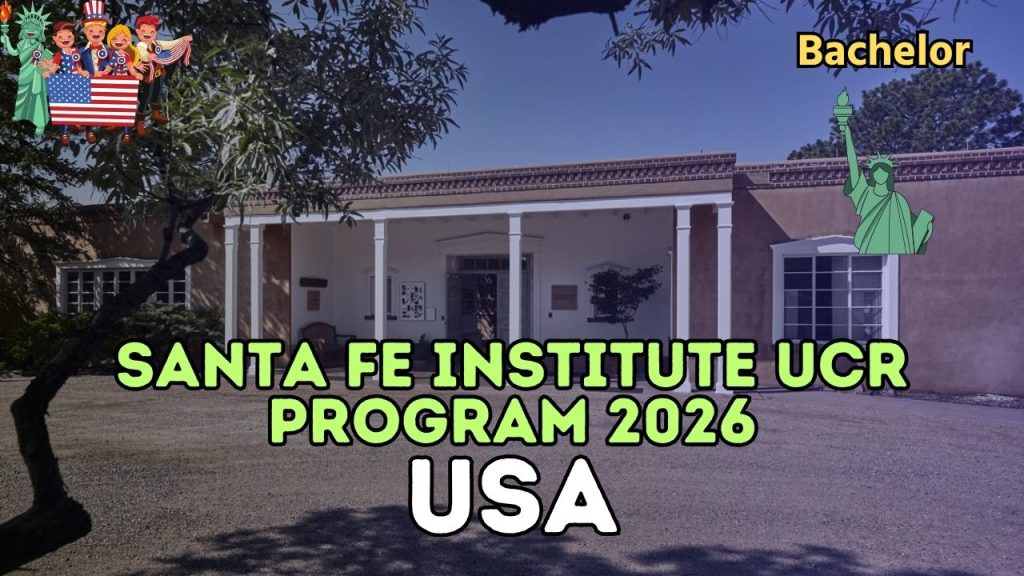
The Santa Fe Institute (SFI) Undergraduate Complexity Research (UCR) Program 2026 offers a prestigious, fully funded 10-week residential research experience in Santa Fe, New Mexico, USA. This unique program empowers undergraduate students worldwide to conduct independent research in complexity science under expert mentorship. If you are an aspiring researcher passionate about interdisciplinary study and real-world complex systems, the SFI UCR Program 2026 is a golden opportunity to advance your academic and professional journey.
Basic Information and Application Deadline
- Program: Santa Fe Institute Undergraduate Complexity Research (UCR) Program 2026
- Location: Santa Fe, New Mexico, USA
- Duration: 10 weeks
- Program Support: Funded by NSF BIO REU and donors (Darla Moore, McKinnon Family, Bengier, Eugene & Jean Stark)
- Application Deadline: January 14, 2026 (MST, UTC-7)
- Type: Fully Funded Residential Research Program
- Eligible Candidates: Undergraduate students globally
- Dates: May 31 – August 8, 2026 (10 weeks, full-time, in-person)
Applicants should submit their applications online by the deadline and ensure all documents are complete to secure their place for the summer research session.
Goals:
- Conduct independent transdisciplinary research with a mentor
- Learn complex systems research through seminars & discussions
- Join the SFI research network and connect with peers
- Develop skills: science communication, research methods, collaboration
- Explore career opportunities in complexity science
- Be part of a supportive UCR community during and beyond the program
University/Institution Details
The Santa Fe Institute is a renowned independent research institute famous for pioneering complex systems research. Located in Santa Fe, New Mexico, it brings together scientists and scholars from diverse disciplines including physical sciences, social sciences, mathematics, and biology to tackle fundamental questions about complexity in the natural and human world.
The UCR program reflects SFI’s mission by offering students a chance to dive deep into interdisciplinary research, combining theory, methods, and data to address significant real-world challenges.
Study Areas and Available Program Names
The SFI UCR program focuses on complexity science, an interdisciplinary field studying complex systems across physical, natural, and social sciences. Students propose and conduct projects guided by leading SFI mentors on topics including:
- Complex systems in biology, ecology, and evolution
- Network theory and statistical mechanics
- Social systems and economic complexity
- Computational modeling and data analysis
- Physical phenomena and emergent behavior in nature
Participants from all scientific backgrounds—whether mathematics, physics, biology, computer science, or economics—are encouraged to engage with transdisciplinary research projects that challenge conventional boundaries.
Santa Fe Institute UCR Program Benefits
The Santa Fe Institute UCR Program 2026 is fully funded, offering generous financial support to all selected participants:
- $7,000 stipend to support living costs during the 10-week program
- Travel support to and from Santa Fe, New Mexico
- Free housing on-site
- All meals are provided throughout the program
- Access to cutting-edge research facilities and seminars
- Mentorship by leading researchers in complexity science
This comprehensive funding ensures that students can focus on research without financial stress.
Benefits Not Included
While the scholarship covers major expenses, it does not include:
- Personal expenses beyond food and housing
- Health insurance or medical costs (applicants should arrange coverage)
- Visa or immigration fees for international students
- Costs related to travel outside program dates
Applicants should budget for incidental personal expenses and ensure they have appropriate health coverage.
Eligibility Criteria for the Santa Fe Institute UCR Program
Eligibility – Undergraduate Students
- Must be current undergraduates (associate’s or bachelor’s program).
- Prior research experience is not required.
- Must continue undergraduate enrollment for at least one term after the program ends in August.
- Students from two-year, four-year, and transfer students are eligible.
- Students in dual- or integrated-degree programs are eligible only if still in the undergraduate portion and returning for at least one more term.
- High school graduates who haven’t started college are not eligible.
- Students who have completed their undergraduate degree are not eligible.
- Priority is usually given to students entering junior or senior year.
- Must be authorized to work in the U.S.
International Applicants
- Students from any country can apply.
- Those at U.S. institutions usually participate under F-1 status via CPT, coordinated with their home university.
- Students outside the U.S. are also eligible.
- Limited visa assistance may be provided to admitted international participants.
Limited visa assistance may be available for international participants.
Required Documents for the Application
Applicants must submit the following materials as part of their application package:
- Biographical information (filled in portal).
- Current academic CV or résumé.
- Research statement: response to three prompts + short project proposal.
- One recommendation letter (professor, mentor, or advisor).
- Unofficial transcripts from all colleges/universities attended.
- Transcript Requirements:
- Unofficial transcripts are enough.
- Must list all completed and in-progress courses with grades.
- If not in English, include English translation.
- No updates or additional documents accepted after the deadline.
- Research Statement / Project Proposal:
- One-page statement with three research ideas.
- Purpose: show interests and thinking process.
- No prior research or technical expertise required.
- Include:
- Clear question/goal.
- Plausible path or approach.
- Reasoning for why approach fits the question.
- Both content-driven and method-driven ideas are welcome.
- Focus on clarity, coherence, and curiosity; polish is less important.
Preparing these documents thoughtfully is key to demonstrating your research potential.
Before Apply
- Read all UCR info pages carefully before applying or asking questions.
- UCR is for curious, motivated students who can work independently and in teams.
- Strong applicants can:
- Teach themselves new material and follow through on ideas
- Communicate and collaborate well
- Think logically and creatively about research
- Students from schools with limited research opportunities are especially encouraged to apply.
- Participants must arrive on the official first day; late arrivals are not allowed.
- The first two weeks are crucial for orientation, meeting mentors, and defining projects.
- If needed, SFI can coordinate with your school for exams or assignments during the first days.
Santa Fe Institute UCR Program Application Process: Step-by-Step Guide
- Create an Account: Visit the official Santa Fe Institute UCR application portal and register an account.
- Complete Application Form: Fill in personal, educational, and contact information.
- Upload Documents: Submit CV, research statement, letter of recommendation, and unofficial transcripts.
- Review and Submit: Double-check all information and submit before the January 14, 2026 deadline (MST).
- Wait for Decision: Applicants are notified following the review process. Prompt responses and communication are recommended.
- Prepare for Program: Upon acceptance, arrange travel documents and visas, and plan for your stay in Santa Fe.
Tips for a Successful Application
- Start your application process early to avoid last-minute issues and allow time for your recommender to submit their letter.
- Craft a clear and compelling research statement that reflects your scientific interests and how they align with complexity science.
- Demonstrate your commitment to returning to undergraduate studies after the program to meet eligibility requirements.
- Highlight any previous research experience or relevant coursework to strengthen your CV.
- Seek feedback from mentors or advisors before submitting your application.
Monthly Living Expenses for International Students in the USA
International students in the USA typically spend between $1,000 to $1,500 per month on living expenses, though this varies by location and lifestyle. Common cost estimates include:
- Housing: $800 to $1,000 (on-campus) or $500 to $3,500 (off-campus depending on city)
- Food: $250 to $400 per month
- Transportation: $36 to $50
- Utilities & Internet: $100 to $150
- Miscellaneous: $100 to $200
The SFI UCR program covers housing and meals, significantly reducing living costs for participants during the program duration. However, personal expenses beyond this support should be budgeted.
Why Choose the Santa Fe Institute UCR Program?
- Fully Funded Research Opportunity: Covers travel, housing, meals, and a stipend allowing full focus on research.
- Expert Mentorship: Work with leading scientists at a globally renowned institute in complexity science.
- Interdisciplinary Learning: Participate in seminars and workshops that enhance your research skills and academic development.
- Networking: Access a global community of scholars and peers across science, mathematics, and social sciences.
- Prestigious Experience: A unique addition to your academic CV, boosting future graduate school and career prospects.
Frequently Asked Questions about the Santa Fe Institute UCR Program
Q: Can international students apply?
A: Yes, applicants from any country enrolled in undergraduate programs are welcome.
Q: What is the application deadline?
A: January 14, 2026 (MST, UTC-7).
Q: Are there any citizenship restrictions?
A: No citizenship restrictions apply.
Q: Is prior research experience required?
A: No prior research experience is necessary, although it is beneficial.
Q: What happens if I graduate before the program ends?
A: Students who will complete their degree before August 2026 are ineligible.
Official Link:
The Santa Fe Institute UCR Program 2026 stands out as an exceptional opportunity for ambitious undergraduates eager to explore complexity science through immersive research in the USA. Apply early to join this transformative experience!