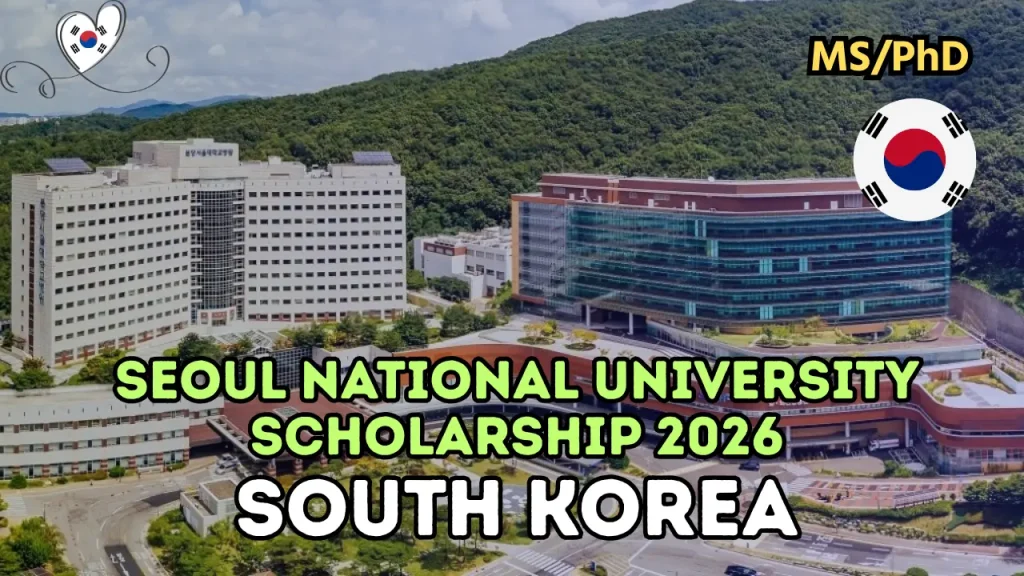
Are you looking for a fully funded pathway to study at the top-ranked university in South Korea? The Seoul National University (SNU) Scholarships 2026 represent a premier academic opportunity for international students worldwide. The academic year at SNU begins in the spring, yet the university offers international admissions for both the spring and fall semesters.
Known globally for its cutting-edge research facilities, world-class faculty, and immense cultural footprint, Seoul National University offers multiple institutional and government-backed fellowships.
Basic Information & Key Application Deadlines
Seoul National University runs two main admission cycles each year: the Spring Intake (starts in March) and the Fall Intake (starts in September). The 2026 academic year features several prominent scholarship tracks integrated directly into the admissions pipeline.
- Host Institution: Seoul National University (SNU), South Korea
- Eligible Levels: Undergraduate, Master’s, and Doctoral (PhD) programs
- Target Group: International students (Non-Korean citizens)
- Major Scholarship Types Available: Global Korea Scholarship (GKS), Graduate Scholarship for Excellent Foreign Students (GSFS), SNU President Fellowship (SPF), and SNU Global Scholarships.
Critical Deadlines for the 2026 Cycle
Because South Korean universities open portals months in advance, deadlines require tight monitoring:
- Fall 2026 Graduate Admissions & SNU Institutional Scholarships (GSFS/SPF): The online portal opens in early March 2026 and typically closes within a tight 3-to-5-day window. Original postal documents are submitted through May.
- Spring 2027 Graduate Intake: The application window opens between July 6, 2026, and July 9, 2026.
- Global Korea Scholarship (GKS) Graduate Track: Portal windows run between February 12 and March 12, 2026 (depending on Embassy vs. University track selection).
- GKS Undergraduate Track: Applications open from September to October 2026 for the subsequent academic entry.
University/Institution Details: The SNU Prestige
Founded in 1946 as the first national university in South Korea, Seoul National University is the undisputed anchor of the elite “SKY” university trio (Seoul National, Koryo/Korea, and Yonsei). Consistently ranked in the top 30 universities globally by QS and Times Higher Education, SNU is spread across its beautiful, sprawling Gwanak Campus in southern Seoul and the medical-focused Yeongeon Campus.
SNU serves as a vital engine for the technological, political, and cultural movements shaping East Asia. Studying here embeds you in an intense, highly motivated academic culture alongside South Korea’s brightest minds and prominent international research scholars.
Study Areas & Available Programs
SNU provides an expansive array of programs, with an increasing number of graduate courses taught entirely or partially in English. Eligible disciplines include:
- Engineering & Technology: Computer Science and Engineering, Mechanical Engineering, Chemical and Biological Engineering, Aerospace Engineering, Architecture.
- Natural Sciences: Physics and Astronomy, Mathematical Sciences, Chemistry, Biological Sciences.
- Social Sciences & Humanities: International Relations, Economics, Sociology, Public Administration, Korean Language and Literature, History.
- Business & Law: Global MBA, Finance, International Business, LLM (Master of Laws).
- Medical & Life Sciences: Pharmacy, Public Health, Nursing, and Medicine (Biomedical tracks).
Seoul National University Scholarships Benefits: What is Fully Funded?
Depending on the specific track you secure (GKS, GSFS, or SPF), the financial support provided is remarkably robust:
Graduate Scholarship for Excellent Foreign Students (GSFS)
- Tuition Fee: Full tuition waiver (up to 4 semesters)
- Living Allowance: 500,000 KRW per month (varies by major)
Silk-Road Scholarship
- Tuition Fee: Full tuition waiver (up to 4 semesters)
- Living Allowance: Up to 600,000 KRW per month (for 4 semesters)
- Airfare: Up to 1,000,000 KRW for one economy round trip
- Korean Language Training: Full fee exemption at the Language Education Institute
Overseas Koreans Scholarship
- Tuition Fee: Full tuition waiver (up to 4 semesters, subject to conditions)
- Living Allowance: Up to 900,000 KRW per month (for 4 semesters)
- Airfare: One economy round trip
- Korean Language Training: Fee exemption for 6 months at the Language Education Institute
- Medical Insurance: Covered through a private insurance company
Korean Government Scholarship Program (KGSP/GKS)
- Tuition Fee: Full tuition waiver
- Master’s: Up to 4 semesters
- PhD: Up to 6 semesters
- Living Allowance: 900,000 KRW per month
- Airfare: One economy round trip
- Korean Language Training: One year (mandatory)
- TOPIK Requirement: Must achieve TOPIK Level 3 within one year to enter the degree program
- Additional Benefits:
- Medical insurance
- Research fund
- Thesis printing fee
- Settlement allowance
- Return allowance (travel expenses)
Benefits Not Included
While these fellowships remove massive financial hurdles, prospective scholars should account for these independent expenses:
- Initial Visa Processing Fees: Costs tied to registering for your D-2 Student Visa at your local South Korean embassy.
- SNU Online Admission Fee: A non-refundable application fee of approximately 80,000 to 90,000 KRW (approx. $65 – $70 USD) paid during online form submission.
- Personal Tech & Winter Outerwear: Specialized laptops or heavy winter clothing required to survive Seoul’s sub-zero winter temperatures.
- Excess Baggage Costs: Courier or airline fees for shipping personal items over the standard luggage restrictions.
Eligibility Criteria for Seoul National University Scholarships
Educational Qualification
For Master’s Program
- Hold a Bachelor’s degree from an accredited university, or
- Be expected to complete your Bachelor’s degree by February 28, 2027.
For Doctoral Program
- Hold a Master’s degree, or
- Be expected to complete your Master’s degree by February 28, 2027.
Nationality / Educational Background Requirements
International Admission I
You are eligible if:
- You and both of your parents are non-Korean citizens.
This is the admission type most international applicants use.
International Admission II
You are eligible if:
- You completed your entire education abroad (from elementary school through university).
SNU notes that applicants who qualify for Admission I are generally encouraged to apply under Admission I.
Language Requirement
You must submit proof of proficiency in English or Korean.
Minimum English Scores
- TOEFL iBT: 80
- IELTS Academic: 6.0
- TEPS: 269
Minimum Korean Scores
- TOPIK Level 3 or above, or
- Completion of Level 4 at a Korean university language center.
Note: Some programs require higher TOPIK levels (Level 5 or 6).
❌ Not Eligible If
- You will graduate after February 28, 2027.
- Your qualification comes solely from:
- Home-schooling programs,
- Degree-equivalency examinations,
- Non-traditional higher education credentials not recognized by SNU.
- You fail to submit required documents within the application period.
Admission Evaluation Criteria
Applicants are evaluated based on:
- Academic performance
- Research potential
- Suitability for the major
- Language proficiency
- Personal statement & study plan
- Recommendation letters
- Academic and extracurricular achievements
Some departments may additionally require:
- Interview
- Examination
- Performance test
Important Notes
- Only one application is allowed.
- Application fee is non-refundable.
- Late submissions are not accepted.
- All documents must be in English or Korean (or accompanied by notarized translation).
- Original documents must be submitted after preliminary admission.
- Foreign degrees/transcripts generally require Apostille or Korean Embassy authentication.
- Admission can be canceled if documents are false or incomplete.
- Students cannot be enrolled at another university simultaneously after admission.
- Failure to pay tuition within the registration period results in cancellation of admission.
Required Documents for the Application
Organizing your paperwork early is paramount. All documents must be issued in English or Korean. If your native records are in another language, they must be officially translated and notarized.
Minimum Checklist for Most Master’s Applicants
- Application form
- Personal statement & study plan
- 2 recommendation letters
- IELTS 6.0+ / TOEFL 80+ / TOPIK 3+
- Bachelor’s certificate
- Bachelor’s transcript
- Passport copy
- Parents’ nationality documents
- Birth/family relationship certificate
- Optional achievements, awards, thesis abstract
Application Documents
- Application Form
- Personal Statement and Study Plan
- Two Recommendation Letters (one from each recommender)
Language Proficiency (At least one required)
- TOPIK score report, or
- TOEFL iBT score report, or
- IELTS Academic score report, or
- TEPS score report, or
- Official proof that the entire degree program was taught in English or Korean
Academic Documents
For Master’s Applicants
- Bachelor’s Degree Certificate (or Expected Graduation Certificate)
- Bachelor’s Academic Transcript
For Doctoral Applicants
- Master’s Degree Certificate (or Expected Graduation Certificate)
- Master’s Academic Transcript
- Bachelor’s Degree Certificate
- Bachelor’s Academic Transcript
Nationality and Family Documents
- Applicant’s Passport Copy (or Nationality Certificate)
- Father’s Passport Copy/Nationality Certificate
- Mother’s Passport Copy/Nationality Certificate
- Birth Certificate or Family Relationship Certificate (showing relationship between applicant and parents)
Additional Documents (Only if Applicable)
- Korean nationality renunciation documents (if applicant or parents were previously Korean citizens)
- Explanatory Statement and supporting documents (for special circumstances)
- Notarized translations for documents not in English or Korean
Portfolio / Additional Academic Materials (Required for Certain Programs Only)
- Portfolio
- Academic Writing Sample
- Thesis
- Thesis Copy
- Portfolio Pledge
Optional Documents
- Additional language certificates (HSK, JLPT, DELF, etc.)
- Awards and scholarship certificates
- Certificates of achievements
- Thesis abstract
- Other supplementary materials
Seoul National University Scholarships Step-by-Step Application Process
Navigating your SNU scholarship application involves a precise sequence of steps. Missing a single administrative window can defer your admission by a full year.
1.Select Your Route & Program:January – February.
Review the SNU International Admissions Guide. Choose whether you will apply through institutional tracks (GSFS/SPF) or via the Korean Government (GKS) Embassy/University tracks.
2.Complete the Online Portal Registration:March / July.
Create an account on the designated SNU or StudyInKorea application system during the active opening days. Fill out the profiles and pay your non-refundable application fee.
3.Register Your Recommenders:March / July.
Input your referees’ corporate emails into the electronic system so they receive secure upload links for their recommendation forms before the portal closes.
4.Mail Apostilled Documents:April – May.
After passing initial electronic screenings, ship your physical, notarized, and Apostilled graduation certificates and transcripts to the SNU Admissions Office via international courier.
5.Attend Department Interviews:May / October.
If required by your specific department, participate in an online oral examination or technical interview conducted via Zoom or Skype.
Pro Tips for a Highly Successful Application
- Tailor the Study Plan to Korean Research Paradigms: Don’t write a generic research statement. Look up active SNU laboratories, mention specific papers published by SNU faculty members, and clearly articulate how your project aligns with South Korea’s industrial or cultural objectives.
- Secure the TOPIK Advantage: Even if your program is advertised as English-medium, having a basic TOPIK Level 3 certificate adds significant bonus points to your profile and distinguishes you in competitive pools.
- Verify the Apostille Early: Getting educational records certified by government ministries can take weeks. Start this process long before the online application portal opens.
- Showcases Cross-Cultural Agility: South Korean academic working environments are highly structured and fast-paced. Use your personal statement to demonstrate resilience, adaptability, and respect for collaborative structures.
Estimated Monthly Living Expenses in Seoul for International Students
Seoul provides a highly advanced public infrastructure at an affordable rate compared to Western hubs. While your SNU monthly stipend readily covers standard costs, here is an average budget breakdown mapped in USD ($):
| Expense Category | Monthly Cost (USD) | Local Seoul Context |
| Accommodation | $300 – $550 | On-campus Gwanaksa dormitories vs. a local off-campus Goshiwon or One-room |
| Food & Groceries | $250 – $400 | Utilizing affordable on-campus cafeterias vs. dining out in Hongdae or Sillim |
| Public Transport | $45 – $70 | Seoul’s unified subway and bus system utilizes affordable T-Money card taps |
| Utilities & Mobile Plan | $60 – $100 | High-speed mobile data, home internet, and seasonal heating costs |
| Books & Academic Supplies | $30 – $60 | Textbook costs and departmental research printing |
| Leisure & Cultural Discovery | $120 – $220 | Local cafes, cinema visits, Noraebang (karaoke), and regional travel |
| Total Estimated Budget | $805 – $1,400 / month | Fully sustainable using your SNU or GKS Stipend package! |
Why Choose Seoul National University? (5 Core Reasons)
- Global Academic Superpower: An SNU degree carries immediate prestige across elite multinational corporations, global research organizations, and top-tier global universities.
- Unbeatable Technological Sandbox: Access state-of-the-art laboratory ecosystems backed directly by industry titans like Samsung, LG, and Hyundai.
- Complete Financial Liberation: Fully funded tuition, airfare allowances, and a robust monthly stipend allow you to dive into your studies with zero debt.
- Gateway to a Multilingual Career: Becoming fluent in Korean while completing a degree opens up highly lucrative international corporate careers inside East Asia and global tech sectors.
- Dynamic Cultural Immersion: Living in Seoul blends ultra-modern infrastructure, vibrant urban centers, and K-culture trends with deep-rooted historical temples and traditions.
Frequently Asked Questions (FAQs)
Can I apply for the SNU scholarship if I don’t speak any Korean?
Yes. Many graduate departments, particularly in STEM and International Studies fields, conduct their core classes entirely in English. However, learning basic conversational Korean will vastly improve your daily integration.
What is the primary difference between the GKS and the GSFS scholarship?
The Global Korea Scholarship (GKS) is funded directly by the South Korean government and includes a mandatory language year. The Graduate Scholarship for Excellent Foreign Students (GSFS) is an internal SNU university award that skips the mandatory language year, letting you enter your degree program directly.
Are undergraduate students allowed to apply for the SNU President Fellowship (SPF)?
No. The SPF track is explicitly reserved for faculty members from developing countries who are pursuing a PhD program at SNU.
Can I work part-time while holding an SNU scholarship?
Under a standard D-2 visa, international students can work part-time for a limited number of hours per week. However, you must secure prior authorization from both your academic advisor and the immigration office. Many fully funded scholarship contracts discourage full employment during active terms.
Important Timeline
- Online Application: July 6–9, 2026 (10:00–17:00 KST)
- Apply online.
- Application fee: KRW 90,000.
- After payment, admission type and department cannot be changed.
- Recommendation Letters: July 6–10, 2026
- Two recommendation letters required.
- Submitted online by recommenders only.
- Portfolio Submission (if required): July 6–9, 2026
- Only for specific departments (Fine Arts, Music, Architecture, etc.).
- Submit directly to the department.
- Preliminary Admission Results: October 16, 2026
- Check online.
- Successful applicants must submit original documents.
- Original Document Submission: October 16 – November 3, 2026
- Final Admission Results: November 20, 2026
- Registration/Enrollment: December 2026 – February 2027
- Korean Proficiency Test: February 2027 (for selected admitted students)

كيف اسجل على منحة دراسية في كوريا الجنوبية في جامعه سيول الوطنية