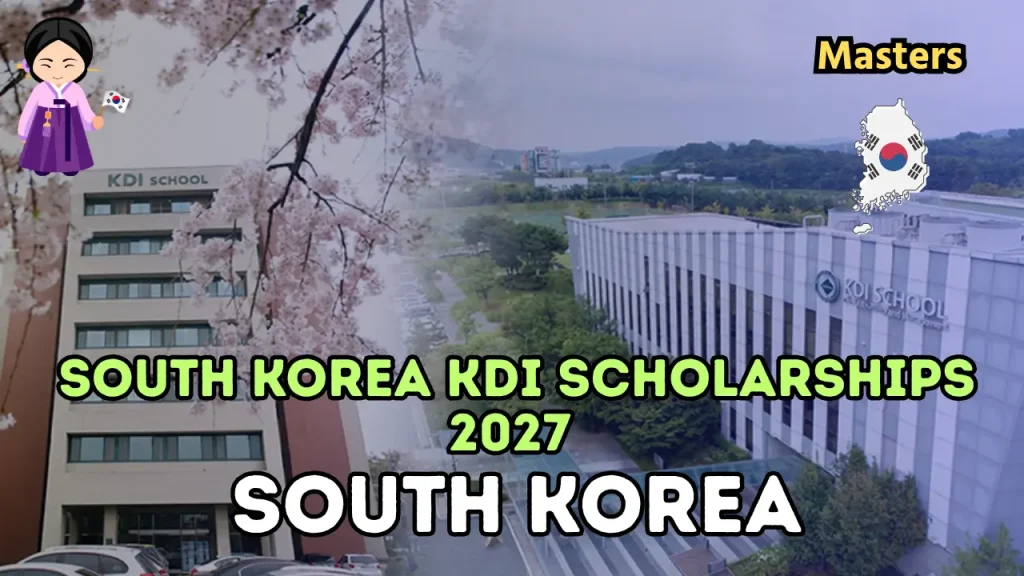
If you want to fast-track your career in public policy, international development, or governance, the South Korea KDI Scholarships 2027 offer an unparalleled pathway. Hosted by the world-renowned KDI School of Public Policy and Management (KDIS), these fully funded scholarships are designed to mold the next generation of global leaders, government officials, and change-makers. South Korea has transformed from an aid recipient into a global economic powerhouse. Studying at KDI School allows you to learn from this unique development model firsthand.
This comprehensive guide breaks down everything you need to know about the KDI School scholarship 2027 application process, including deadlines, eligibility, study areas, and cost-of-living estimates.
Basic Information About the Scholarships
The KDI School of Public Policy and Management offers several highly prestigious, fully funded scholarship tracks for international students. These include the Global Ambassador Scholarship (GAS), the Seoul G20 Global Leaders Fellowship, and partnered tracks like the Global Korea Scholarship (GKS/NIIED).
- Program Type: Full-time
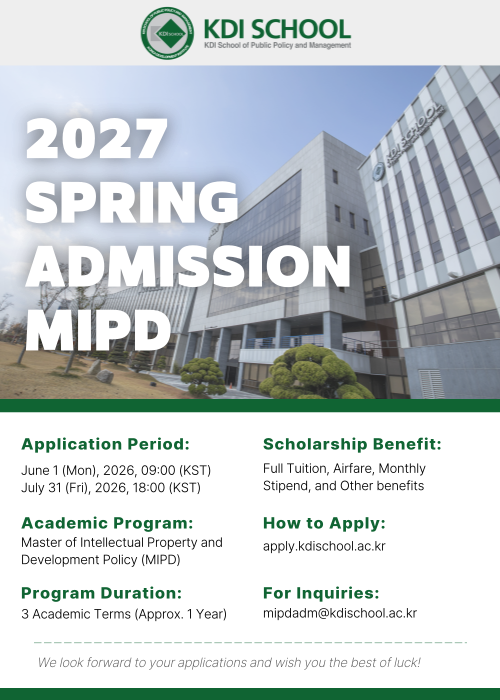
- Duration: 3 academic terms (approximately 1 year)
- Graduation Requirement: Minimum 36 credits (including a research project)
- Concentrations
- Primary Concentration: Intellectual Property and Innovation Policy
- Secondary Concentration (Optional): Available for all concentrations except the Intellectual Property concentration
- Critical Deadlines & Admission Timelines
- Spring 2027 Intake (Master’s & Ph.D. Programs):
- Application Period: Opens early July 2026 and closes July 31, 2026 (18:00 KST).
- Document Review & Interviews: August to September 2026.
- Final Results Announcement: Late October 2026.
- Program Entrance: February 2027.
- Fall 2027 Intake (Master’s Programs Only):
- Application Period: Typically opens March 2027 and closes late March 2027.
- Program Entrance: September 2027.
- Spring 2027 Intake (Master’s & Ph.D. Programs):
University and Institution Details
KDI School of Public Policy and Management (KDIS) was established in 1998 as the educational wing of the Korea Development Institute (KDI)—South Korea’s premier economic think tank. Located in the master-planned administrative capital of Sejong City, KDIS offers a uniquely specialized academic environment.
KDI School is globally recognized for its practical, data-driven curriculum. It is one of the few institutions outside the United States to receive the prestigious NASPAA accreditation (Network of Schools of Public Policy, Affairs, and Administration), guaranteeing that your degree meets top-tier international standards.
Study Areas & Available Programs
All courses at KDI School are taught entirely in English. The curriculum balances core theoretical policy design with empirical data analysis. The primary degree programs available for the 2027 cycle include:
Master’s Degree Programs (1 to 1.5 Years)
- Master of Public Policy (MPP): Focuses on policy analysis, macroeconomic policy, public finance, social policy, and regional development.
- Master of Development Policy (MDP): Explores international development, sustainable development, development economics, and human capital.
- Master of Public Management (MPM): Concentrates on public administration, leadership, public sector innovation, and strategic management.
- Master of Intellectual Property and Development (MIPD): Jointly operated with the World Intellectual Property Organization (WIPO), focusing on innovation policy, patent laws, and economic growth.
Ph.D. Programs (Minimum 3 Years)
- Ph.D. in Public Policy (PP)
- Ph.D. in Development Policy (DP)
South Korea KDI Scholarships Benefits
The KDI School international awards are among the most generous full-ride packages in Asia. While exact benefits vary slightly by track, standard packages (like GAS and G20) include:
- Full Tuition Waiver: 100% of your tuition fees are covered across all academic trimesters.
- Monthly Stipend: A recurring monthly allowance ranging from 1,000,000 KRW to 1,200,000 KRW (approximately $730 to $880 USD, depending on exchange rates) to offset food and personal expenses.
- Round-trip Airfare: Economy class air travel from your home country to South Korea and back upon graduation (featured in G20, GKS, and ASEAN tracks).
- Settlement Allowance: A one-time cash disbursement of 200,000 KRW (~$150 USD) to help you adjust upon arrival.
Benefits Not Included
To budget effectively, you must be aware of expenses not covered directly by the scholarship funding:
- National Health Insurance (NHI): While some tracks subsidize basic insurance, international students in Korea are legally required to enroll in the Korean National Health Insurance program, which costs a mandatory monthly premium out-of-pocket.
- Textbooks and Printing: Physical course materials, personal laptops, and campus printing allocations.
- Dormitory Security Deposits: A refundable safety deposit required by the campus housing office before move-in.
Eligibility Criteria for South Korea KDI Scholarships
To pass the initial screening round, applicants must cleanly meet the following financial, professional, and academic benchmarks:
This program is especially designed for:
- Government officials involved in innovation policy.
- Intellectual property administrators.
- Patent office personnel.
- Researchers and academicians.
- Technological transfer specialists.
- Legal practitioners are interested in intellectual property policy.
- Managers who oversee the startup ecosystem.
- Economic development practitioners.
- Professionals from international organizations.
- Graduates interested in technology, innovation, and development policy.
Academic & Nationality Background
- Citizenship: Both the applicant and their parents must hold non-Korean citizenship.
- Prior Degree: Master’s applicants must hold a recognized Bachelor’s degree. .
Professional Experience Requirements
- Global Ambassador Scholarship (GAS): Open to all international applicants, though preference is given to public sector employees.
- Seoul G20 Global Leaders Fellowship: Requires applicants to be from a non-G20 country and hold a division head level role or have over 6 years of public sector experience. If from a G20 country, a minimum of 1 year of public sector or public research experience is mandatory.
English Language Requirements
| Test | Minimum Score |
|---|---|
| TOEFL iBT | 72 |
| IELTS | 6.0 |
| OPIc | IM3 |
| TEPS | 286 |
| Duolingo English Test | 100 |
English Test Exemption
Applicants who earned a bachelor’s degree or higher from approved English-speaking countries (e.g., United States, United Kingdom, Canada, Australia, New Zealand, Ireland, etc.) are exempt from submitting English test scores.
Required Documents for the Application
Ensure all documents are neatly compiled, digitized, and legally authenticated:
- Online Application Form
- Statement of Purpose (5 questions)
- Bachelor’s Degree Certificate (English)
- Bachelor’s Academic Transcript (English)
- Two Recommendation Letters
- English Proficiency Test Score
- Passport-style Photo
- Proof of Employment (Optional)
- Master’s Degree Certificate and Transcript (if applicable)
South Korea KDI Scholarships Step-by-Step Application Process
A successful application requires careful execution of each administrative stage:
1.Submit the Online Application:Step 1.
Create an account on the KDI School admissions portal during the July application window. Complete all form data and upload your digitized documents.
2.Track Recommendation Letters:Step 2.
Ensure your two chosen recommenders click the secure link emailed to them by KDIS and submit their reference forms before the strict July 31 deadline.
3.Pass the Zoom Interview:Step 3.
If your documents clear the initial review, you will receive an invitation for an interview via Zoom. This interview tests your policy awareness and academic drive.
4.Mail Legalized Hardcopies:Step 4.
Upon receiving your conditional final admission offer, you must mail your physical, Apostilled/Consular-legalized degree certificates directly to Sejong City via courier.
Tips for a Successful Application
- Align Your SOP with Sustainable Development Goals (SDGs): KDI School prioritizes applicants whose career goals align with international frameworks like the UN SDGs. Express clearly how your research will address inequality, public health, or economic planning.
- Secure Clear Professional Recommendations: If you work in government, ensure your recommendation letters highlight your potential for upward mobility and leadership within your ministry or agency.
- Do Not Delay Legalization: Obtaining an Apostille or Consular stamp from a government office can take weeks. Start this process before the application results are finalized.
Monthly Living Expenses for Students (USD)
Sejong City offers a modern, high-tech infrastructure with a slightly lower cost of living than the capital city of Seoul. The following table outlines your expected monthly budget:
| Expense Category | On-Campus Dormitory Living | Off-Campus Apartment Living |
| Housing / Accommodations | $150 – $250 (Dorm fees) | $350 – $550 (Rent + deposit) |
| Food & Cafeteria Meals | $250 – $350 | $300 – $450 |
| National Health Insurance | $55 | $55 |
| Mobile Phone & Internet | $30 – $50 | $30 – $50 |
| Public Transport (Bus/KTX) | $30 – $60 | $40 – $80 |
| Personal & Leisure | $100 – $150 | $150 – $250 |
| Total Estimated Expenses | $615 – $916 USD | $925 – $1,435 USD |
Budget Takeaway: Your monthly scholarship stipend ($730 – $880 USD) comfortably covers your living costs if you choose to reside in the subsidized on-campus dormitories.
Why Choose This Scholarship? (Top 5 Reasons)
- 1. Access to Elite Economic Expertise: Learning directly from professors who actively draft South Korea’s national economic strategies provides you with invaluable, real-world policy insights.
- 2. Unmatched Global Networking: KDI School hosts students from over 70 different nations every year, allowing you to build an international network of diplomats, ministers, and public sector executives.
- 3. Comprehensive Financial Security: The elimination of tuition fees, alongside the monthly stipend and airfare coverage, ensures you can focus entirely on your academic research without financial stress.
- 4. Pristine Academic Credentialing: The dual benefit of NASPAA accreditation and a connection to South Korea’s top economic think tank makes your resume highly attractive to organizations like the World Bank, UN, and IMF.
- 5. Immersive Cultural Experience: Living in South Korea lets you experience a unique blend of rich cultural history, cutting-edge technology, and safe, modern urban infrastructure.
Frequently Asked Questions (FAQs)
Can I apply for more than one KDI School scholarship track at a time?
No separate applications are required. You apply once to the school, and the admissions committee automatically considers you for all internal scholarship tracks (GAS, G20, etc.) for which you meet the baseline eligibility rules.
What happens if I fail to maintain a good GPA?
To maintain your scholarship eligibility throughout the program, you must maintain a minimum GPA of 3.0 out of 4.0. Dropping below this threshold can result in the suspension of your monthly stipend.
Is it possible to work part-time while studying on this scholarship?
KDI School programs are highly intensive trimester systems. While your student visa allows for limited part-time work with university permission, the school strongly discourages working full-time due to the rigorous course loads.
Can I bring my family or spouse with me to South Korea?
Yes, but you must arrange their F-3 dependent visas independently. Keep in mind that the scholarship stipend is calculated to support a single individual; you will need to prove additional personal funds to support dependents.
Are there separate language tracks for Korean speakers?
No. All core international master’s and doctoral degrees are conducted completely in English. However, KDI School offers complimentary introductory Korean language and culture courses to help international students integrate into local life.
Application Period
- June 1, 2026 (09:00 KST) – July 31, 2026 (18:00 KST)
- Admission Timeline
- Online Application: June–July 2026
- Document Review: August 2026
- Interview & Review Result: September 2026
- Final Admission Result: Mid-October 2026
- Registration: October–November 2026
- Classes Begin: Early February 2027