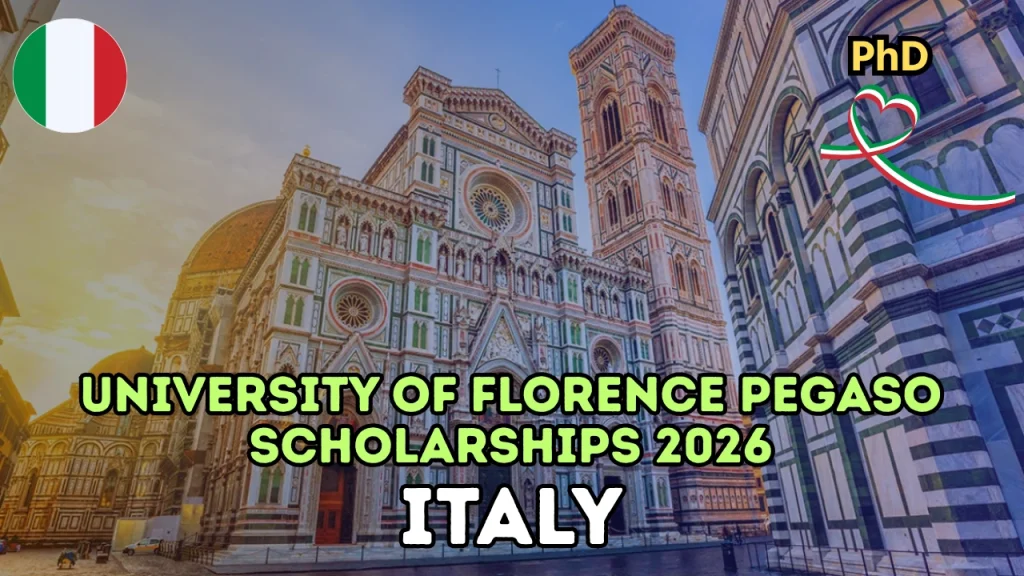
Are you a highly motivated researcher looking to pursue fully funded doctoral studies in one of Europe’s most culturally historic and academically distinguished hubs? The University of Florence PEGASO Scholarships 2026 in Italy present an unparalleled gateway to high-impact doctoral research. Funded under the framework of Giovanisì—the landmark regional initiative by the Tuscany Region (Regione Toscana) utilizing European Social Fund (PR ESF 2021/27) resources—the PEGASO PhD programs aim to foster independent thinking, global collaboration, and cutting-edge industrial innovation.
This comprehensive guide breaks down everything you need to know about the 2026 application cycle, available PhD tracks, monthly living costs in Italy, and insider strategies to secure this life-changing European fellowship.
Basic Information About the PEGASO Scholarships
The PEGASO PhD Fellowship is a premier research award offered to domestic and international doctoral candidates at the administrative headquarters of the University of Florence and its regional partner institutions.
- Host Country: Italy
- Host Institution: University of Florence (Università degli Studi di Firenze / UniFI)
- Funding Body: Region of Tuscany (Regione Toscana via European Social Fund)
- Study Level: PhD (Third Cycle of Higher Education)
- Program Duration: 36 Months (3 Years)
- Academic Cycle Starts: November 1, 2026
- PhD programs will start only after approval by the Italian Ministry of University and Research (MUR).
- By applying, you automatically accept all the rules of the call.
- All official updates will be published on the university’s PhD webpage.
- Application Deadline: August 6, 2026, at 12:00 noon Central European Summer Time (CEST).
University/Institution Details: The Florentine Research Edge
Founded officially in 1321, the University of Florence is a cornerstone of global humanism and scientific discovery. UniFI spans multiple expansive research complexes across the city, hosting modern laboratories, immense archival libraries, and prestigious international collaborative centers.
For the PEGASO 2026 framework (Cycle 42), the University of Florence works in deep synergy with regional partners including the University of Pisa, the University of Siena, the Scuola Normale Superiore di Pisa, and the Scuola Superiore Sant’Anna. As a doctoral researcher under this regional umbrella, you don’t just register at a single school; you gain widespread access to an interconnected grid of elite Tuscan research facilities, university libraries, and localized corporate innovation spaces.
Available Positions
- Positions may include:
- Fully funded scholarships
- Pegaso Scholarships
- Externally funded scholarships
- Non-funded (without scholarship) positions (only in some programs)
- More scholarships may be added later.
- Some scholarships are research-topic specific, meaning you must work on the assigned research topic.
- If a PhD program has only scholarship positions, you cannot give up the scholarship and still enroll.
Study Areas & Available PhD Programs
The PEGASO scholarships are strategically organized into key disciplinary areas designed to stimulate regional development and address complex global issues. The available doctoral pathways span five core macro-areas:
Biomedical Area
- PhD in Neurosciences: High-level research studying neural pathways, sensory impairment, and the application of Artificial Intelligence in visual rehabilitation.
- PhD in Biomedical Sciences: Advanced cellular pathology, molecular medicine, and chronic age-onset clinical conditions.
Scientific Area
- PhD in Chemical Sciences: Sustainable materials synthesis, chemical biology, and advanced molecular modeling.
- PhD in Mathematics and Computer Science: Cryptography, deep learning algorithms, and high-performance computation.
Social Sciences Area
- PhD in Development Economics and Local Systems (DELOS): Regional socioeconomic resilience, structural environmental policy, and local institutional analysis.
- PhD in Life Course Research (LCR): Multi-disciplinary demography, life-course trajectories, and societal welfare structures.
Technological Area
- PhD in Advanced and Sustainable Agricultural-Forestry Systems: Precision farming technologies, agro-ecosystem preservation, and climate resilience in forestry.
- PhD in Smart Computing: Industrial automation, IoT grids, and secure digital transformations.
Humanities and Education Area
- PhD in Comparative Languages, Literatures, and Cultures: Cross-cultural linguistic theory, digital humanities, and literary text history.
University of Florence PEGASO Scholarships Benefits:
The PEGASO PhD Scholarship offers a robust financial structure tailored to let you focus entirely on your academic innovations without monetary stress.
- Annual scholarship: €16,243 per year (before deductions)
- Additional benefits:
- 50% extra scholarship during approved research abroad (up to 12 months).
- Research budget worth at least 10% of the scholarship.
- Scholarship paid monthly.
- One-Time Financial Support for International Students
- The university offers: Up to €5,000 one-time financial support
- Research Abroad Supplement: If your approved doctoral path requires working outside of Italy, your monthly stipend is increased by 50% for the duration of your stay abroad.
- Dedicated Research Fund: The scholarship explicitly allocates at least 10% of the overall budget value directly to the student for personal research expenses, including textbook purchases, computing equipment, and international conference registrations.
- One-off International Support: International student winners can tap into a dedicated one-off financial integration package of up to €5,000 to ease their transitional and settling-in processes.
- Full Tuition Exemption: Standard regional university enrollment taxes and academic tuition fees are completely waived for all selected PEGASO scholars.
Benefits Not Included
While the financial package ranks among the most generous in Southern Europe, applicants must self-fund a few operational items:
- Application Fee: Submission requires an initial, non-refundable administrative processing fee of €30 paid directly to the university’s online system.
- Initial Travel Costs: Flights or train travel from your home country to Florence for the start of the program are handled out-of-pocket (though the €5,000 international allocation can later help balance these books).
- Visa and Residence Permit Costs: Fees for obtaining an Italian long-stay student visa and your subsequent physical Permesso di Soggiorno (Residence Permit) within 8 days of arriving in Italy.
- Accommodation Deposit: Landlords in Florence traditionally request a 1-to-2 month refundable safety deposit before handoff of apartment keys.
Eligibility Criteria for University of Florence PEGASO Scholarships
To sustain high standards of research excellence, the Tuscany Region enforces absolute baseline thresholds for all applicants:
- You can apply if you have:
- A Master’s degree (or equivalent).
- A recognized foreign Master’s degree equivalent to an Italian Master’s degree.
- No age or nationality restriction (except for Pegaso Scholarship).
- You can also apply if:
- You will finish your Master’s before 1 November 2026.
- You must submit proof of graduation within 10 days after receiving your degree.
- Be under 35 years old.
- Have English proficiency at B2 level.
- Recipients must:
- Spend at least 6 months abroad during the PhD (12 months for international scholarships).
- Complete at least 3 months of research/training in a company or public organization (when required).
- Attend soft skills and entrepreneurship courses.
- Not receive another EU-funded scholarship during the PhD (no double funding).
- Intellectual Property
- Research results are protected under Italian law.
- Students retain authorship rights.
- Students must follow confidentiality rules when handling research data.
PhD Student Responsibilities
Students must:
- Study full-time.
- Conduct research continuously.
- Complete the required stay abroad.
- Earn at least 6 credits in complementary/soft skills courses.
- Paid work is allowed only if approved by the Academic Board.
- Annual income from paid work must not exceed the annual scholarship amount.
PhD Degree Award
To receive the PhD:
- Complete the three-year program.
- Pass the final examination.
- Submit the final thesis electronically to the university repository.
Selection consists of:
- Evaluation of:
- Academic qualifications
- Research project
- Interview
- In person or online (depending on the program)
- Some interviews may be conducted in English.
- Language proficiency may be assessed.
Only candidates who pass the first evaluation are invited for the interview.
Required Documents for the Application
All files must be uploaded digitally in PDF format. Documents written in languages other than English or Italian must be accompanied by an official translation.
- Passport or national ID. Academic transcripts.
- Degree certificate (or expected graduation proof).
- Research proposal (if required). Other documents required by the specific PhD program.
- Pay the €30 non-refundable application fee.
- Important:
- Submit a separate application for each PhD program.
- Pay a separate €30 fee for each application.
- Once submitted, the application cannot be edited.
Foreign Degree Holders
Applicants with foreign degrees must submit:
- Degree certificates.
- Academic transcripts.
- English or Italian translation.
- Before enrollment:
- Diploma Supplement (EU degrees), or
- CIMEA Statement or Declaration of Value (non-EU).
Non-EU students also need:
- Student Visa (Type D).
- Registration through Universitaly.
University of Florence PEGASO Scholarships Application Process: A Step-by-Step Guide
Securing a slot requires careful attention to the University of Florence’s digital portal setup. Follow this sequence:
1.Select Your Academic Fact Sheet:Step 1.
Visit the official UniFI portal and download ‘Annex 2’. Carefully read the criteria, evaluation metrics, and specific research themes for your desired doctoral course.
2.Register on the SOL Platform:Step 2.
Navigate to the dedicated PEGASO admission portal (sol.unifi.it/domdottpegaso/login_en.jsp) and create a new applicant profile by entering your biographical details.
3.Upload Project and Documents:Step 3.
Log into your dashboard, select your specific PhD ranking list, upload your EuroPass CV, academic transcripts, and your formal Research Project Proposal.
4.Pay the Processing Fee:Step 4.
Execute the €30 application payment via the integrated online portal system and save the digital receipt confirmation.
5.Finalize and Submit Before 12 Noon:Step 5.
Verify all text components, upload the payment receipt, and hit submit before the absolute deadline on August 6, 2026. Keep your application submission code safe.
Pro-Tips for a Winning Application
- Tailor the Project Directly to the Fact Sheet: Do not submit a generalized research proposal. Each PEGASO program outlines precise operational research lines (e.g., specific molecular pathways or AI modules). Frame your project methodology so it links up perfectly with those predefined objectives.
- Optimize Your EuroPass CV: The evaluation committee awards fixed point values for past academic activities. Clearly highlight any published abstracts, software skill sets, conference presentations, or institutional research assistantships you have held.
- Prepare for the Oral Examination/Interview: Shortlisted applicants will undergo a rigorous interview panel (frequently via remote video software). Be ready to confidently defend your research project’s feasibility, explain your data collection strategy, and answer questions in fluent English.
Monthly Living Expenses for International Students in Florence
While Florence is a premier international tourism city, standard student life remains manageable if you balance your expenses logically. Here is a realistic projection of monthly living costs in Florence translated into USD ($):
| Expense Category | Average Monthly Cost (USD) | Florentine Student Context |
| Accommodation | $500 – $800 | Single room in a shared student flat outside the immediate historical center |
| Food & Groceries | $250 – $380 | Shopping at local markets (e.g., Sant’Ambrogio) and avoiding tourist-trap cafes |
| Public Transport | $30 – $50 | Heavily discounted annual student bus passes valid across the Autolinee Toscane grid |
| Research Costs & Books | $40 – $75 | Covered comfortably by your separate 10% research budget allocation |
| Utilities & Mobile Plan | $90 – $140 | Electricity, heating adjustments, high-speed internet, and local SIM plans |
| Leisure & Socialization | $150 – $250 | Exploring Tuscan countrysides, museum days, and coffee stops |
| Total Estimated Budget | $1,060 – $1,695 / month | Perfectly matched with the monthly PEGASO payout! |
Why Choose the University of Florence PEGASO Scholarship? (5 Core Reasons)
- Elite Financial Security: A guaranteed 3-year base stipend matching €16,243 per annum, combined with full tuition waivers and international bonuses, grants you absolute peace of mind to innovate.
- Mandatory Global Mobility: The built-in rule requiring up to 12 months of research abroad—boosted by a 50% stipend increase—ensures you graduate with an expansive network of international institutional contacts.
- Integrated Regional Synergy: The program’s structural partnerships connect you directly with elite institutions like the Scuola Normale Superiore and the University of Pisa, widening your research resource grid.
- Direct Industry Connections: Many PEGASO research tracks require targeted 3-month placements within companies and public research bodies, building an instant bridge toward post-doctoral industrial employment.
- Unmatched Cultural Inspiration: Living and working in Florence offers an immersive experience inside the birthplace of the Renaissance, surrounded by unparalleled art, history, and vibrant Italian culture.
Frequently Asked Questions (FAQs)
What is the “double funding” prohibition for PEGASO scholars?
Under EU and Italian regional guidelines, you cannot hold another major fellowship or EU-funded grant simultaneously with your PEGASO scholarship during the 3-year doctoral timeframe.
Can I apply if I have not yet finished my Master’s thesis?
Yes! You can apply during the summer window as long as your official defense takes place and your graduation certificate is fully secured before October 31, 2026.
Is an Italian language certificate mandatory for international students?
No. While learning basic Italian will greatly ease your daily life in Tuscany, many of the technical PEGASO PhD programs permit research execution and oral exams entirely in English, requiring only a minimum B2 English capability.
How are the final selection rankings determined?
The selection board scores applications based on a maximum matrix (often 120 points), dividing points between your academic CV/records, the scientific caliber of your written Research Project, and your performance during the oral interview stage. Final official rankings are published online by September 30, 2026.
Application Deadline
- Application Opens: 7 July 2026
- Application Deadline: 6 August 2026 (12:00 noon CEST)
Official Link:
University of Florence Scholarships 2026 in Italy
Ultimate Guide to the University of Warsaw Scholarships 2027 in Poland