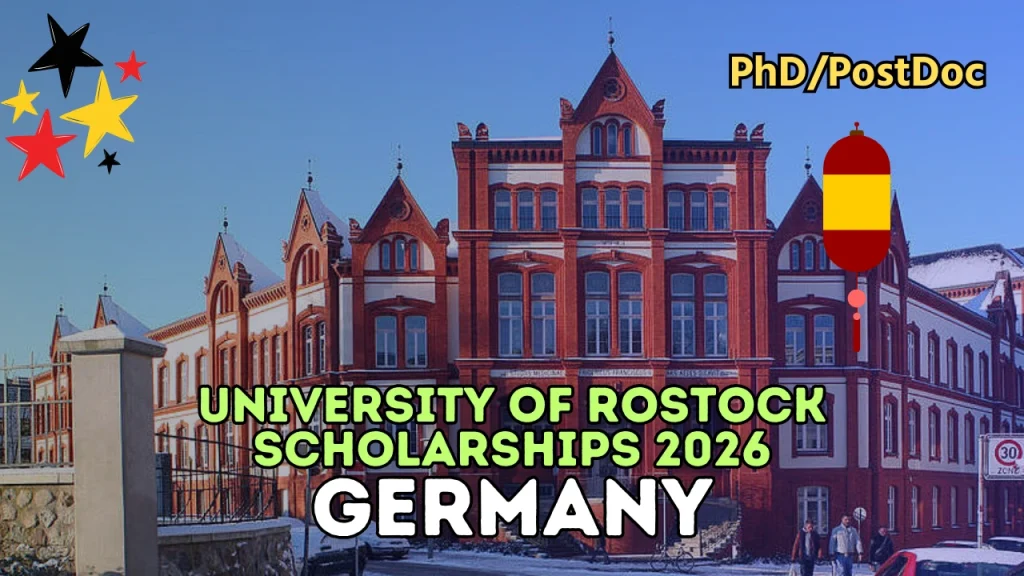
The University of Rostock Scholarships 2026 in Germany offer fully funded and partial funding options for PhD candidates, postdoctoral researchers, and outstanding young scientists, with several calls open throughout 2026. These scholarships combine monthly support, project funding, and prestigious academic prizes that can significantly boost your research career in Germany.
Basic information about University of Rostock Scholarships 2026
For 2026, multiple scholarship and funding calls are now open in connection with the University of Rostock and its partner academies, particularly in Northern Germany. These include conference funding, publication grants, postdoctoral fellowships, and science prizes specifically designed for early-career researchers. A popular announcement promoted for 2026 describes “University of Rostock Scholarships 2026 in Germany (Fully Funded)” mainly targeting PhD and postdoctoral levels, open to applicants from all nationalities, and located in Germany, with a last date of 2 March 2026 for at least one of the calls.
Key 2026 deadlines linked to these calls include:
- Conference funding “Forum Young Science”: 2 March 2026
- Elise Reimarus Publication Prize: 2 March 2026
- Young Academy Fellows Postdoctoral Fellowships: 7 April 2026
- Joachim Jungius Science Prize: 30 June 2026
International students should note that general funding at the University of Rostock is limited and usually supplemented through national scholarship organizations like DAAD and various private foundations.
University of Rostock: Institution overview
The University of Rostock is one of the oldest universities in Germany and is located in the coastal city of Rostock in Mecklenburg‑Western Pomerania, Northern Germany. As a public university, it charges only modest semester contributions while offering a wide portfolio of bachelor’s, master’s, and doctoral programs across eight faculties, including natural sciences, engineering, medicine, humanities, and social sciences. For international students, the Rostock International House provides guidance on admissions, visas, and funding opportunities, although it emphasizes that direct university stipends for foreign students remain limited.
Study areas and programs linked to scholarships
The 2026 funding calls connected with the University of Rostock and regional academies are designed primarily for:
- PhD candidates (all disciplines, depending on the specific program)
- Postdoctoral researchers, especially in the humanities and social sciences
- Young scientists organizing conferences or collaborative academic events
- Researchers preparing monographs or major publications
Examples of funding lines include:
- Young Academy Fellows postdoctoral fellowships (multi‑year research support)
- Conference funding “Forum Young Science” for academic events
- Publication prizes for humanities and social sciences monographs
- Science prizes such as the Joachim Jungius Science Prize
Alongside these, general scholarship pathways for students and early‑career researchers at Rostock often run via DAAD, private foundations, gender and diversity funds, and junior scientist support schemes at the university.
University of Rostock Scholarships benefits
Depending on the specific 2026 scheme, University of Rostock–related scholarships and academy funding can include substantial financial and academic benefits:
- Conference funding of up to €5,000 (for activities until March 2027)
- €4,000 publication award for monographs in social sciences and humanities
- Long-term financial and academic support through the Young Academy Fellows program
- Prestigious €5,000 Joachim Jungius Science Prize for research on “Transmissions.”
- Provides financial support and academic recognition for young scholars in Northern Germany
Conference Funding: Young Science Forum
- Deadline: March 2, 2026
- Funding: Up to €5,000
- Purpose: Conferences planned until March 2027
- Eligible applicants: Students, PhD candidates, and Postdocs (all disciplines)
- Link: https://www.awhamburg.de/fjw
Publication Award: Elise Reimarus Prize
- Deadline: March 2, 2026
- Award amount: €4,000
- Purpose: Publication of a monograph
- Field: Humanities and Social Sciences
- Eligible applicants: Postdocs
- Link: https://www.awhamburg.de/elise-reimarus
Postdoctoral Fellowships: Young Academy Fellows
- Deadline: April 7, 2026
- Duration: At least 3 years
- Support: Financial and academic (conceptual) support
- Eligible applicants: Postdocs (all disciplines)
- Link: https://www.awhamburg.de/yaf-ausschreibung
Research Award: Joachim Jungius Prize
- Deadline: June 30, 2026
- Award amount: €5,000
- Theme: Scientific work on “Transmissions”
- Eligible applicants: Postdocs (all disciplines)
- Link: https://www.awhamburg.de/jjp
Benefits not included
While “fully funded” is often used in promotional material, it is important to understand what is typically not covered by these scholarships:
- Regular living expenses beyond the defined stipend or fixed project amount (for example, if you receive 4,000–5,000 EUR, you must still manage your personal monthly budget).
- Tuition is generally already low or non‑existent at German public universities, so most schemes do not explicitly “cover tuition” but focus on living and research costs.
- Visa fees, residence permit fees, and some travel costs may not be covered and often remain the student’s or researcher’s responsibility.
- Family expenses and dependent support are usually not included, unless a specific fellowship states family supplements (which is more common in some national foundations than in these academy grants).
- Non‑academic costs such as leisure travel, personal insurance upgrades, and luxury housing remain outside the scope of the scholarship.
Eligibility criteria for University of Rostock Scholarships
Eligibility for the 2026 University of Rostock–connected scholarships and academy funding lines is generally competitive and targeted at young academics:
- Open to young academics in Northern Germany:
- Bremen (HB)
- Hamburg (HH)
- Mecklenburg-Western Pomerania (MV)
- Schleswig-Holstein (SH)
- Must be a higher-education student, PhD candidate, or postdoctoral researcher
- Postdocs from all disciplines are eligible (some awards limited to humanities & social sciences)
International applicants must also fulfill the general admission requirements of the University of Rostock and meet visa and residence rules for Germany.
Required documents for the application
Although each scholarship call has its own detailed list, typical required documents for University of Rostock–related scholarships and 2026 academy funding include:
- Completed online or PDF application form for the specific grant.
- Curriculum vitae in tabular form, listing education, research experience, and publications.
- Academic transcripts and degree certificates (bachelor’s, master’s, or PhD as applicable).
- Research proposal or project description, especially for postdoctoral fellowships and conference funding.
- Motivation letter explaining why you are applying, your career goals, and how the scholarship supports your plan.
- Recommendation letters from professors or supervisors, which are very common in German funding schemes.
- Proof of language proficiency (German or English) if required by the program.
- For conference or publication funding: detailed budget, event concept, and publication outline.
Always check the exact call text on the official site before submitting, because missing documents can result in automatic rejection.
University of Rostock Scholarships application process (step‑by‑step)
Here is a step‑by‑step guide to applying for University of Rostock Scholarships 2026 and related academy funding:
- Identify the right call
- Visit the University of Rostock “Financing/Stipends” and scholarships pages, as well as the Hamburg Academy call pages linked for 2026.
- Match your academic level (PhD, postdoc, student) and discipline with the appropriate scholarship or prize.
- Check eligibility and deadlines
- Confirm you meet the regional, academic, and thematic criteria of the particular call.
- Note crucial deadlines such as 2 March 2026, 7 April 2026, and 30 June 2026 and set reminders well in advance.
- Prepare academic documents
- Collect certified copies of your transcripts, degree certificates, and language proof as required.
- Request recommendation letters early so referees have time to write strong, personalized references.
- Draft a strong project proposal
- For fellowships, science prizes, or conference funding, write a clear proposal outlining objectives, methodology, timeline, and expected impact.
- Align your proposal with the themes and priorities mentioned in the call (e.g., specific topics for the science prize).
- Complete the application form
- Fill out the application form carefully, answering all questions and ensuring consistency with your CV and proposal.
- Double‑check that all mandatory fields and checkboxes are completed.
- Submit before the deadline
- Send your application via the specified portal, email, or postal address as indicated in the official call.
- Keep digital copies of all submitted documents and confirmation emails for your records.
- Follow up and prepare for selection
- Some scholarships or prizes may include interviews or presentations after a pre‑selection phase.
- If invited, prepare to explain your project clearly and show how it contributes to your field and the regional academic community.
Tips for a successful scholarship application
To maximize your chances in the highly competitive University of Rostock scholarship environment, follow these practical tips:
- Start early: Funding for international students is limited and application windows are strict, so begin preparing several months before the deadline.
- Tailor each application: Customize your motivation letter and proposal to each specific scholarship or prize rather than reusing the same text.
- Show academic excellence: Highlight top grades, awards, publications, conference talks, and relevant research experience.
- Demonstrate regional and thematic fit: Emphasize how your work benefits the Northern Germany research area or aligns with the academy’s focus topics.
- Get feedback: Ask supervisors or mentors to review your proposal and CV for clarity and impact before submission.
- Proofread carefully: Spelling mistakes or missing documents signal carelessness and can damage an otherwise strong profile.
A concise, well‑structured, and clearly argued application stands out more than a long, unfocused one.
Monthly living expenses for international students (USD)
Studying at the University of Rostock is relatively affordable compared with larger German cities, but you should still plan a realistic monthly budget. The university estimates that students typically need around 980 EUR per month for living costs in Rostock, including rent, health insurance, food, and study materials. National estimates for Germany suggest international students spend between 850 and 1,300 EUR per month depending on city and lifestyle.
Using an approximate rate of 1 EUR ≈ 1.10 USD, the 980 EUR Rostock estimate corresponds to about 1,078 USD per month. A typical monthly breakdown in Germany looks like this:
- Rent (shared flat or student room): 330–770 USD
- Food and groceries: 220–330 USD
- Transport and utilities: 110–220 USD
- Health insurance and mandatory fees: 120–180 USD
- Personal expenses, books, and leisure: 110–165 USD
Overall, most international students in Germany can expect a monthly budget in the range of roughly 935–1,430 USD, with Rostock usually closer to the lower middle of that spectrum because it is not a major metropolitan area.
Why choose the University of Rostock Scholarships? (at least 5 reasons)
There are several strong reasons to target University of Rostock Scholarships 2026 and the linked academy funding if you are planning research in Germany:
- Strong financial and academic support
- Grants of up to 4,000–5,000 EUR and multi‑year fellowships give you real freedom to focus on research, conferences, and publications.
- Prestige and career acceleration
- Science prizes and Young Academy Fellowships are highly regarded in the German academic landscape and can greatly strengthen your CV for future positions.
- Access to a historic, research‑active university
- The University of Rostock combines centuries of academic tradition with modern facilities and research groups across many disciplines.
- Affordable study destination
- With living costs around 980 EUR per month and low semester fees, Rostock offers an excellent cost‑to‑benefit ratio for international researchers.
- Supportive environment for international academics
- Rostock International House and related offices offer advising on funding, visas, and integration, helping you navigate German academic life more smoothly.
- Networking in Northern Germany’s research hubs
- The regional focus on Bremen, Hamburg, Mecklenburg‑Western Pomerania, and Schleswig‑Holstein connects you to multiple universities, institutes, and academies.
These advantages make the 2026 scholarships a compelling option for ambitious international PhD and postdoctoral researchers who want to build a long‑term academic profile in Germany.
Frequently asked questions (FAQ)
1. Are the University of Rostock Scholarships 2026 fully funded?
Promotional materials describe the scholarships as “fully funded” for PhD and postdoctoral levels, but the actual calls show that funding typically comes in the form of specific grants (e.g., 4,000–5,000 EUR) and fellowship packages rather than open‑ended coverage of all expenses. You should compare the award amount with your expected annual budget in Rostock to see if additional external funding is needed.
2. Can international students apply?
Yes, international applicants are explicitly welcome in many of the 2026 calls, particularly for postdoctoral fellowships and science prizes, provided they are based in or connected to the Northern Germany region. In general, the University of Rostock also directs foreign students toward national scholarship providers like DAAD and private foundations.
3. What levels of study are covered?
The highlighted 2026 scholarships concentrate on PhD, postdoctoral, and early‑career researcher funding, including conference and publication support. For bachelor’s and master’s students, funding usually comes from other scholarship organizations and only limited university‑level stipends such as graduation scholarships.
4. When is the application deadline for 2026?
Several important deadlines include 2 March 2026 for conference and publication funding, 7 April 2026 for Young Academy Fellows postdoctoral fellowships, and 30 June 2026 for the Joachim Jungius Science Prize. Always double‑check the official call text for the exact deadline of the specific scholarship you want to apply for.
5. Do these scholarships cover living expenses in full?
Some fellowships may provide monthly support for the duration of the program, but project‑based grants (e.g., for conferences or monographs) are not designed to cover all living costs. You should plan for a monthly budget of around 1,000–1,100 USD or more in Rostock and combine scholarships, part‑time work where permitted, and personal savings.
6. Where can I find more scholarships related to the University of Rostock?
You can search the University of Rostock’s own stipend pages, the DAAD scholarship database, and dedicated scholarship portals that list funding options for students at this university. These platforms regularly update open calls, eligibility, and deadlines for international applicants.
Application Deadlines
- March 2, 2026
- Elise Reimarus Publication Prize
- Conference Funding (Forum Young Science)
- April 7, 2026
- Young Academy Fellows Postdoctoral Fellowship
- June 30, 2026
- Joachim Jungius Science Prize