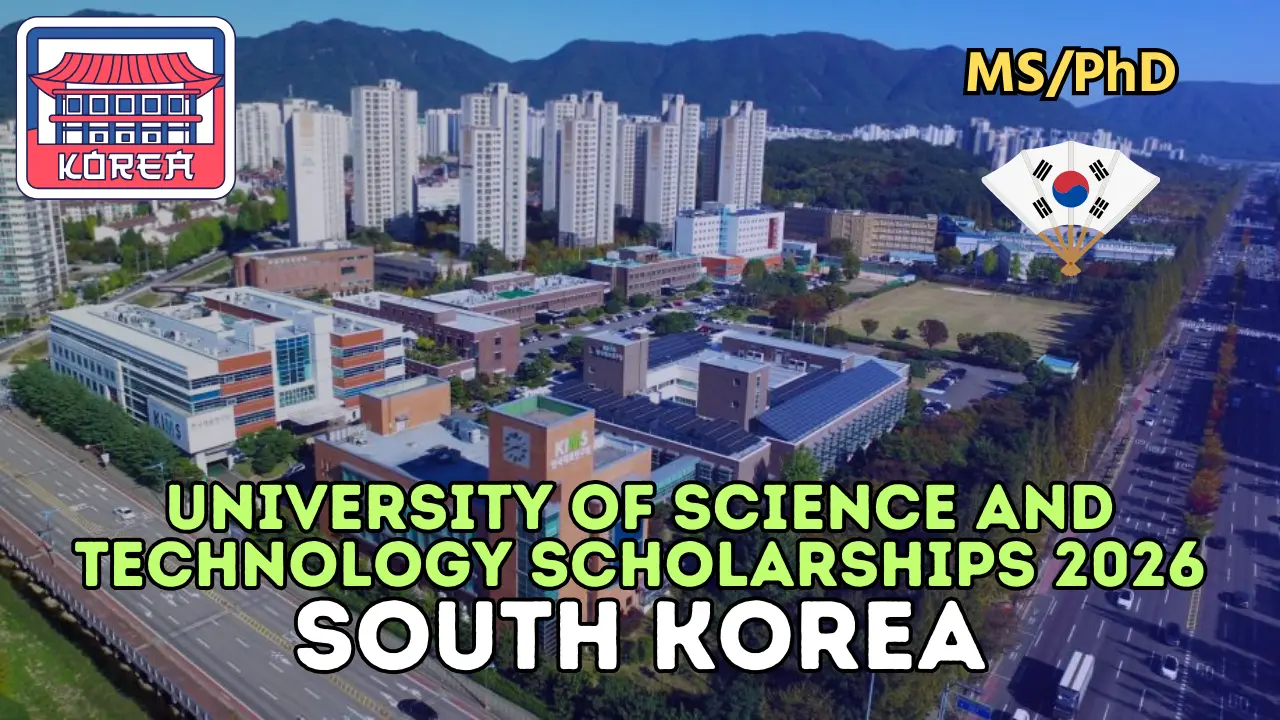
The University of Science & Technology (UST) Scholarships 2026 in South Korea offer fully funded graduate study for international students who want to pursue Master’s, PhD, or integrated MS leading to PhD programs in science, engineering, and advanced technology fields. Current 2026 reports state that the application deadline is 24 April 2026, and the scholarship package includes full tuition, entrance fee support, monthly stipends, insurance, and several academic support benefits. This opportunity is one of the most attractive because it combines strong research training with generous financial support in a country known for innovation, laboratories, and technology-led education.
Basic information about UST Scholarships 2026
- Scholarship name: University of Science and Technology (UST) Scholarships 2026 in South Korea.
- University: University of Science and Technology (UST), South Korea
- Degree Levels:
- Master’s (MS)
- Doctoral (PhD)
- Integrated MS–PhD
- Scholarship Type: Fully Funded
- Eligible Nationality: Open to all countries
- Number of scholarships: One 2026 source states 300 scholarships are available.
- Application Deadline: 23 February 2026
- Medium of instruction: Primarily English (with Korean language training options).
University/institution details
The University of Science and Technology (UST) in South Korea is a government-funded graduate university that works closely with national research institutes, giving students direct exposure to real scientific projects rather than only classroom-based learning. This makes UST different from many traditional universities: students are often trained inside high-level research environments connected to Korea’s national innovation system, which is one of the strongest in Asia.
UST is widely recognized for graduate education in science and technology, and the scholarship is specifically aimed at students pursuing research-based postgraduate degrees. If your goal is to study in Korea while building practical research skills in laboratories and national institutes, the UST model is especially attractive because it connects scholarship funding with hands-on academic work.
Key institutional points for international students:
- Focus: High‑level research in science, engineering, and emerging technologies.
- Structure: Network of research‑institute campuses under one university system.
- Language: Courses and research supervision commonly available in English, with Korean support and language classes.
- Reputation: Recognized as one of the best options to study in Korea on a fully funded scholarship for research‑oriented students.
Study areas and available programs
UST Scholarships 2026 cover a wide range of science and technology‑focused majors and research fields. While the exact list of programs is long and updated each intake, common UST study areas include:
- Advanced Materials and Chemical Engineering
- Bio-Analytical Science
- Science of Measurement
- Biotechnology
- Medicinal Chemistry and Pharmacology
- Bioscience
- Medical Physics
- Industrial Technology
- Food Biotechnology
- Nano Science
- Engineering (All Fields)
- ICT
- Ocean Science.
University of Science and Technology Scholarships benefits
UST Scholarships 2026 are fully funded and designed to remove almost all financial barriers for international students.
Main financial benefits:
- Full tuition fee
- University entrance fee
- Free accommodation
- Monthly stipend:
- Master’s: KRW 1,200,000 per month
- PhD: KRW 1,600,000 per month
- Health and accident insurance
- Round-trip airfare
- Access to e-library and counseling services.
- Overseas training and exchange opportunities.
- Research paper awards and excellence awards upon graduation in listed summaries.
- Korean language course fee support.
Benefits not included
Although UST Scholarships are generous, there are still some expenses you should be ready to cover yourself.
Common non‑covered or partially covered costs:
- Visa processing fees in your home country.
- Apostille or consular verification charges for academic and police documents.
- Some personal living costs beyond your monthly stipend (shopping, leisure, travel inside Korea).
- Possible small campus fees or student association fees (depends on institute).
- Any taxes or deductions applied to your stipend, as UST explicitly states stipend amounts are before deductions.
Eligibility criteria for University of Science and Technology Scholarships
UST has clear academic eligibility criteria for international applicants applying for the 2026 intake.
General eligibility:
- Nationality: Applicants from all countries are welcome; the scholarship is open to all international students.
- Academic background:
- Master’s applicants: Must have completed or expect to complete a Bachelor’s degree by September 2026
- PhD applicants: Must have completed or expect to complete a Master’s degree by September 2026
- Field match: Your previous major and research interests should fit the department or lab you choose.
- Language: Ability to study in English (and/or Korean) as required by the program; some labs may require proof of English proficiency.
- Good academic record and research potential demonstrated through GPA, publications (if any), projects, and recommendation letters.
Required documents for the application
UST international admission guidelines highlight a detailed list of mandatory documents.
Typical required documents:
- Completed online application form.
- Bachelor’s degree certificate and transcript (and Master’s certificate/transcript for PhD applicants), or proof of expected graduation.
- Study plan or statement of purpose explaining your academic goals and research interests.
- Letters of recommendation (usually from professors or supervisors who know your work).
- CV or academic resume.
- Thesis or research paper (for some PhD or research‑heavy programs).
- Passport copy and ID‑style photos.
- Proof of English proficiency such as IELTS/TOEFL if required by the lab or department.
- Criminal record certificate with Apostille or consular verification, needed later for final admission and visa.
University of Science and Technology Scholarships application process (step‑by‑step guide)
The UST Scholarship 2026 application process is fully online and follows a clear sequence.
- Research programs and labs
Explore the official UST website’s program list and laboratory pages to find the major and research group that best match your background. Use SEO‑style searches like “UST South Korea departments and labs” when exploring options. - Check eligibility and deadlines
Confirm you meet the academic and language requirements for your chosen degree level and note the exact 2026 application deadline for your intake (commonly in February for Spring/Fall rounds). - Prepare your documents
Collect all required certificates, transcripts, recommendation letters, passport scans, and test scores; arrange official translations and notarizations where needed. Ensure all documents are in Korean or English, as other languages are not accepted without certified translation. - Create an online account
Register on the UST international admissions portal and fill in all personal, academic, and program‑selection information carefully. - Upload documents in correct format
Upload scanned documents as PDF files (image‑only formats are discouraged) and double‑check clarity and completeness before submission. - Pay the application/admission fee
Pay the non‑refundable admission fee (about 150 USD or equivalent in KRW) by credit card through the portal; bank transfer is not accepted. - Submit the application
Review all sections, verify your chosen major and lab, and submit the application before the UST 2026 scholarship deadline.
Tips for a successful application
To make your UST Scholarship 2026 application stand out among thousands of international applicants, focus on quality and clarity.
- Apply early, because scholarship-linked graduate portals can become busy close to deadline.
- Match your academic background to a research-focused field, since UST is best suited to students with a strong science or engineering direction.
- Prepare language scores in advance if your program requires them, especially if you need IELTS, TOEFL, or TOPIK.
- Keep your documents clear and consistent, especially your degree timeline, transcript, and identity documents.
- Show research interest, not just general interest in studying abroad, because UST is built around institute-level scientific work.
- Research your target laboratory or institute before applying, since fit matters in research universities.
- Read the international admission guideline line by line, because exemptions, document rules, and language conditions may differ by category
Monthly Living Expenses for International Students
South Korea can be affordable or expensive depending on city and lifestyle, but a practical student estimate is:
- Accommodation: USD 250 to USD 700 per month depending on dormitory or private housing.
- Food and groceries: USD 200 to USD 350 per month.
- Transportation: USD 40 to USD 80 per month.
- Utilities and internet: USD 60 to USD 120 per month if not included in housing.
- Phone and personal expenses: USD 80 to USD 180 per month.
- Books, lab, and study needs: USD 30 to USD 70 per month.
- Estimated total monthly budget: USD 660 to USD 1,500 depending on location and personal lifestyle.
This means the UST monthly stipend can significantly offset living expenses, especially for students who manage housing carefully and use student services well.
Why Choose This Scholarship?
- It is fully funded, covering tuition, fees, stipends, and insurance support.
- It is open to international students from around the world, making it broadly accessible.
- UST is research-driven, which is ideal for students who want serious laboratory and institute experience.
- It supports Master’s, PhD, and integrated graduate pathways, so it works for different stages of academic growth.
- The monthly stipend is strong enough to reduce living pressure in South Korea.
- Korean language support and exchange opportunities add extra value beyond tuition funding.
- A UST degree can strengthen careers in science, engineering, innovation, and international research.
Frequently asked questions (FAQ)
1. Is the UST Scholarship 2026 fully funded?
Yes, UST Scholarships 2026 are fully funded, covering full tuition, entrance fees, a monthly stipend, insurance, and various academic support benefits for international Master’s and PhD students.
2. Who can apply for the University of Science and Technology Scholarships 2026 in Korea?
International students from any country who hold (or expect to hold) a relevant Bachelor’s degree for Master’s or Master’s degree for PhD by the application deadline can apply.
3. How much is the monthly stipend?
Public summaries list KRW 1,200,000 for Master’s students and KRW 1,600,000 for PhD students.
4. Is IELTS required?
Some programs may require proof of language ability, and one public summary lists examples such as IELTS 6.0+, TOEFL iBT 79+, or TOPIK Level 4+, though exemptions may apply.
5. Can I work part‑time while studying at UST?
South Korean visa rules allow limited part‑time work for international students with permission, but the UST stipend is designed so that you can focus primarily on your research and studies.
6. How competitive is the UST Scholarship?
UST offers hundreds of scholarships, but competition is strong because it is one of the best fully funded scholarships in South Korea for science and technology fields; strong academic records and research fit are essential.
7. Where can I apply for the University of Science and Technology Scholarship 2026?
You must apply through the official UST international admissions portal, following the guidelines and deadlines listed in the latest “International Admission Guideline” for the 2026 intake.
Application Deadline: 24th April 2026.
Official Link:
Apply Link:
Audi Environmental Foundation Scholarship 2026 in South Africa