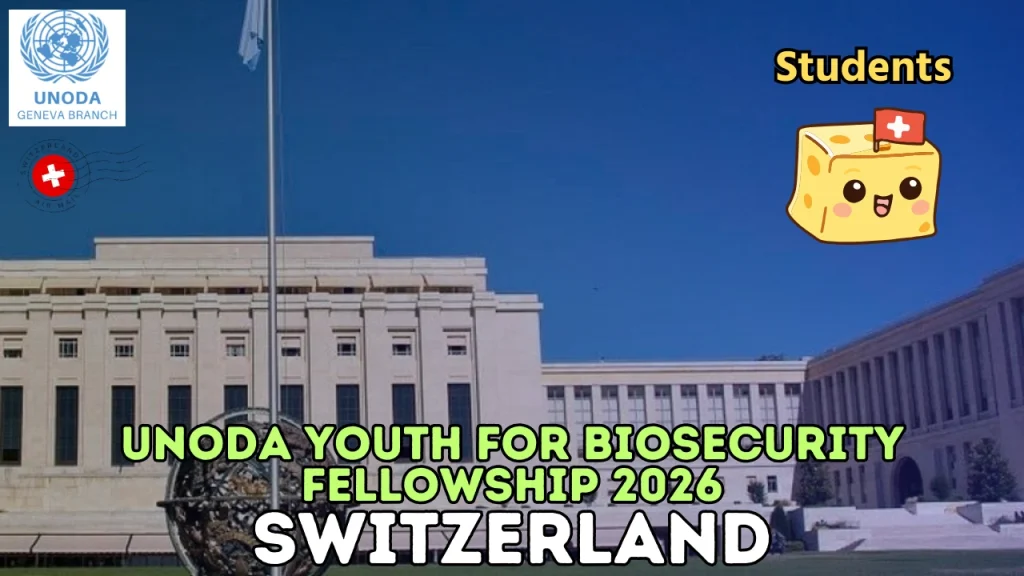
If you’re a young scientist from the Global South who wants real exposure to biosecurity diplomacy and the Biological Weapons Convention (BWC) process, the UNODA Youth for Biosecurity Fellowship 2026 in Geneva, Switzerland is one of the strongest fully funded opportunities this year. This program blends interactive online learning with an in-person Geneva study visit aligned with the BWC Working Group meetings in August 2026.
Basic information (with deadline)
The UNODA Youth for Biosecurity Fellowship Programme 2026 is the fourth edition of UNODA’s youth biosecurity training initiative, designed for emerging biosecurity leaders. The application deadline is March 5, 2026.
- Host city/country: Geneva, Switzerland (in-person segment)
- 3-month programme (June–August 2026)
- 20 young scientists selected from the Global South
- Includes online webinars + in-person visit to Geneva, Switzerland
- Participation during the Biological Weapons Convention Working Group meeting (August 2026).
- Format: Online webinars + collaborative poster project + in-person study trip.
- Fellowship length: Runs over 3 months with minimal time commitment to fit around work/study schedules.
- Cohort size: 20 competitively selected young scientists from the Global South.
Programme Includes
Online Phase
- 5 interactive webinars
- 3 June – 1 July 2026
- Every Wednesday (2 hours per session)
- Time: 2 PM CET (Opening session at 3 PM CET)
Scientific Poster Project
- Collaborative poster preparation in July 2026
- Presentation at BWC Working Group meeting in August 2026
In-Person Visit
- 17–21 August 2026
- 5-day visit in Geneva, Switzerland
- Full participation required
University/institution details
This is not a university degree scholarship; it is a United Nations fellowship delivered by the United Nations Office for Disarmament Affairs (UNODA) in Geneva. The in-person component takes place in Geneva during meetings of the BWC Working Group on the Strengthening of the Convention.
Study areas (available program names)
Because it is a fellowship (not an academic degree), the “program names” are best described as the structured training components provided by UNODA. The official structure includes:
- Youth for Biosecurity Fellowship Programme 2026 (Fourth Edition).
- Online training: Five substantive webinars (Biosecurity Diplomacy learning series).
- Practical component: A collaborative scientific poster competition project.
- Field exposure: Five-day in-person visit in Geneva during the BWC Working Group meetings.
Theme: Curatorial Practice Focused on the Community (2026 Program)
- Focus on curators who closely work with communities.
- Explore how curating and art can build a sense of community.
- Use personal experiences in cultural work.
- Create long-term and meaningful community relationships.
- Educate and empower communities through art and institutions.
- Study different community-centered curatorial models.
- Explore local, regional, global, and online environments.
- Examine digital and network platforms.
- Review past museum exhibitions.
- Redesign exhibitions to make them:
- More relevant today
- More connected to communities
- More interactive and discussion-based
Objectives
Learn & Lead
- Increase knowledge of disarmament and biosecurity.
- Strengthen leadership skills.
Think & Act
- Engage in discussions with senior experts.
- Participate in multilateral disarmament meetings.
- Contribute to global policy conversations.
Engage with Community
- Join a global youth professional network.
- Connect with Biological Weapons Convention (BWC) practitioners.
- Engage with emerging scientists in biosecurity discussions.
UNODA Youth For Biosecurity Fellowship benefits (what’s funded)
The fellowship is positioned as fully funded for the official Geneva trip dates, following UN rules and regulations. Successful applicants receive:
- Economy class flight tickets provided
- Daily subsistence allowance (according to UN rules)
- Official Invitation Letter for the Visa
Benefits not included (plan for these)
UNODA notes that successful applicants are responsible for getting the necessary travel documents, including visas, to attend the in-person visit in Switzerland. In practical terms, that means you should be prepared for:
- Fellows must arrange their own visa and travel documents
- Any costs outside the official travel dates or outside what UN rules cover.
Eligibility criteria for UNODA Youth For Biosecurity Fellowship
To be eligible, applicants must meet the criteria listed in the call.
- Be under 35 years old
- Be a citizen of a BWC State Party
- Be from a Least Developed, Low, Lower-Middle, or Upper-Middle Income Country (according to OECD DAC list)
- Have an advanced degree in life sciences or related field
- Have English proficiency (B2 level or higher) with certificate proof
- Female candidates are strongly encouraged to apply
- Commit to attending the full programme (all webinars + Geneva visit)
- Incomplete applications will not be considered
- Must confirm availability for entire programme before applying
Required documents for the application
The call states that incomplete applications will not be considered, so document readiness matters. The call also indicates you must be able to confirm availability for the full program (webinars + Geneva trip).
Prepare these items (keep them in clean PDF format unless the portal states otherwise):
- Proof of eligibility details (age/citizenship) and required education level (advanced degree in relevant field).
- Proof of English proficiency at CEFR B2+ with a certificate.
- A clear confirmation of your availability for all fellowship components, including the 17–21 August 2026 Geneva visit.
UNODA Youth For Biosecurity Fellowship application process (step-by-step)
Because UN fellowship portals can change slightly each year, follow the official “Youth for Biosecurity Fellowship” application page linked in the call. A practical step-by-step workflow looks like this:
- Confirm you meet all eligibility rules (age, citizenship category, degree field/level, English B2+).
- Prepare your documents early, especially the English proficiency certificate and availability confirmation.
- Complete the online application carefully and do not leave any required fields blank, because incomplete submissions are not considered.
- Submit before March 5, 2026 (don’t wait for the last day—technical issues happen).
- Keep a copy of your submission details and be ready to respond quickly if UNODA contacts you for clarifications.
Tips for a successful application
This fellowship is competitive, and UNODA is looking for people who can contribute thoughtfully to biosecurity and diplomacy discussions.
Use these high-impact tips:
- Show your “why”: Link your science background to real biosecurity challenges (lab biosafety, dual-use awareness, outbreak preparedness, responsible innovation) and to global governance conversations.
- Prove you can commit: The fellowship requires attendance across five webinars and the Geneva visit, so state your availability clearly.
- Write like a future collaborator: Emphasize teamwork and communication—especially because there is a collaborative poster competition project.
- Keep English evidence ready: Your CEFR B2+ proof is not optional, so upload the correct certificate.
- Be specific about impact in your country/region: UNODA’s cohort focus is the Global South, so highlight how you will share knowledge locally (training, policy engagement, lab culture improvements, mentoring).
Monthly living expenses in Geneva (USD)
Geneva is one of Europe’s most expensive cities, so budgeting matters even with funded travel and a daily subsistence allowance for the official dates. A realistic estimate for a student/young professional lifestyle is:
- Shared accommodation: $1,000–$1,800/month
- Food & groceries: $350–$650/month
- Local transport: $70–$110/month
- Mobile + internet: $40–$80/month
- Personal/miscellaneous: $150–$300/month
Estimated total: $1,610–$2,940/month (varies by housing and habits).
Note: UNODA provides a daily subsistence allowance for the official trip dates under UN rules, but it’s still smart to bring a small buffer for unexpected costs and any days outside the official coverage.
Why choose this fellowship? (5+ strong reasons)
- It connects life science talent directly to biosecurity diplomacy and the BWC policy ecosystem.
- You learn through a structured blend of online webinars and real multilateral exposure during the BWC Working Group meetings in Geneva.
- The program is designed for the Global South and selects 20 young scientists, creating a focused, high-quality network.
- It includes a collaborative scientific poster project, which helps you build a tangible output you can showcase professionally.
- Travel support is provided for the in-person segment (economy tickets + DSA for official dates), reducing financial barriers.
- UNODA explicitly emphasizes leadership growth, expert dialogue, and international networking—useful for careers in public health, research governance, and science policy.
Frequently asked questions (FAQ)
1) What is the deadline for the UNODA Youth for Biosecurity Fellowship 2026?
The deadline is March 5, 2026.
2) Is this a university scholarship in Switzerland?
No—this is a UNODA fellowship (training + field exposure), not a university degree program.
3) How long is the fellowship and what are the dates?
The fellowship runs over a 3-month period and includes five webinars from 3 June to 1 July 2026, plus an in-person Geneva visit 17–21 August 2026.
4) How many fellows are selected?
UNODA plans to select 20 young scientists from the Global South.
5) Do I need English proficiency proof?
Yes—applicants must provide proof of English proficiency at CEFR B2 or higher, with a certificate.
6) What costs are covered for the Geneva visit?
UNODA provides economy-class travel tickets and a daily subsistence allowance for the official dates, in line with UN rules and regulations.
7) Who arranges the visa and travel documents?
Successful applicants are responsible for obtaining necessary travel documents, including visas, to attend the Switzerland visit.
Application Deadline
- 5 March 2026
Official Link:
University of Sydney Scholarships 2026 in Australia