
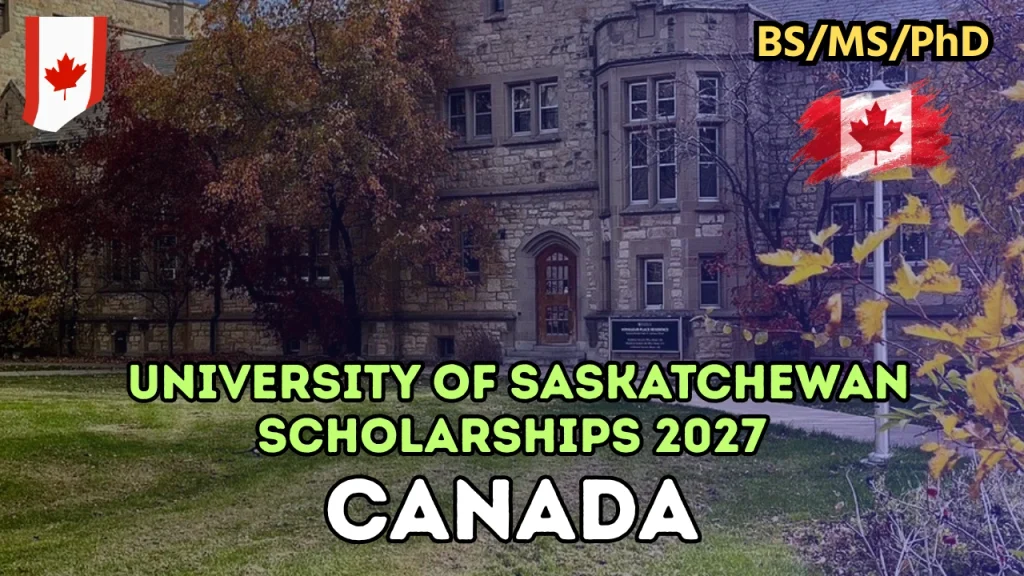
Securing a degree in Canada opens doors to world-class research, international networking, and global career opportunities. The University of Saskatchewan Scholarships 2027 offer one of the most accessible and generous funding pathways for international students aiming to pursue undergraduate, master’s, and Ph.D. degrees.
Whether you are looking to earn your first degree or advance your career through cutting-edge post-graduate research, understanding how to land a scholarship at the University of Saskatchewan (USask) is your first step toward success. This comprehensive guide covers funding benefits, eligibility criteria, required documents, step-by-step application procedures, real living costs in USD, and top tips to help your application stand out.
Basic Information & Application Deadlines
The University of Saskatchewan offers both merit-based entrance scholarships and graduate research funding to help cover tuition and living expenses.
| Key Detail | Information |
| Host Country | Canada |
| Host Institution | University of Saskatchewan (USask) |
| Degree Levels | Undergraduate, Master’s, and Ph.D. (Doctoral) |
| Funding Type | Fully Funded & Partial Scholarships |
| Eligible Candidates | Domestic & International Students |
| Competitive Awards Deadline | February 15, 2027 to May 01, 2027 (varies by program) |
University & Institution Details
Founded in 1907, the University of Saskatchewan is a public research university located in Saskatoon, Saskatchewan. As a member of the prestigious U15 Group of Canadian Research Universities, USask is renowned for addressing global challenges like food security, water management, clean energy, and public health.
- Location: Saskatoon, Saskatchewan, Canada
- Student Population: Over 26,000 students from more than 130 countries
- World Ranking: Top 300 globally in major subject areas including Agriculture, Water Resources, and Veterinary Medicine
- Campus Life: Known for its vibrant campus architecture, research facilities (like the Canadian Light Source synchrotron), and student support services.
- About the University
- The University of Saskatchewan (USask) is a Canadian public university.
- It offers more than 150 study areas through its colleges and schools.
- International students can benefit from scholarships, transfer credits and different admission opportunities.
- The information provided mainly discusses undergraduate admission and scholarships, including opportunities for International Baccalaureate (IB) students.
Study Areas (Available Program Names)
USask offers a wide array of programs across:
- Society and Law
- Agriculture, Plants, and Animals
- Math, Engineering, Technology, and Physics
- Business and Economics
- Life Sciences and Chemistry
- Health
- Teaching
- History, Culture, and Arts
- Indigenous Programs
- Environment and Earth Sciences
- Under University of Saskatchewan Graduate Scholarships (UGS):
- Anthropology
- Art & Art History
- Curriculum Studies
- Education – cross-departmental PhD program
- Indigenous Studies
- Languages, Literatures, & Cultural Studies
- Large Animal Clinical Sciences
- Linguistics & Religious Studies
- Marketing
- Music
- Philosophy
- Small Animal Clinical Sciences
- Veterinary Pathology
- Women, Gender & Sexuality Studies
- Non-direct programs
For graduate scholarships (UGS, Dean’s Scholarships), eligible departments include Anthropology, Art & Art History, Curriculum Studies, Education (cross-departmental PhD), Indigenous Studies, Languages and Cultural Studies, Marketing, Music, Philosophy, Veterinary Pathology, and more.
University of Saskatchewan Scholarships Benefits
1. University of Saskatchewan International Excellence Award
- Scholarship amount: CAD 10,000.
- Number of awards: 1.
- Financial support is awarded based on academic achievement.
2. International Baccalaureate (IB) Excellence Award
- Scholarship amount: CAD 20,000.
- Number of awards: 1.
- Financial support for an academically outstanding IB student.
3. International Student from Saskatchewan Award
- Scholarship amount: CAD 15,000.
- Number of awards: 4.
- Awarded to outstanding new international undergraduate students.
4. International Student from Manitoba Award
- Scholarship amount: CAD 10,000.
- Number of awards: 1.
- Awarded to a top-performing international undergraduate student.
5. International Student from Alberta Award
- Scholarship amount: CAD 10,000.
- Awarded to a top-performing international undergraduate student.
6. International Student from British Columbia Award
- Scholarship amount: CAD 10,000.
- Awarded to a top-performing international undergraduate student.
7. Transfer Scholarships
| Academic average | Scholarship amount |
|---|---|
| 85% or above | CAD 2,000 |
| 80%–84.9% | CAD 1,500 |
| 78%–79.9% | CAD 1,000 |
- An additional CAD 2,500 award is available to the student with the highest transfer scholarship average from selected institutions.
- The scholarship is credited directly to the student’s USask account to help pay tuition and fees.
- Payment is generally made by mid-September, subject to enrolment requirements.
Benefits Not Included
- International Airfare: Flights to and from Canada must be paid out-of-pocket.
- Visa & Study Permit Fees: Government processing fees for Canadian Study Permits and Biometrics.
- Initial Settlement Costs: Temporary hotel stays, security deposits for off-campus housing, and warm winter clothing.
- Excess Personal Expenses: Personal entertainment, international phone plans, and non-essential travel.
Eligibility Criteria for University of Saskatchewan Scholarships
- Nationality: Open to international students from all countries
- For Bachelors: Graduated from high school outside of Canada
- For Masters: Completed a recognized undergraduate degree
- For PhD: Must hold a Master’s degree in a relevant field
- Academic Achievement: Minimum 80% GPA (varies by program)
- English Language Proficiency: IELTS, TOEFL, or Duolingo English Test scores required (unless exempt)
- Additional Program-Specific Requirements: Some programs require nominations or department pre-approval
1. University of Saskatchewan International Excellence Award
- Must be an international student.
- Must apply for an eligible undergraduate programme at USask.
- Must demonstrate strong academic performance.
- Consideration is automatic upon admission; no separate scholarship application is required.
- Must apply for admission by February 15.
2. International Baccalaureate (IB) Excellence Award
- Must be an international student.
- Must have completed the International Baccalaureate (IB) Diploma Programme.
- Must apply for an eligible undergraduate programme at USask.
- Selection is based on academic achievement.
- Consideration is automatic upon admission.
- Must apply for admission by February 15.
3. International Student from Saskatchewan Award
- Must be a new international undergraduate student.
- Must apply from a high school in Saskatchewan, Canada.
- Must be a temporary resident in Canada during the first year of study.
- Selection is based on academic achievement.
- Consideration is automatic.
- Admission deadline: May 1.
4. International Student from Manitoba Award
- Must be an international undergraduate student.
- Must apply from a high school in Manitoba, Canada.
- Must be a temporary resident in Canada during the first year of study.
- Selection is based on academic achievement.
- Consideration is automatic.
- Admission deadline: May 1.
5. International Student from Alberta Award
- Must be an international undergraduate student.
- Must apply from a high school in Alberta, Canada.
- Must be a temporary resident in Canada during the first year of study.
- Selection is based on academic achievement.
- Consideration is automatic.
- Admission deadline: May 1.
6. International Student from British Columbia Award
- Must be an international undergraduate student.
- Must apply from a high school in British Columbia, Canada.
- Must be a temporary resident in Canada during the first year of study.
- Selection is based on academic achievement.
- Consideration is automatic.
- Admission deadline: May 1.
7. Transfer Scholarships
- Must be transferring from an accredited post-secondary institution.
- Must apply to a direct-entry undergraduate programme at USask.
- Must have completed at least 24 transferable credits during the preceding academic year (September–April).
- Must have an academic average of at least 78% (B+).
- Must apply for admission by May 1.
- Must complete at least 18 credit units during the academic year in which the scholarship is awarded.
- Dual-registered students must complete at least 9 of those credits at USask. University of Saskatchewan+1
English Language Requirements
Applicants may demonstrate English proficiency through one of the following accepted tests.
| English Test | Minimum Overall Score | Minimum Individual Score |
|---|---|---|
| IELTS Academic | 6.5 | 6.0 in each band |
| TOEFL iBT (new scale) | 4.5 | 4.0 in each section |
| Cambridge C1 Advanced | 176 | Not specified |
| CAEL | 70 | 60 in each skill |
| Duolingo English Test | 120 | 100 in each area |
| PTE Academic | 63 | 59 in each skill |
Important conditions:
- English test results must be valid for two years.
- Scores from different test dates cannot be combined.
- Duolingo requirements effective January 1, 2026, are 120 overall and at least 100 in each area.
- Older TOEFL results (before January 21, 2026) are accepted with a minimum score of 86 overall and 19 in each component, subject to the validity period.
Required Documents for the Application
- Official transcripts of academic records
- Proof of English language proficiency (IELTS/TOEFL/Duolingo)
- Statement of Purpose or Motivation Letter
- Curriculum Vitae/Resume
- Letters of Recommendation (usually three for graduate awards)
- Research proposal (for most graduate applications)
- Valid passport copy
- Application form (completed online).
University of Saskatchewan Scholarships Application Process (Step-By-Step Guide)
Step 1: Choose a programme
- Explore the available degree, diploma and certificate programmes.
- Select a programme that matches your academic background and career goals.
2nd Step: Check admission requirements and deadlines
- Requirements depend on:
- Your chosen programme.
- Your intended admission semester.
- Whether you are a first-time university applicant or a transfer student.
- Check the required academic qualifications, prerequisite subjects and English proficiency requirements.
- Apply early because some scholarships have earlier deadlines than admission.
Step 3: Create an admissions account
- Visit USask Application Portal.
- Create an admissions account using an active email address.
- Complete the online application, which takes approximately 30 minutes.
- You can save your application and complete it later.
Information required for the application:
- Personal and contact information.
- Educational history, including previous university education.
- Intended programme of study.
- Visa or Mastercard to pay the application fee.
Application fee:
- Minimum CAD 120 for most programmes.
- The fee is non-refundable.
Step 4: Check your application status
- Log in regularly to your admissions account.
- Check whether your documents have been received.
- Find out if additional documents are required.
- Check your admission decision.
Step 5: Submit supporting documents
Commonly required documents include:
- Academic transcripts and certificates.
- Previous university or college transcripts.
- English language proficiency test results.
- Other programme-specific documents, if required.
Step 6: Accept your admission offer
- USask will notify you by email when an admission decision is available.
- Log in to your account to download your decision letter.
- Accept or decline the offer electronically before the deadline stated in the offer letter.
- Accepting the offer is necessary before course registration.
Step 7: Prepare to start
- Apply for scholarships, if eligible.
- Arrange accommodation.
- Prepare for tuition payments and other expenses.
- Explore student services and university facilities.
Tips for a Successful Application
- Start Early: Prepare your documents 3 to 6 months in advance. Contact referees early to give them sufficient time to submit letters. Scholarship Roar
- Tailor Your SOP: Avoid generic letters. Connect your past academic projects with current USask faculty projects.
- Highlight Leadership & Volunteering: USask competitive awards look beyond grades to evaluate community engagement, leadership, and extracurricular achievements. USask admissions – University of Saskatchewan
- Format Documents Correctly: Ensure translated transcripts are notarized and all documents are in clear PDF format.
Monthly Living Expenses for International Students (in USD)
Living in Saskatoon is significantly more affordable than in major Canadian metropolitan areas like Toronto or Vancouver. Below is an estimated breakdown of monthly living costs in US Dollars (USD):
| Expense Category | Estimated Monthly Cost (USD) | Notes |
|---|---|---|
| Accommodation | $650 – $950 | Shared apartment or on-campus housing |
| Food & Groceries | $250 – $350 | Cooking at home vs. campus dining |
| Local Transit (U-Pass) | Included / $65 | Included in student fees for full-time students |
| Health Insurance & Medical | $50 – $80 | Provincial coverage + university plan |
| Books & Academic Supplies | $70 – $110 | Varies by program |
| Personal & Utilities | $110 – $180 | Mobile plan, internet, laundry |
| Total Estimated Monthly Cost | $1,190 – $1,735 USD | Approx. $14,200 – $20,800 USD per year |
Why Choose the University of Saskatchewan?
Here are 5 key reasons why USask should be at the top of your list:
- World-Leading Research Facilities: USask is home to unique national research infrastructure, including the Canadian Light Source (CLS) synchrotron and the Global Institute for Water Security.
- Generous Funding & Affordable Living: USask offers high scholarship stipends alongside a cost of living in Saskatoon that is substantially lower than in Ontario or British Columbia. Collegedunia
- Strong Post-Graduation Work Pathways: International graduates from eligible USask degree programs can apply for a Post-Graduation Work Permit (PGWP) for up to 3 years.
- Welcoming International Community: Over 3,000 international students from 130+ countries study on campus, supported by the International Student and Study Abroad Centre (ISSAC).
- Pathways to Permanent Residency (PR): Graduates from Saskatchewan institutions often qualify for provincial immigration streams like the Saskatchewan Immigrant Nominee Program (SINP).
Frequently Asked Questions (FAQ)
1. Is the GRE or GMAT mandatory for admission?
Most graduate programs at USask do not require GRE scores, though certain programs (such as the Edwards MBA) may require a GMAT score. Check specific departmental requirements.
2. Can I work while studying at USask on a scholarship?
Yes. Eligible international full-time students holding a valid study permit are allowed to work on-campus and off-campus during academic sessions within Canadian immigration regulations, alongside their studies.
3. Are these scholarships automatically awarded?
Some entrance scholarships are awarded automatically based on high school admission averages. However, Competitive Entrance Scholarships and graduate funding require separate online applications through the PAWS student portal.
USask admissions – University of Saskatchewan
4. What is the minimum GPA required to keep my scholarship?
Most renewable scholarships require you to maintain full-time registration status and maintain an annual academic average of at least 75% – 80%.
Important Deadlines at a Glance
| Scholarship | Admission Deadline | Award Value |
|---|---|---|
| International Excellence Award | February 15 | CAD 10,000 |
| IB Excellence Award | February 15 | CAD 20,000 |
| Saskatchewan Award | May 1 | CAD 15,000 |
| Manitoba Award | May 1 | CAD 10,000 |
| Alberta Award | May 1 | CAD 10,000 |
| British Columbia Award | May 1 | CAD 10,000 |
| Transfer Scholarships | May 1 | CAD 1,000–2,500 |
Official Link:
The University of Saskatchewan Scholarships 2027 offer international students an exceptional academic experience combined with strong financial support. By keeping track of program deadlines, preparing your application materials early, and highlighting your research or academic performance, you can position yourself for success in Canada.